Minister Kim Younghoon: "Researching Introduction of Minimum Remuneration System for Platform Workers... Tripartite Dialogue Needed"
Minister of Employment and Labor Kim Younghoon is pushing for the introduction of a "minimum remuneration system" to guarantee minimum wage-level compensation for an estimated 8 million special employment and platform workers. He identified the scope of those subject to the rule, the criteria for remuneration, and the party responsible for bearing costs as the key issues, and emphasized that labor-management-government dialogue is needed for the implementation of the system.
On the 23rd, appearing on the YouTube channel 'Jeongeori TV,' Minister Kim said, "If broadly defined, special employment and platform workers are estimated to number over 8 million," adding, "They are in a constitutional blind spot, as it is difficult for them to secure their labor rights and they are excluded from minimum wage application."
He continued, "The Ministry of Labor has launched a study on introducing the minimum remuneration system," and stated, "We will establish a system to prevent people from being discriminated against because of their employment type."

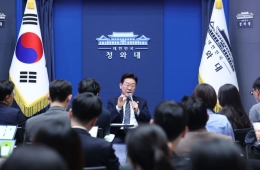
Kim Younghoon, Minister of Employment and Labor, is conducting a briefing on the 'Proposal for Social Dialogue Related to the Special Act on Mega Districts' at the Government Seoul Office in Jongno-gu, Seoul on September 15, 2026. Photo by Jo Yongjun
View original imagePreviously, the Ministry of Labor commissioned a research project for a 'fact-finding survey to review and design the introduction of the minimum remuneration system.' Approximately 1,000 subcontracted workers will be surveyed to assess their actual income levels. The survey will also account for total time spent providing labor—including standby and travel time—and work-related costs, then calculate their hourly income accordingly. The results will be compared with the minimum wage to review proposed designs for the minimum remuneration system.
In terms of system design, Minister Kim stated, "There are three main issues: how far to extend the coverage of workers eligible for the minimum remuneration system, how to establish the criteria, and who will bear the related costs," emphasizing, "Tripartite dialogue among labor, management, and government is essential for the system's implementation."
Regarding the extension of the mandatory retirement age, he called for an intergenerational win-win approach that considers both youth employment and continued employment for middle-aged and older workers. Minister Kim said, "Many young people prefer jobs at major corporations, financial institutions, or public enterprises, and they worry that raising the retirement age may reduce their chances of securing such positions. Broadly speaking, 20 percent of jobs could experience conflict, while the remaining 80 percent would not," he said.
Hot Picks Today
 Changing Outfits and Snapping Photos in Hotels... "Please Don't Take Pictures": Europe Cracks Down on Influencers Over Privacy Concerns
- "Tried leveraged semiconductor stocks, watched 3.5 billion won shrink to 200 million won": Salaried investor in tears
- "Please Let Me Go Home"... Customers Trapped in Department Store Parking Lot for 5 Hours Vent Their Anger
- "I Should Enjoy It After Retirement": Prices Quadruple... Memberships Over 100 Million Won Popular, but Closures Mount
- "Come Live With Me on My Farm": Man Sells Everything and Travels 1,930 km, Trusting a Beautiful Woman
He added, "In an era when living to 100 is increasingly common, continued employment for middle-aged and older workers is a crucial issue," and stressed, "This is a problem that can be addressed through public discourse and must be resolved through an intergenerational win-win approach."
© The Asia Business Daily. All rights reserved. Unauthorized AI training and use prohibited.