Takaichi Calls for Deletion of "Enemy State" Clause Targeting Defeated Nations in UN Speech
"Marking 70 Years Since Japan Joined the UN...Contributions Through ODA and More"
"UN Must Become a More Effective Organization"
Calls for Reform Alongside Structural Changes
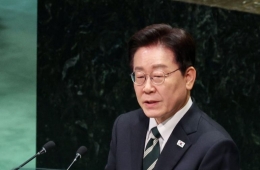
Japanese Prime Minister Sanae Takaichi called for the removal of the "enemy state" clause in the United Nations Charter, which targets the defeated nations of World War II, during her UN speech on the 22nd (local time). She also emphasized the need for reform of the UN Security Council.
During her speech at the General Assembly held at the UN headquarters in New York on this day, Prime Minister Takaichi stated, "I say this strongly, with the pride and honor of Japan, which has made significant contributions to the UN's activities for 70 years." She added that it has now been 70 years since Japan joined the United Nations, and that, over the years, Japan has actively contributed to the UN's roles through various initiatives such as Official Development Assistance (ODA).

Japanese Prime Minister Sanae Takaichi is holding a press conference on the cabinet reshuffle at the Prime Minister's official residence in Tokyo on the 17th. Tokyo, Japan – Reuters Yonhap News.
View original imageThe enemy state clause, whose removal Prime Minister Takaichi demanded, is a document that was created in June 1945, at the end of World War II, under the leadership of the United States, former Soviet Union, United Kingdom, France, and China. The clause stipulates that if the Axis powers of World War II attempt to resume their policies of aggression, the states that signed the UN Charter may undertake military action immediately, without the authorization of the Security Council.
The clause does not specifically name any country as the enemy but defines enemy states as "all states which were enemies of any signatory to the Charter during World War II." For this reason, it is generally interpreted as referring to the defeated Axis powers, such as Japan, Germany, and Italy.
The enemy state clause became a matter of controversy again last year in the context of China-Japan tensions over the Taiwan issue. When Prime Minister Takaichi suggested that Japan could intervene in the event of a Taiwan crisis, China pushed back by using the enemy state clause as grounds to pressure Japan.
In response, the Japanese government stated that the clause is now obsolete and that China's argument that the UN could take military action based on it does not reflect reality. The Sankei Shimbun, reporting on the Prime Minister's proposal, also noted, "The clause has already become obsolete, and although a UN General Assembly resolution to delete it was adopted in 2005, it has still not been removed."
Prime Minister Takaichi, in addition to demanding the removal of the enemy state clause, also emphasized the need to reform the Security Council. She pointed out that the current Security Council is composed mainly of the victors of World War II – the United States, United Kingdom, France, China, and Russia – and argued, "This structure reflects the international order of 1945."
She further stated, "At a time when the world is in turmoil, it is precisely now that the UN must be reborn, regain the trust of the international community, and transform into a stronger and more effective organization," calling for an expansion of both permanent and non-permanent members of the Security Council.
As grounds for this, she cited the repeated use of veto power by Russia, which invaded Ukraine, to block resolutions condemning its actions. She added that it would be difficult to say that the Security Council is functioning for the peace of the international community.
Meanwhile, regarding the International Criminal Court (ICC), which has come under increased pressure from the U.S. administration of President Donald Trump, she stated, "Japan is a country that upholds the rule of law and has consistently supported various international courts."
Hot Picks Today
 "Quit Job to Start Life in Canada, Now Forced to Return Home"… Language School Closure Leaves Korean Students Stranded
- After Customer Numbers Plummeted, Is This the End? Travel Agencies Make a Dramatic Comeback by Flipping the Market
- 'Japan in Chaos' as Unprecedented Outbreak Spreads ... "Four Days Is Too Short," Yet Japan Remains Top Travel Pick
- "Sorry for the Baby’s Crying": New Parents Apologize First, Neighbors’ Replies Are Heartwarming
- "Thought It Was a Student Meal at This Price"... A 2,400-Won Meal at a Five-Star Hotel, What's Going On?
Furthermore, she proposed that Japan should host the "AI Summit" at an early date to discuss the risks of artificial intelligence (AI) and possible response measures amid escalating competition between the U.S. and China, and she also pledged to make efforts for the prompt resolution of the issue of Japanese citizens abducted by North Korea.
© The Asia Business Daily. All rights reserved. Unauthorized AI training and use prohibited.