President Lee Declares 'Inclusive, Stable, and Responsible': Three Blueprints for Peaceful Coexistence on the Korean Peninsula
President Lee Addresses UN General Assembly
Presents Directions for “Inclusive, Stable, and Responsible” Peaceful Coexistence on the Korean Peninsula
“We Will Lay the Groundwork for the Early Resumption of North Korea-U.S. Dialogue”
Calls for Dialogue Among Stakeholders for Ending the War and Transitioning to a Peace Regime
Proposes “K Initiative”: Global AI Basic Society, Green Transformation, and Energy Supply Chain Solidarity
President Lee Jae-myung presented “Inclusive, Stable, and Responsible Peaceful Coexistence” as the three pillars for peace on the Korean Peninsula during his address at the UN General Assembly on September 22 (local time). Regarding the North Korean nuclear issue, he highlighted the need for a phased solution: first halting North Korea’s advancement of its nuclear and missile capabilities, then reducing them in the medium term, and ultimately achieving a “nuclear-free Korean Peninsula” in the long term.

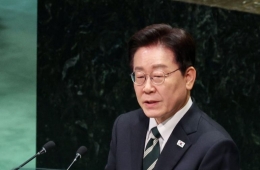
President Lee Jae-myung is delivering a keynote speech at the United Nations General Assembly Hall in New York, USA on the 22nd (local time). 2026.9.23 Yonhap News Agency
View original imagePresident Lee, the third speaker following Angola and Mongolia, delivered his keynote speech at the 81st United Nations General Assembly at UN Headquarters in New York. He stated, “We will seek joint growth through cooperation, based on mutual respect of each other’s systems and recognition of differences between North and South Korea,” outlining his vision. He reaffirmed South Korea’s determination to serve as a “pacesetter” for dialogue, considering the resumption of North Korea-U.S. talks as the starting point for turning around the situation on the Korean Peninsula.
President Lee first proposed “inclusive peaceful coexistence,” indicating that the two Koreas should acknowledge their differences with mutual respect and broaden shared interests through collaboration where possible. He stressed, “We will respect the North and cooperate where cooperation is possible,” suggesting potential collaboration in fields such as public health, disaster response, and climate crisis.
He also expressed his intent to pursue “stable peaceful coexistence” by reducing the risk of inter-Korean conflict and establishing institutional mechanisms to manage crises. President Lee stated, “We will build institutional devices to prevent crises and control conflicts,” emphasizing, “Restoring basic communication channels and building trust is the first step toward stable peaceful coexistence.”
He went on to suggest “responsible peaceful coexistence,” a vision to extend peace on the Korean Peninsula beyond stability in inter-Korean relations, expanding it to the stability of Northeast Asia and the international community. “We will actively join efforts to promote stability and cooperation in Northeast Asia beyond a war- and nuclear-free Korean Peninsula, and strive for a world free from war and conflict,” President Lee said.
Central to these three pillars, President Lee identified ending the Korean War and establishing a peace regime as core tasks. “More than anything, the key task is to put an end to the longstanding war on the Korean Peninsula and to build a peace regime,” he said. “The Republic of Korea will work to lay the groundwork for an early resumption of the long-stalled North Korea-U.S. dialogue, which can evolve into talks among stakeholders to end the Korean War and transition to a peace regime on the Peninsula.”
On the North Korean nuclear issue, President Lee made clear the need for a phased approach. “First, we need to halt North Korea’s advancement of its nuclear and missile capabilities, and over the medium term pursue reductions, which will ultimately pave the way for a nuclear-free Korean Peninsula,” he said. While maintaining denuclearization as the ultimate goal, he suggested that negotiations begin with halting any further increases in North Korea’s nuclear and missile capabilities.
President Lee then pointed out that it has been 35 years since the simultaneous accession of both Koreas to the United Nations, urging the UN and Security Council to play a responsible and constructive role.
'Global AI Basic Society,' 'Green Transformation,' and 'Global Energy Supply Chain Solidarity'—Three Major Visions Proposed

President Lee Jae-myung is delivering the keynote address at the United Nations General Assembly in New York, USA, on the 22nd (local time). 2026.9.23 Yonhap News Agency
View original imageIn his address, President Lee also proposed the “K Initiative,” aimed at expanding South Korea’s role in the international community alongside the Korean Peninsula issue. He presented “Global AI Basic Society,” “Green Transformation,” and “Global Energy Supply Chain Solidarity” as his three key global visions.
The “Global AI Basic Society” calls for sharing the benefits of advances in artificial intelligence technologies across nations and social classes. While evaluating the AI revolution as a driver of new prosperity, President Lee warned, “If we are not properly prepared, inequality and imbalance will worsen.” He announced plans to establish a “Global AI Hub”—involving international organizations, multilateral development banks, industry, and academia—to leverage AI as a tool to solve global challenges such as the climate crisis, health, food, and refugees.
Through the “Green Transformation,” he pledged to link carbon neutrality to industrial competitiveness and job creation. With the “Korean-Style Green Transformation (K-GX) Strategy,” South Korea seeks to transform its industrial structure and share its experience and achievements with the international community. He also said Korea will lead discussions on sustainable marine development through the 4th United Nations Ocean Conference, which it will co-host with Chile in 2028.
President Lee also called for building a solidarity in energy supply chains. Citing recent tensions in the Strait of Hormuz and the Red Sea, he emphasized the principle of free and safe passage through international straits, stating, “Acts that attack merchant vessels and threaten the lives and safety of crew members can never be justified.” He pledged to utilize existing frameworks such as the International Energy Agency (IEA) to prevent energy supply chain crises from escalating into broader challenges for the global economy and people’s livelihoods.
As a mode of cooperation to address the complex crises facing the global community, President Lee proposed an “Alliance of Constructive Contributors.” Rather than creating new international organizations or exclusive blocs, his vision is to have nations with the capacity and willingness to provide global public goods work together in specific areas and gradually expand their cooperation. “This means each country can cooperate flexibly and openly in areas where it has strengths, gradually broadening the scope of collaboration,” he explained.
Emphasizes the Need for UN Reform—Supports the “UN 80 Initiative”

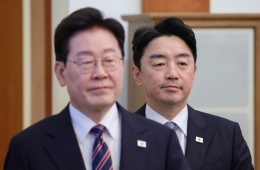
President Lee Jae-myung and First Lady Kim Hye-kyung are moving to the General Assembly Hall at the United Nations Headquarters in New York on the 22nd (local time). 2026.9.23 Yonhap News Photo by Yonhap News
View original imagePresident Lee also underlined the importance of United Nations reform. Supporting the “UN 80 Initiative” for reducing overlap and accelerating decision-making within the organization and its programs, he said, “We also support Security Council reform to make it more effective, democratic, and responsible.”
“The Republic of Korea is uniquely positioned to testify to the power of noble solidarity embodied in the United Nations,” President Lee said. “We will reciprocate that solidarity with even greater responsibility and contribution.” He concluded, “South Korea will boldly take the lead toward a peacefully coexisting Korean Peninsula and a United Nations that delivers results for all.”
Hot Picks Today
!["Just by Parking Money at the Bank? Unusually High Parking Account Rates Lately [Practical Asset Management]"](https://cwcontent.asiae.co.kr/asiaresize/93/2026092308565839400_1790121417.png) "Just by Parking Money at the Bank? Unusually High Parking Account Rates Lately [Practical Asset Management]"
"Just by Parking Money at the Bank? Unusually High Parking Account Rates Lately [Practical Asset Management]"
- "Sudden Surge of Customers" Sales Soar 800%... What Happened at Busan Convenience Stores
- Korea Wins Without Playing... Another Mishap by Japanese Organizers Disqualifies Qatar
- "Shock at the Gym"... 'Ultimate Villain' Applies Strong Adhesive to Apartment Community Equipment
- "Such an Extent?" Shocking Change Observed in Japan... How Severe Is the 'Economic Stagnation'?
© The Asia Business Daily. All rights reserved. Unauthorized AI training and use prohibited.