USD 200 Billion U.S. Investment Enters Implementation Phase... Eight Nuclear Plants, Texas Power Project, and Alaska LNG
6,472MW Gas Combined Cycle Power Plant to be Built in Encinal, Texas
Up to USD 120 Billion for Eight U.S. Nuclear Plants... Plans for Westinghouse Stake Acquisition
Alaska LNG Project Awaits Feasibility Review

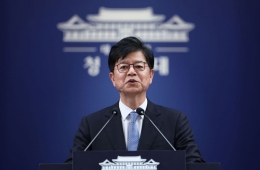
Kim Jungkwan, Minister of Trade, Industry and Energy, announced the results of investment negotiations with the U.S. on the 22nd of last month at the Government Complex Seoul. Ministry of Trade, Industry and Energy.
View original imageThe government has finalized the construction of a gas combined cycle power plant in Texas, United States, as the first project in the Korea-U.S. Strategic Investment program, totaling USD 200 billion. In addition, the framework for Korea-U.S. nuclear power plant cooperation has been established with plans to use USD 120 billion for building eight large nuclear power plants in the United States, and Korea will also begin a feasibility review of the Alaska liquefied natural gas (LNG) project.
USD 22.3 Billion Texas Gas Power Project Confirmed as No.1 Strategic Investment... Full Participation of Korean Companies
On October 1, the governments of Korea and the United States announced three strategic investment projects: "Project Star," a Texas gas combined cycle power plant; "Project Power," the Korea-U.S. Nuclear Power Framework; and "Project North," the Alaska LNG project.
First, Project Star will be formally pursued as the first project within the framework of Korea-U.S. Strategic Investment. The project involves constructing and operating a 6,472MW gas combined cycle power plant for artificial intelligence data centers in the Encinal area of Texas, United States, with a total project investment of USD 22.3 billion. The plant will supply electricity directly to nearby data centers, with Phase 1 commercial operations scheduled to start in 2029 and full facility operation by 2032 as the target.
The project will be led by global real estate developer Related Companies and U.S. power operator NextEra Energy. Lewis Energy Group will provide the site, natural gas, water, and related infrastructure. The government comprehensively reviewed the capabilities of project partners, increasing power demand from data center investments in Texas, and projected electricity prices before concluding that the project makes commercial sense. Domestically, all procedures such as the deliberations and resolutions of the Project Management Committee and the Operations Committee, as well as reporting to the National Assembly, have been completed.
The scope of participation by Korean companies will be expanded from only supplying power generation equipment to encompassing all aspects of the project, including engineering, construction, long-term operation, and maintenance. The U.S. side will provide opportunities for Korean-made equipment, including turbines, to be supplied to other similar projects in the United States in the future.

Up to USD 120 Billion for Eight U.S. Nuclear Plants... First Entry of Two APR1400 Units into the United States
In the nuclear sector, an agreement was reached under the "Korea-U.S. Nuclear Power Framework" to construct eight large-scale nuclear power plants in the United States using up to USD 120 billion from the Korea-U.S. Strategic Investment Fund. The planned construction includes two units of the Korea-designed APR1400 nuclear reactor and six units of Westinghouse's AP1000 reactor. The governments of both countries, together with Westinghouse, Korea Electric Power Corporation, and Korea Hydro & Nuclear Power, plan to jointly sign the framework.
Construction will start with two AP1000 units, followed by simultaneous construction of two APR1400 units and two AP1000 units, and then two additional AP1000 units. The two countries have agreed to work towards reducing the EPC (Engineering, Procurement, and Construction) contract interval between the first and second phases to within six months.
Notably, the APR1400 now has a path to enter the U.S. market for the first time. Previously, the entry of APR1400 into the United States was restricted due to the Settlement Agreement (SA) between Korean companies and Westinghouse. The government explained that this framework creates the basis to construct two APR1400 reactors in the United States. Korean construction and equipment companies are also expected to participate in the AP1000 construction.
Funding for the eight plants will total up to USD 120 billion, consisting of approximately USD 100 billion in construction costs and USD 20 billion in contingency reserves. The maximum investment per two-unit cluster is set at a total of USD 30 billion, comprising USD 25 billion in construction costs and USD 5 billion in contingency reserves. Even if the contingency reserves are not actually used, they are included in the USD 200 billion total Korea-U.S. strategic investment figure. Conversely, if project costs exceed USD 30 billion per two-unit group, any excess will not be covered by the Korea-U.S. Strategic Investment Fund.
Measures to pre-secure long-lead items—such as reactor vessels, steam generators, and reactor coolant pumps, which require long manufacturing periods—are also being pursued. Provided that commercial viability reviews and National Assembly reporting requirements under domestic law are met, the government has discussed with the U.S. side the possibility of an early payment of up to USD 10 billion by the end of the year.
An acquisition of shares in Westinghouse is also being pursued. To enable Korea and the U.S. to share commercial profits from the U.S.-based AP1000 business, Korean companies are considering acquiring a stake in Westinghouse. However, the specific investment terms, such as the acquiree's stake and voting rights, have not yet been finalized and will be determined through further negotiations between the companies involved.
This framework does not constitute a final investment decision on the eight nuclear power plant projects. Currently, it sets out the overall framework for Korea-U.S. nuclear cooperation, and specific details regarding construction sites, business structure, and schedules must still be determined for each individual project. Each project will undergo commercial viability reviews and National Assembly procedures to decide an ultimate go/no-go.

Alaska LNG Project Under Review... Final Investment Decision Dependent on Feasibility
The Alaska LNG project has been resolved to remain at the feasibility review stage rather than proceeding directly to investment. The project aims to construct a large-scale gas pipeline to transport natural gas from northern to southern Alaska, as well as an LNG export terminal. Korea and the United States have agreed to determine eventual Korean participation by considering commercial viability and compliance with domestic legal conditions.
If the project proceeds, the U.S. side will ensure favorable conditions for Korean-made equipment and domestic suppliers to participate. This includes tariff reductions on essential items such as steel and guaranteeing economically viable long-term LNG purchase contracts. Korea will also be granted preferential access to the Alaska LNG produced by the project.
The government has also established shared safeguards to mitigate the risks associated with large-scale investment. All projects will be implemented under a single umbrella-type investment purpose company (I-SPV) and project-specific P-SPVs. The I-SPV will consolidate management of project financing and profit distribution, while individual projects will be carried out by P-SPVs wholly owned by the I-SPV.
The core mechanism is "risk pooling," which links the profits and losses of each project to the overall investment. The Korea-U.S. profit distribution ratio for each project will remain at 5:5 until Korea recovers all principal and interest invested in the entire project, and transition to a 1:9 ratio in favor of the U.S. will be put on hold. If a particular project's profitability is lower than expected, the 5:5 period will be extended using profits from other projects, thereby enhancing the likelihood of full recovery for the Korean side.
The annual investment ceiling of USD 20 billion and the total ceiling of USD 200 billion will be stipulated as legally binding provisions in the SPV operation contract. If business prospects are deemed impaired, the governments may renegotiate the business plan, budget, and profit distribution ratios. Korea will also have rights to access information such as financial statements, business reports, and fund usage, as well as consent rights regarding significant changes to the business scope, new share issuances, or share transfers.
Hot Picks Today
![[Breaking] Trump: "Korea to Invest in U.S.... Eight Large Nuclear Power Plants and Gas Power Plant in Texas"](https://cwcontent.asiae.co.kr/asiaresize/93/2026092813302742391_1790569827.png) [Breaking] Trump: "Korea to Invest in U.S.... Eight Large Nuclear Power Plants and Gas Power Plant in Texas"
[Breaking] Trump: "Korea to Invest in U.S.... Eight Large Nuclear Power Plants and Gas Power Plant in Texas"
- "Instead of Japan, Let's Go to Korea": Chinese Tourists Flock In... Travel Demand Surges During Up to 13-Day Golden Holiday
- "No Age or Income Limits, Everyone Gets 100,000 Won... This City to Provide Subsidies to All Residents"
- "1.62 Million Won per kg? Why Are Prices So High... Even After Chuseok, They Haven't Dropped" Yangyang Songi Mushrooms Reach Record-High Price
- "Did They Really Use That Pot for Cooking?" Outrage as Chinese Kindergarten Caught Washing Rags in Kitchen
Kim Junggwan, Minister of Trade, Industry and Energy, stated, "Since taxpayers' precious money is invested, we will uphold the principle of investing only in projects that are commercially reasonable and put the national interest first. At the same time, we intend for the Korea-U.S. Strategic Investment Program to create a virtuous cycle that will foster growth and strengthen the competitiveness of our companies."
© The Asia Business Daily. All rights reserved. Unauthorized AI training and use prohibited.


![[Update] Trump: "Korea to Invest in Texas Power Plant, 8 Nuclear Plants, Alaska LNG"](https://cwcontent.asiae.co.kr/asiaresize/307/2026100105593246483_1790801971.png)