Government to Identify and Support 'Victims of Illegal Private Lending' Driven to the Brink by Debt Collection
Crisis Indicators Expanded to 50 Categories, Including Changes in Water Usage
Proactive Welfare Support to Include Vulnerable Borrowers
The government will proactively identify and provide welfare support to households facing financial crises, such as victims of illegal private lending and individuals whose debt restructuring has been suspended. It has decided to significantly enhance the linkage of public big data to ensure that vulnerable groups threatened by debt collection and recovery efforts are not left in welfare blind spots.

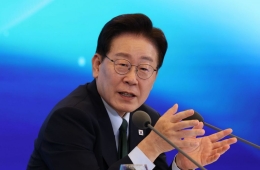
Hyun Soo-yeop, First Vice Minister of Health and Welfare, is briefing on measures to identify and strengthen support for financially distressed households at the Government Seoul Office in Jongno-gu, Seoul, on July 9, 2026. Photo by Jo Yongjun
View original imageThe Ministry of Health and Welfare announced on September 22 that the Cabinet has approved a partial amendment to the Enforcement Decree of the “Act on the Use and Provision of Social Security Benefits and the Identification of Recipients,” which centers on these measures. This amendment is a follow-up to the cross-government emergency household identification and support measures announced in May and July this year.
The key aspect of this revised enforcement decree is the new integration of information on victims of illegal private lenders and illegal private lending brokers, as reported to the Financial Supervisory Service’s Illegal Private Lending Victim Reporting Center, into the system for detecting welfare blind spots. Through this system, the government plans to proactively detect households victimized by illegal private lending—who have been easily excluded from welfare networks—and provide them with the necessary welfare services.
The system for identifying recipients of policy-based financial services for ordinary citizens will also be extensively restructured. Previously, only those whose applications for policy-based financial services such as special guarantee loans under the Sunshine Loan program were rejected were detected. Going forward, the scope will be expanded to include vulnerable debtors who are expected to face economic hardship due to low income or poor credit, even if they have been approved for preventive loans against illegal private lending.
Furthermore, the scope for identifying individual debtors whose debt restructuring plans—through institutions like the Credit Recovery Committee—have lost effectiveness due to failed implementation will be greatly expanded. Previously, only information on borrowers overdue for more than 90 days was utilized. In the future, data will also be linked for those at risk of default or whose debt restructuring has been suspended despite having short-term delinquencies of less than 90 days, allowing for earlier support.
To better detect crisis indicators closely tied to everyday life, information on households with unusual changes in water usage will be added to crisis information, in addition to single households with no water usage. As a result, the number of crisis information types collected and analyzed by the blind-spot detection system will increase from the existing 47 to a total of 50, with three new categories—victims of illegal private lending, vulnerable borrowers using policy-based financial services, and households with significant changes in water usage—added and one category updated.
Hot Picks Today
![Claims That "Daiso Is Being Shut Down to Save AliExpress and Temu" Spread Widely... A Fact-Check [Why&Next]](https://cwcontent.asiae.co.kr/asiaresize/93/2023121315590987574_1702450749.jpg) Claims That "Daiso Is Being Shut Down to Save AliExpress and Temu" Spread Widely... A Fact-Check [Why&Next]
Claims That "Daiso Is Being Shut Down to Save AliExpress and Temu" Spread Widely... A Fact-Check [Why&Next]
- "What Marketing at a Time Like This?" After Laying Low... Starbucks Overtakes A Twosome Place to Reclaim No. 1
- "What’s the point of blocking gap investment?" Outlying home prices jumped 400 million won, topping 2 billion won... "Caught in a regulatory trap" [One Year of Land Transaction Permit Rules Across Seoul]
- U.S. Justice Department Targets 5 Major Broadcasters for 'Press Pool Boycott'... Wields 'Antitrust Law' as Weapon in Broad Pressure Campaign
- "Trying to Play with the Tiger?" He Jumped Into Its Enclosure... British Man Dies
Hyun Sueop, First Vice Minister of Health and Welfare, stated, “Debt collection goes beyond economic harm and causes severe suffering, breaking a person’s life and spirit.” He emphasized, “This amendment is significant for establishing a legal framework to identify households in financial crisis without any blind spots, and we will spare no effort to ensure that no neighbor in urgent crisis is overlooked in our identification and support efforts.”
© The Asia Business Daily. All rights reserved. Unauthorized AI training and use prohibited.