President Lee Heads to UN Multilateral Stage: "Sanctions on North Korea Should Be Traded for Freeze on Nukes"
President Lee Visits New York for the UN General Assembly
Advance Interviews with Local Media Including The New York Times
North Korea Escalates Overt Nuclear Missile Threats
A Nuclear Freeze Needed Before Denuclearization
Step-by-Step Approach: Suspension, Reduction, and Dismantlement
Emphasizing an Effective and Practical Solution
President Lee Jae-myung, currently visiting the United States, stated, "U.S. President Donald Trump should demand a freeze, not the dismantlement, of North Korea's nuclear weapons." He argued that instead of insisting on sanctions, there should be a deal to halt North Korea's nuclear weapons development in exchange for sanctions relief. President Lee plans to announce this vision for peaceful coexistence on the Korean Peninsula during his speech at the United Nations General Assembly.

President Lee Jae-myung and First Lady Kim Hye-kyung are greeting well-wishers aboard Air Force One upon arrival at JFK International Airport in New York, USA, on the 21st (local time). 2026.9.22 Yonhap News Agency
View original imageIn an interview with The New York Times, released on the 21st (local time), President Lee remarked, "It is highly meaningful to consider an exchange whereby the ineffective sanctions against North Korea are traded for a halt in the country’s nuclear weapons and intercontinental ballistic missile (ICBM) development." He stressed, "It is clear that if denuclearization remains the goal under current conditions, nothing will be achieved."
President Lee also stated, "According to our estimates, North Korea currently has the capability to produce, or may already be producing, an additional 10 to 20 nuclear weapons each year," warning, "If North Korea amasses enough nuclear weapons and missiles to ensure its survival, it may feel tempted to export such arms for profit."
On this subject, The New York Times reported, "President Lee argues that, regardless of how difficult this type of deal may be to accept, realistically there is no other alternative." The paper continued, "North Korea has become increasingly explicit in its nuclear missile threats against South Korea. As wars in Ukraine and Iran are changing the geopolitical landscape, North Korea is no longer the isolated international outlier that the United States tried to tame with a mix of pressure and dialogue."
During a written interview with the Associated Press published the same day, President Lee again emphasized that a freeze is necessary before denuclearization. He explained, "If you want to change the direction of a moving vehicle, you first need to stop it," and described a step-by-step approach of suspension, reduction, and dismantlement as a practical method to effectively resolve the North Korean nuclear issue.
President Lee further noted, "Considering that North Korea’s nuclear and missile capabilities have become highly advanced, waiting for complete denuclearization to be achieved all at once is not a realistic solution." He expressed concern that "in the meantime, North Korea’s nuclear capabilities will continue to advance, further heightening the threat."
When asked whether North Korea might refuse to dismantle its nuclear weapons after sanctions relief, President Lee responded that it is necessary to demonstrate that taking steps toward stable and sustainable peace is a realistic and workable path toward a safe and prosperous future.
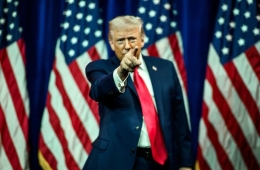
He also evaluated President Trump’s actions aimed at a North Korea-U.S. summit positively. President Trump has reduced the South Korea-U.S. Ulchi Freedom Shield (UFS) exercises, noting he has "very good relations" with Chairman Kim. President Lee stated, "These are deliberate measures to send a clear message that the United States has no hostile intent toward North Korea," adding, "(The U.S. and South Korea) are leaving the door open to dialogue with North Korea without preconditions."
He then urged, "What is needed now is a political decision at the leadership level. The leaders of North Korea and the United States must meet directly, build trust, and work together to find common ground."

President Lee Jae-myung is greeting Kang Kyung-wha, Ambassador to the United States, who came to welcome him at New York JFK International Airport on the 21st (local time). 2026.9.22 Yonhap News Photo by Yonhap
View original imagePresident Lee is set to deliver a keynote speech at the UN General Assembly on the 22nd reflecting these ideas. In his address, he will propose a gradual and practical solution to the North Korean nuclear issue and further develop his vision for promoting peace on the Korean Peninsula. He also plans to explain the government’s policy of peaceful coexistence to António Guterres, Secretary-General of the United Nations, and request the attention and cooperation of the international community.
Hot Picks Today
 "Two Spend 500,000 Won in a Flash, Yet Wait Two Hours?" ... 'Dreamland' Shunned by Kids and Foreign Tourists
- The Era of Getting 200 Million Won After 30 Years Is Over... A Japanese Bank's "Perpetual Department Head" Who Just Clocked In Cries Out
- Spain Hit by Its Worst Tragedy... Lee Kangin, Moreno and Real Madrid Join Soccer World in Mourning
- They Said, “Make It Your Home for Life” - Then Suddenly Kicked 200 Passengers Off... What Happened to the Around-the-World Cruise?
- "130 Rice Bowls Sold Out in a Day"... 'Unfiltered Face' Adds 8 Million Won to Night Market Sales: China's Bungeunwoo
Meanwhile, with respect to President Trump expressing dissatisfaction over South Korea’s deployment to the Strait of Hormuz and the $350 billion investment in the U.S., President Lee stated, "I fully understand that the U.S. president can make a variety of remarks from his position." However, he explained that under the Korean Constitution, it is prohibited to dispatch troops to wars already underway, and that South Korea will ensure its military is not drawn into U.S.-Iran conflicts. Regarding investments in the U.S., he emphasized his wish to build a partnership that creates greater mutual benefit during President Trump’s term.
© The Asia Business Daily. All rights reserved. Unauthorized AI training and use prohibited.