Multi-Business and Side Business Owners Among Micro-Businesses to Be Distinguished... Amendment to Framework Act on Micro-Enterprises Approved
Limitations of Identifying Small Business Owners by Sales Figures Alone
Legal Basis Established to Provide Data on Cost of Goods Sold and SG&A Expenses
It is expected to become easier to determine the scale of multi-business owners and side-business operators, and to more accurately identify and target low-income small business owners who genuinely require substantive policy support.

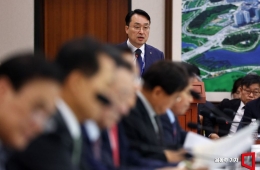
On the 22nd, cabinet members attending the video cabinet meeting between Sejong and Seoul held in the Cabinet Meeting Room of the Government Seoul Building in Jongno-gu, Seoul, are listening to remarks by Prime Minister Hansung-sook. Photo by Cho Yongjun, September 22, 2026.
View original imageThe Ministry of SMEs and Startups announced that a partial amendment to the 'Small Business Basic Act,' which will enable the integration, construction, and utilization of previously dispersed data related to small businesses, was approved at the cabinet meeting on the 22nd.
Until now, the Ministry has reviewed sales and the number of full-time employees based on existing legal provisions, and has established and executed related support policies on this basis. As a result, there have been issues of support being provided contrary to policy intent—such as a single owner receiving overlapping support by operating multiple unmanned stores, or an office worker running a Smart Store as a side business being included as a small business beneficiary.
There have also been ongoing calls to consider not only small business sales but also expenses, such as cost of goods sold and selling and administrative expenses (SG&A), as well as actual business income, when developing support programs.
Under this amendment, the Ministry will now be able to secure income and expense-related data from the National Tax Service, including not just sales (previously provided), but also business and earned income, cost of goods sold, and SG&A expenses.
The amendment allows the data collected to be entrusted to affiliated organizations under the Ministry of SMEs and Startups that are responsible for small business research and support work. Given the nature of handling tax information, employees of the institution performing this work will be deemed government officials under criminal law during task execution, and will therefore be subject to regulations applicable to government officials.
Hot Picks Today
 "If You Don't Apply, My KRW 1.7 Million Will Be Gone"... Unclaimed National Pension Refunds Vanish After 'This Deadline'
- U.S. Alarmed as Infections from "Brain-Melting Fungus" Surge... 70% Fatality Rate, Cause Unknown
- Lee Juwan, Who Forecast Samsung at 70,000 Won and SK hynix at 200,000 Won, Says They're "Still Overvalued"; Others Counter: "Fundamentals Are Solid, Correction Is Excessive"
- "An Opinion, Not False Information"... Man in His 40s Who Called May 18 a "Riot" on Ilbe Acquitted on Appeal
- Kang Minkyung Raved, "Worth the Money," Then It Sold Out in 10 Minutes... Convenience Store Collaborations Pay Off
Lee Byungkwon, the Second Vice Minister of the Ministry of SMEs and Startups, stated, "We expect to fundamentally resolve the issue of overlapping support that has arisen from business-centered assistance so far, and ensure that government funding is better and more effectively directed to small business owners in real need. We will continue to promote the integration of dispersed small business data through collaboration with various organizations and further advance small business policy in the future."
© The Asia Business Daily. All rights reserved. Unauthorized AI training and use prohibited.


!["Please Take Them Off!" They Made It All the Way to the Bed... Then "80% of Fecal Bacteria" Struck [Deep Scroll]](https://cwcontent.asiae.co.kr/asiaresize/307/2026101610053063338_1792112730.png)