[Good Morning Market] US Nasdaq Hits Record High... Domestic Market Expected to Rise on 'Meta AI' Momentum
![[Good Morning Market] US Nasdaq Hits Record High... Domestic Market Expected to Rise on 'Meta AI' Momentum](http://www.asiae.co.kr/news/img_view.htm?img=2025021408530832215_1739490788.png)
The Nasdaq index in the United States hit a new record high, driven by easing macroeconomic uncertainties and the popularity of Meta's Agent artificial intelligence (AI). As international oil prices and U.S. Treasury yields both fell, risk appetite recovered, and it is expected that the domestic stock market will also continue its upward trend, supported by the strength of U.S. AI-related stocks.
On the 21st (local time), the Nasdaq closed at 27,122.09, up 2.26% from the previous trading day. The S&P 500 rose by 1.49%, and the Dow Jones Industrial Average climbed by 0.71%. The Philadelphia Semiconductor Index surged by 4.29%.
One of the main drivers of the rise in the U.S. stock market was the easing of macroeconomic burdens. Expectations for reduced tensions between the United States and Iran led to a drop in international oil prices, and the yield on the U.S. 10-year Treasury note fell to around 4.95%. West Texas Intermediate (WTI), which had been trading above $100 per barrel for some time, fell to the $91 range, alleviating concerns about inflation and interest rates in the market.
Additionally, the success of Meta's Agent AI service invigorated the overall tech sector. Meta's stock surged by 11.43% in a single day, while AMD and Intel rose by 9.95% and 12.1%, respectively. Nvidia and Micron were also up by 2.3% and 2.77%, respectively.
Kiwoom Securities analyzed that the popularity of Meta's Agent AI is creating a narrative that goes beyond a single company's favorable news and extends across the entire semiconductor sector. They explained that as Agent AI adoption increases, CPU usage rises, leading to more server expansions. This, in turn, could drive demand for DDR5 and boost the performance of CPU and memory manufacturers.
The domestic stock market is also expected to be influenced by this positive momentum from the United States. The previous day, the KOSPI closed up 1.65% at 7,007.72, supported by the strong performance of U.S. semiconductor stocks, robust exports from September 1 to 20, and expectations for special dividends from Samsung Electronics. The KOSDAQ also rose by 1.11% to reach 836.27.
It is noteworthy that the recovery momentum in the market has been sustained even after the KOSPI surpassed the 7,000 mark. According to Kiwoom Securities, the KOSPI's recent lows have gradually increased from 6,471 to 6,579 and 6,627 since mid-August. Although resistance has emerged around 7,000, there have been three instances above this level in September where the closing price digested the supply in this range.
Valuation concerns are also reportedly lower than during previous overheating periods. As of September 21, the KOSPI's forward price-to-earnings ratio (PER) was approximately 5.5 times. For the KOSPI excluding the semiconductor sector, the forward PER was 10.5 times, lower than the 13 to 14 times seen during the overheated period of May to June, and similar to the average of 10.46 times since 2010.
However, there still remains a possibility of increased volatility in oil prices and interest rates this week, as various political events are scheduled, such as the United States–China summit and potential talks between the United States and Iran at the United Nations General Assembly. With the Chuseok holiday approaching, there may also be short-term profit-taking or a wait-and-see attitude, raising the possibility that the KOSPI may fall below the 7,000 mark again.
Kiwoom Securities, however, views this as more of a breathing period rather than a trend reversal. They emphasize that attention should be paid to the revival of investment narratives centered around leading stocks, especially as sensitivity to macroeconomic factors diminishes.
Hot Picks Today
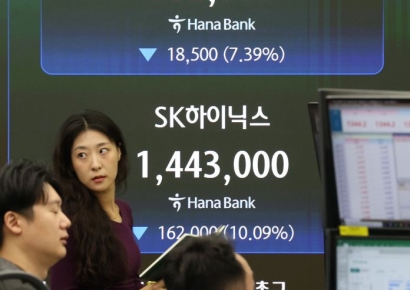 "I Like the High Dividends" "This Is a Better Bet Than Samsung Electronics and SK hynix": What Foreign Investors Bought While Selling 14.7 Trillion Won
- Women Who Say "A Husband's Annual Salary of 100 Million Won Is a Given"... Matchmaking CEO: "They Talk About It Like It's Nothing"
- "Who Turned Up the Refrigerators?" Hackers Target 700 Supermarkets, Sparking Alarm... "A Blow to France's Food Security"
- 'Discount' Ballantine's vs. 'Cost-Cutting' Johnnie Walker ... Strategies Diverge Amid Strong Dollar
- "I'll Give You 53.4 Billion Won to Keep Quiet"... Influencer Reveals Secret Deal; Musk Denies It
Ji Young Han, an analyst at Kiwoom Securities, said, "The 7,000 level cannot be regarded as an upper limit shaped by valuation burdens or a slowdown in earnings consensus." He added, "It is more appropriate to view the resistance around 7,000 as the result of accumulated supply from previous high points being released during the index’s rebound. After the Chuseok holiday, we should focus on the possibility of both the floor and ceiling of the current 6,400–7,050 range moving higher."
© The Asia Business Daily. All rights reserved. Unauthorized AI training and use prohibited.