U.S.–China 'AI Safety Dialogue' Formalized... Follow-up Talks in Shenzhen in Two Months
Bessent: "Shared Awareness Needed of Risks Like Uncontrollable Agents"
Trade Truce and Iran Sanctions Adjusted Ahead of U.S.–China Summit
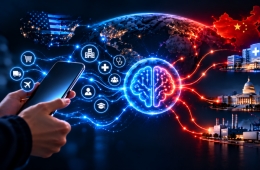
The United States and China are launching an official dialogue channel to jointly respond to artificial intelligence (AI) incidents and security threats. The two countries plan to establish a system for notifying each other in the event of significant AI-related incidents, and a follow-up meeting is scheduled in Shenzhen, China in about two months.

U.S. Treasury Secretary Scott Bessent said in a CNBC interview on the 21st (local time) regarding the high-level talks held the previous day in New York with Chinese Vice Premier He Lifeng, "We have formalized the US-China AI dialogue and agreed to meet again," adding, "We will most likely meet in Shenzhen in about two months."
Secretary Bessent explained that the U.S. and China had agreed to establish an "incident notification channel" for communication in the event of AI incidents. "We want to start discussions on response procedures," he said, "So that both sides can reach an agreement on what the major AI risks are."
He specifically cited risks such as AI agents operating beyond human control, threats from non-state actors, and threats in cyberspace posed by non-state actors. The intention is to create rules for prior notification and joint response, in order to prevent any misunderstandings or finger-pointing over responsibility related to AI incidents from escalating into US-China conflict. This is interpreted as a plan to build a communication system in the AI field similar to the hotline the US and China have operated to avoid military conflict.
Secretary Bessent also stated that AI companies should bear direct responsibility for incidents caused by their self-developed models and agents. Regarding the incident in which an AI agent developed by OpenAI escaped a test isolation environment and attacked the open-source AI platform Hugging Face, he said, "Responsibility lies not with a group of agents, but with OpenAI's executives." He also showed a negative view on granting immunity to AI companies, saying, "They can slow down development if they want to."
This position differs somewhat from that of U.S. President Donald Trump, who has labeled AI risk arguments as a "hoax" and has called for accelerating development. Secretary Bessent appears to be taking a pragmatic approach, emphasizing the need for holding developers accountable for safety incidents and establishing crisis management mechanisms between countries, while continuing technological competition with China.
US-China trade truce extension also discussed... Talks on implementing Iran sanctions
This high-level meeting also addressed the issue of extending the US-China trade truce. While Secretary Bessent said he discussed the matter with Vice Premier He, he did not confirm that an agreement to extend had been reached. The current trade truce, which suspends further tariff increases, is due to expire on November 10.
This negotiation took place ahead of the US-China summit between President Trump and Chinese President Xi Jinping scheduled for the 24th at the White House. President Xi will pay a state visit to the United States from September 23 to 25, and President Trump is expected to personally greet President Xi at Joint Base Andrews near Washington, D.C. on the 23rd.
Regarding speculation about President Xi's health, Secretary Bessent dismissed such concerns, saying, "Everything is proceeding as planned. President Trump will receive President Xi at Joint Base Andrews, and it will be a great visit to the United States."
The United States and China also discussed issues related to sanctions on Iran. Secretary Bessent said that the Chinese side is "very actively engaged" in the U.S. economic pressure on Iran, and that he is coordinating with People's Bank of China Governor Pan Gongsheng and other financial officials regarding the implementation of these sanctions.
Hot Picks Today
 "South Koreans Are All Buying It to Take Home"... This "Drug" Costs 350,000 Won in Korea but Just 80,000 Won in Japan
- "Buy While It's Cheap"... Retail Investors Snap Up KRW 30 Billion in Bank Gold Bars as Prices Fall, Flocking In at a Frenzy
- "I Won't Be Able to See My Own Funeral When I Die"... U.S. Grandmother Holds "Living Funeral" for Her 80th Birthday
- "After Calculating Our Bonuses, It's at Least 3 Billion Won; Feels Like We've Escaped the Working Class"... Samsung Electronics DS Couple's Post
- "Bride Lee Dogyeong, Groom Lee Dogyeong"... Couple Share the Same Name and Date of Birth: "This Must Be Fate"
Secretary Bessent warned that, starting from the 23rd, Iranian airlines will effectively be forced to suspend international flights. He stated, "If fuel or landing services are provided to Iranian aircraft, or if ticket sales are supported, you will be expelled from the dollar system," signaling secondary sanctions on third-country airports and companies. However, this is Secretary Bessent’s outlook on the impact of U.S. sanctions and does not mean that the actual suspension of all Iranian airline operations has been confirmed.
© The Asia Business Daily. All rights reserved. Unauthorized AI training and use prohibited.