All Five Top Military Officers Convicted for Martial Law Involvement: Ye Inhyeong 18 Years, Lee Jinwoo 15 Years (Comprehensive)
Park Ansou: 10 Years, Kwak Jonggeun: 9 Years, Moon Sangho: 12 Years
Lee Jinwoo, Park Ansou, Kwak Jonggeun Re-detained After Release on Bail
Special Prosecutors: "Will Decide on Appeal After Reviewing Verdict"
Ye Inhyeong, former Commander of the ROK Military Counterintelligence Command, and Lee Jinwoo, former Commander of the Capital Defense Command, who were put on trial for deploying troops to the National Assembly and the National Election Commission during the 12·3 Martial Law, have been sentenced to 18 years and 15 years in prison, respectively, in the first trial.

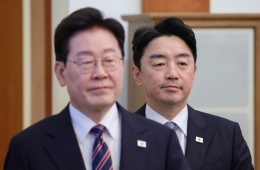
Ye Inhyung, Former Commander of the Defense Security Command. Photo by National Assembly Press Photographers' Association
View original imageOn September 21, the 26th Criminal Division of the Seoul Central District Court (Presiding Judge Hyun-Kyung Lee) sentenced former Commander Ye to 18 years and former Commander Lee to 15 years in prison, both indicted on charges including performing key roles in insurrection and abuse of authority. Park Ansou, former Army Chief of Staff (who was the Martial Law Commander at the time), was sentenced to 10 years; Kwak Jonggeun, former Commander of the Army Special Warfare Command, received nine years; and Moon Sangho, former Commander of the Military Intelligence Command, was sentenced to 12 years. The charge of perjury additionally applied to Ye was also found guilty.
The court ordered the re-detention of Lee, Park, and Kwak, who had been released on bail pending trial. Ye and Moon remain in custody.
Previously, at the final hearing in July, the special prosecution team for insurrection and treason requested 30 years each for Ye and Lee, 25 years for Park, and 20 years each for Kwak and Moon.
The court stated that former President Yoon Suk Yeol and former Defense Minister Kim Yonghyun sought to neutralize the National Assembly and attempted to arrest and detain key figures without warrants, based on unconstitutional and unlawful proclamation orders. It was presupposed that the martial law was declared with the purpose of making it impossible for the National Assembly and the Election Commission to exercise their authority. The court regarded this as an insurrection aimed at subverting the constitutional order, and that those involved in these key duties should be punished under the charge of performing important duties in insurrection. Four of the five defendants—except for Kwak, who admitted all charges—argued they lacked the intent or purpose for constitutional subversion or insurrection, but the court did not accept this.
The court cited Ye’s notes as evidence that he heard about the intention to enforce martial law several times during meals with former President Yoon and former Minister Kim, even though he knew that such reasons would not justify martial law during peacetime. Ye’s handwritten notes included phrases such as “top priority on arrests and searches for violating the proclamation,” “joint investigation by military and police,” and details like “list of key personnel,” “joint arrest teams operation,” and “securing evidence from the Election Commission.” The court held that these notes matched the actual execution of martial law to a considerable extent, and indicated that Ye drafted them after discussions with Yoon and Kim, thus recognizing active premeditation.
All perjury charges against Ye were also found to be proven. He had testified that he never ordered the head of the counterintelligence bureau to secure the Election Commission’s server, nor told the National Police Chief that counterintelligence staff would be sent there; however, the testimonies of both the bureau head and the police chief were found credible and consistent by the court.
For Lee, the court pointed to his written notes, made prior to the martial law declaration, which mentioned “address to the nation,” “personal distribution of crowbars, hammers, blank rounds,” and “advance deployment of anti-terror units.” Lee claimed the notes assumed various scenarios in accordance with the Integrated Defense Act, but the court determined that the notes aligned with the process in which President Yoon issued a statement and then declared martial law, and were inconsistent with the intent of the Integrated Defense Act.
The court also confirmed that, just before the vote on lifting martial law, Lee was instructed by President Yoon to drag lawmakers out of the National Assembly and subsequently issued similar orders to his subordinates. This was backed by the statement of a former senior aide who, being nearby, could overhear the phone call, and whose testimony corresponded with other unit members.
Park, as Martial Law Commander, was found guilty of calling the National Police Chief to report the proclamation and requesting restriction of entry to the National Assembly, resulting in a second blockade. He claimed he was coerced and acted under a mistake of law, but the court did not accept his defense. The court stated, “Despite apparently recognizing the need for legal review upon receiving the proclamation, there is no evidence to suggest such a review was actually conducted.” However, for the charge regarding his ordering Capital Defense and Special Warfare Command troops to deploy, the court ruled not guilty due to lack of evidence of collusion.
Moon was convicted of sending intelligence command operatives into the Election Commission’s premises immediately after the martial law declaration, on suspicion of election fraud relayed by former Commander Noh Sangwon. The court stated that Moon was aware that arresting and detaining Election Commission officers and seizing server data would prevent the constitutional authority from functioning.
In explaining the reasons for sentencing, the court said, “It is never acceptable to make it impossible for constitutional institutions to exercise their authority,” and added, “The defendants betrayed the duty and mission of the military, as well as its political neutrality, in favor of the interests of specific forces.”
Regarding Ye, the court pointed out he shifted blame onto his subordinates by denying and committing perjury about orders to secure the Election Commission’s server. The fact that the order was not actually carried out was attributed to the passive response of his subordinates and the resistance of citizens, but this was not considered as a mitigating circumstance. Lee was also cited for denying the order to remove lawmakers from the National Assembly and shifting responsibility onto subordinates, but the fact that he instructed Capital Defense troops to be unarmed and did not use force was taken as a limited mitigating factor.
The court considered the fact that Park had no prior conspiracy with Yoon or Kim and prevented the use of tasers or blank rounds by Special Warfare Command as extenuating. Kwak, having been directed by Kim to deploy troops to the National Assembly, Election Commission, Democratic Party Headquarters, and a polling research office, played what the court described as “the most important role in blocking the resolution to lift martial law in the National Assembly.” However, his consistent testimony—including a conscience statement early in the investigation—was taken into account, and his sentence was consequently reduced under the provisions of the special prosecutors’ law.
After sentencing, the special prosecution team commented, “It is significant that the court recognized the defendants among the military leadership, including Yoon Suk Yeol and Kim Yonghyun, conspired for a prolonged insurrection using martial law as a means.” They added, “It is important that the verdict confirmed the responsibility of the military’s key commanders for abandoning their duties. The damage to the military’s political neutrality and public trust in the armed forces was also regarded as an important factor in the court’s judgment.”
However, they also expressed disappointment that “the prison terms for each defendant fell short of expectations,” and said, “We will closely review the details of the written verdict before deciding whether to appeal and to what extent.”
Hot Picks Today
 "3821% Returns" "Better Than Stocks": 30s and 40s Flock to the Market, Secondhand Trading Surges
- [Exclusive] "Nvidia Researchers to Work in Yangjae"... LG Electronics to Establish 'Joint Robotics Development Base'
- "Often Ate Malatang and Chinese Food..." Shock Over the Reality of Chinese Bamboo Shoots Mass-Produced With Sulfur
- "I’ll Take This, Please"... Buying the Last Lottery Ticket Brings a Jackpot
- "Surprisingly Real, Perfect Like AI" -- Global Media Praise Korean Fencer's Beauty
Meanwhile, after the sentencing was announced, there was unrest in the courtroom as some spectators shouted, “This is a political ruling,” and “Stay strong, Commander!” There were also outbursts that “the worst offender received the lightest sentence,” referring to Kwak, who admitted guilt and apologized but received the least severe punishment.
© The Asia Business Daily. All rights reserved. Unauthorized AI training and use prohibited.