National Fire Agency to Expand Personnel Exchanges and Restore Trust in Anonymous Reporting... Reforming Organizational Culture
Complete Ban on Personnel Disadvantages for Whistleblowers
Jobsite Caution and Prohibition Guidelines to Be Distributed to All Staff
Sexual Harassment and Sexual Violence Prevention Guidelines Revised, Training Strengthened
On September 21, the National Fire Agency announced its "Comprehensive Plan for Reforming Organizational Culture in the Firefighting Sector," centered on broader personnel exchanges for commanders, the participation of external experts in audits, and the nationwide expansion of anonymous reporting systems.

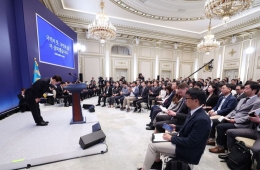
A scene from the emergency meeting of national fire commanders chaired by the Fire Commissioner, held in June at the conference hall of the Fire Agency in Sejong City. Photo by Yonhap News
View original imageThis initiative reflects the agency’s determination to resolve the structural silence and institutional distrust uncovered in last month’s organizational culture assessment, and to correct recurring misconduct at the organizational structure level.
The National Fire Agency stated that through these measures, it aims to eliminate favoritism, establish an audit system without sanctuaries, and foster a culture of mutual respect and whistleblower protection. Furthermore, the agency plans to institutionalize annual organizational culture assessments to continuously monitor and evaluate improvements.
The new measures are based on the organizational culture assessment results released last month. Although as many as 70% of respondents who experienced misconduct answered, "I could not say anything," the actual proportion who officially reported incidents fell short of even 1%. Trust in anonymity for whistleblowers received a score of 3.99 on a 7-point scale—lowest among all questions. In particular, women and employees with 6–10 years of service reported higher rates of experiencing misconduct and lower levels of institutional trust.
The National Fire Agency analyzed that this is not an individual response problem, but rather structural silence caused by fears of identity exposure and distrust of institutional mechanisms. Accordingly, the agency established ten initiatives under four core strategies: eliminating favoritism, implementing audits without sanctuaries, protecting whistleblowers, and promoting a culture of mutual respect.
To break down the closed organizational culture, the agency will fully expand cross-regional personnel exchanges for commanders. This is designed to prevent the lenient handling of audits or disciplinary actions that can arise from local ties and personal connections among long-term employees in the same region.
With the revision of the Fire Officers Act, transfers and secondments will become possible between the National Fire Agency and local governments, as well as among local governments themselves. In cases of serious misconduct requiring disciplinary action, the Commissioner of the National Fire Agency can transfer personnel to other regions. Additionally, competency evaluations for senior officials will be introduced for fire superintendent promotion candidates, and a unified recruitment system will be established to provide local civil servants the opportunity for high-level promotions to improve fairness and transparency in personnel decisions.

The audit system will also be significantly reinforced. A special audit unit will be established to conduct cross-regional audits, and lawyers will be assigned to audit departments to strengthen legal review capabilities.
For serious cases such as misconduct by fire lieutenants or above, abuse of power, or sexual misconduct, the National Fire Agency will conduct direct audits. If a case is difficult for local governments to investigate impartially, the National Fire Agency will take over at the request of the local fire headquarters chief. Institutional improvements will allow external professionals, including labor attorneys and lawyers, to directly participate in audit investigations.
The Disciplinary Review Committee will decide whether to pursue external investigations at the request of victims, and the participation of female committee members will be mandatory in cases involving sexual misconduct. National Fire Agency auditors will participate in local disciplinary deliberations to ensure consistent disciplinary standards, and supervisors who allowed misconduct to persist will also be held accountable.
Protecting whistleblowers is a core element of this plan. In regions without anonymous reporting systems, external professional systems will be introduced, and employees will be clearly instructed on identity protection procedures such as not logging IP addresses.
During investigations, separate interview spaces will be provided, confidentiality agreements from witnesses will be required, and multi-stage manuals to prevent secondary harm will be distributed. Any personnel disadvantages inflicted as a result of reporting will be strictly prohibited; verified retaliation will itself become subject to investigation.
To promote a culture of mutual respect, the newly established Firefighters' Legal Rights Protection Officer will lead efforts, including a comprehensive revision of sexual harassment and sexual violence prevention guidelines, and the distribution of guidelines to improve workplace language sensitivity.
The education system will transition to a life-cycle model, with mandatory courses on misconduct prevention added to initial training. A one-week professional course for auditors will be established at the Central Fire Academy. To protect employees with 6–10 years of service, who experience the highest rates of misconduct, jobsite behavior guidelines addressing caution and prohibitions will be distributed to all staff, and public service ethics will be included in management training.
The organizational culture assessment will be conducted annually to track improvements. Preventive audits will be carried out in regions with low improvement rates or high negative response rates.
Hot Picks Today
![[Exclusive] "Nvidia Researchers to Work in Yangjae"... LG Electronics to Establish 'Joint Robotics Development Base'](https://cwcontent.asiae.co.kr/asiaresize/93/2026092110452736212_1789955126.jpg) [Exclusive] "Nvidia Researchers to Work in Yangjae"... LG Electronics to Establish 'Joint Robotics Development Base'
[Exclusive] "Nvidia Researchers to Work in Yangjae"... LG Electronics to Establish 'Joint Robotics Development Base'
- "I’ll Take This, Please"... Buying the Last Lottery Ticket Brings a Jackpot
- Jeong Jeomsik: "Virtual Asset Taxation Without Sufficient Preparation Will Become a Burden for Young People"
- "Old-Fashioned Culture vs Not Serious Enough"... Why Generation Z Applicants with 'Iced Lattes' Are Rejected in Interviews
- "They Might Start Pitching Tents and Grilling Meat"... The 'Hammock Villain' Appears at Cheonggyecheon
Choi Yongcheol, Commissioner of the National Fire Agency, stated, "This plan was developed recognizing that the problem lies not between individuals but in the malfunctioning of systems for detecting and correcting misconduct. We will initiate organizational culture reforms by creating an environment where members can voice their opinions without fear of disadvantage."
© The Asia Business Daily. All rights reserved. Unauthorized AI training and use prohibited.