US Investment Negotiations on Edge... National Assembly Briefing Likely Delayed Again to 22nd
Challenges in Rolling Out First US Investment Project
US Raises Additional Demands, "Commercial Rationality" at the Center
National Assembly Briefing Postponed from the 17th to the 22nd
Uncertainty Remains as Negotiations Continue
There appears to be little progress between South Korea and the United States in finding common ground on the first project of the $350 billion U.S. investment agreement. This is because both sides are experiencing significant difficulties in applying the investment principles agreed upon last year to actual projects. As the tug-of-war continues, it seems likely that the Ministry of Trade, Industry and Energy's briefing to the National Assembly, originally scheduled for the 22nd, will be postponed again.
An official close to the ruling party told The Asia Business Daily on the 21st, "A closed-door National Assembly briefing by the Ministry of Trade, Industry and Energy was scheduled for 9:30 a.m. tomorrow, but it appears to have been dropped." A government official also noted, "We have yet to receive tomorrow's schedule from the National Assembly," and added, "A new schedule may be announced during the day." The ministry had planned a closed-door briefing on the first U.S. investment project and its terms to the National Assembly’s Industry, Trade, Energy, SMEs, and Startups Committee on the 17th. However, as negotiations with the U.S. were not finalized, the schedule had already been postponed to the 22nd once before.

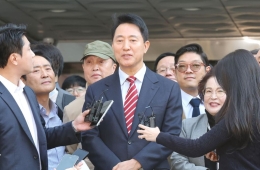
Kim Jung-kwan, Minister of Trade, Industry and Energy, who visited the United States to finalize the U.S. investment negotiations, is seen entering through Terminal 2 of Incheon International Airport on the 13th, listening to questions from the press. 2026.9.13 Yonhap News Agency
View original imageThe continuous delay in the briefing schedule is due to unresolved differences between the two countries regarding the detailed terms of the initial investment project. Under last year's agreement on the $350 billion U.S. investment, $150 billion was to be allocated to shipbuilding cooperation, with the remaining $200 billion targeted at strategic sectors such as energy, semiconductors, pharmaceuticals, critical minerals, and artificial intelligence. The South Korean government stipulated that only projects with sufficient prospects of capital recovery based on 'commercial reasonableness' would be pursued within the $200 billion allocation, and it established a safeguard to cap annual investments at $20 billion.
However, as the initial project was being fleshed out, negotiations became entangled after the U.S. made additional demands regarding the application of the previous agreement. South Korea is seeking provisions that would allow it to halt investments if a project turns out to be commercially unviable or circumstances change, as well as a structure enabling overall profit and loss calculations across multiple projects. There also needs to be additional coordination on setting a $20 billion annual investment cap, specifying participation by Korean firms, and including precise contractual terms to ensure stable capital recovery.
The issue of who bears the business risks requested by the U.S. side is also a key point of contention. The South Korean government holds the view that investment in the U.S. gas-fired combined cycle power plant project—considered the leading candidate for the first investment—should proceed only if a stable earnings structure, such as a long-term power purchase agreement (PPA), is in place. Additionally, South Korea is reportedly insisting that specific provisions be included in the agreement, such as creating an umbrella-type special purpose vehicle (I-SPV) to allow profits from more smoothly operating projects to be used for capital recovery, and the appointment of a Korean project manager.
The government cannot easily compromise on the conditions of the first project, as it essentially sets a precedent for the upcoming $200 billion in strategic investments. If principles regarding capital recovery or loss prevention are relaxed for the first project, similar conditions might recur in future investment negotiations. For the government, determining the terms for the inaugural project is far more important than rushing its announcement.
As a result, speculation is mounting both within and outside government circles about the possibility that negotiations could break down. When the ministry delayed the National Assembly briefing on the 17th, it explained that "more time was needed to narrow the gap with the U.S.," and recently, it has even acknowledged the possibility of the agreement falling apart. President Lee Jaemyung also personally stated in a press conference on the 18th that the negotiations were not going smoothly. President Lee emphasized the principle of only pursuing projects with 'commercial reasonableness' and remarked, "After reviewing the contents, I found some parts difficult to agree with, so discussions are ongoing."
However, some observers caution that the recent negotiation difficulties should not be immediately interpreted as signs of a prolonged stalemate or a complete breakdown. Last year as well, after agreeing on the overall $350 billion investment framework, both nations spent months disagreeing over the scale of direct investment, execution methods, and profit-sharing. Even right up until the U.S.-ROK summit on the sidelines of the APEC meeting in Gyeongju, no compromise had been reached, but in the end, a breakthrough was achieved at the head-of-state level, establishing a compromise to roll out direct investments of up to $20 billion per year. As many of the current points of contention are already on the table, there remains a possibility that talks will pick up speed in the final stages.
Hot Picks Today
 "The Transfer Failed, but 'Ding-Dong,' Money Came In"... KRW 32.5 Billion Financial Incident at Toss Bank
- 'Acquitted on appeal,' Oh Sehoon: "I'll work even harder to repay you"... Special Counsel: "Disappointing ruling; we will appeal to the Supreme Court" (Updated)
- "Made 12 Billion Won Cleaning Up Other People's Dog Poop With Just a Rake"... 'Poop Scoop Millionaire' Is All the Rage in the U.S.
- "My Blood Vessels Got Cleaner Just by Drinking It"... Surprise: The "Tea" Even Doctors Make Sure to Drink
- 'Hangover Legend' Returns After 11 Years... Lee Sunmin Hyung's 'Captain Q' Sells Out
Some interpret the repeated delays of National Assembly briefings as evidence that both sides are locked in a final showdown over the last remaining conditions. In the end, the key to the U.S. investment negotiations will not be when the first project is announced, but rather how thoroughly last year's agreed-upon safeguards are reflected in the actual contract.
© The Asia Business Daily. All rights reserved. Unauthorized AI training and use prohibited.