How Are Credit Risks Assessed in the Era of Blockchain Finance?
Korea Ratings·KR Holds Inaugural Conference
on Digital Finance Transformation
As the virtual asset market continues to grow and blockchain technology is increasingly integrated into financial infrastructure, there have been calls for credit assessments, regulatory frameworks, and enhanced cooperation among market participants to adapt to this evolving landscape.
On September 21 at 10 a.m., Korea Ratings·KR held its first digital finance conference on the theme of "Digital Financial Infrastructure Transformation" at Conrad Seoul in Yeouido, Seoul. This conference was organized solely by Korea Ratings·KR. Speakers and panelists from Mirae Asset Securities, Shinhan Financial Group, Binance, Dunamu, Toss Bank, Kim & Chang, and Koscom are taking part in the event.
The conference addresses how to establish and assess market trust during this transitional period, where not only virtual assets but also stablecoins and asset tokenization are rapidly changing financial infrastructure. Hyukjin Jung, policy chief of the Evaluation Policy Division at Korea Ratings·KR, and Hongmi Kim, head of the Financial & Structured Products Ratings Division, will each present on credit assessment during the era of digital finance transformation and the role of credit ratings in the era of won-denominated stablecoins.
Jung noted that blockchain-based digital finance reorganizes asset types onto an on-chain basis, leading to new types of credit risks. For example, increased technological dependence brings to the forefront platform, smart contract, external security, and rights representation risks. These risks are not entirely new, but rather represent new channels through which existing credit risks can spread. He emphasized that credit ratings should convert these complex technological risks into a common, comparable credit metric to provide market participants with an objective standard.

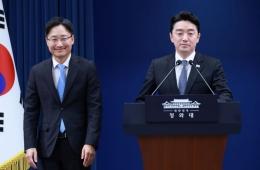
On the morning of the 21st at 10 a.m., participants are presenting at the pre-conference press briefing of the "Transformation of Digital Financial Infrastructure" conference hosted by Korea Ratings at Conrad Seoul in Yeouido. Photo by Kyu-Min Oh
View original imageKim explained that as the global stablecoin market rapidly expands, major countries are streamlining laws and regulations. She emphasized that in Korea, which is also preparing for legislation, legal grounds, market trust, integrated infrastructure, and technological validation are essential for the successful adoption of won-denominated stablecoins. She added that credit rating agencies should establish comprehensive evaluation systems that cover everything from reserves to technology risks in accordance with domestic regulations to support market stability.
There was also a suggestion that Korea needs to establish a safety net through regulatory measures that encourage virtual assets to remain within the domestic market. Sungim Son, managing director at Mirae Asset Securities, explained that Hong Kong, led by government initiative, has moved beyond the experimental stage into full commercialization, where actual funds are raised through virtual assets. Hong Kong regulates tokenized assets as an extension of existing securities law, and even before opening up the market, it established investment protection mechanisms and payment infrastructure. During this process, Hong Kong also experienced the JPEX exchange case, the largest financial fraud incident in its history, but rather than loosening regulations, it expanded its regulatory guidelines to cover previously uncovered areas. She stated, "Hong Kong does not view this as wholly new infrastructure, but is expanding the system by involving both existing financial infrastructure and current market players." She stressed the need for Korea to focus on developing a structural safety net that prevents capital outflow by drawing on Hong Kong's three lessons: designing issuance, circulation, and settlement simultaneously; utilizing the existing financial system; and expanding regulations in response to incidents. Junhwan Kim, team leader of the Digital Asset TFT at Shinhan Financial Group (managing director), presented on how banks and financial holding companies are addressing digital assets and stablecoins.
Later, in a Fireside Chat session moderated by Sungdeok Kim, head of the Digital Asset Business Division at Koscom, Steve Kim, Director of Business Development for Asia Pacific at Binance, and Hongyeol Ryu, CEO of Bithumb, discussed the global virtual asset market and trading and custody infrastructure. The panel also addressed bringing virtual assets into the regulatory sphere and how to respond to market developments. Panelists included Haebung Lee, Head of Investor Protection Center at Dunamu; Jinhyun Park, Chief Strategy Officer (CSO) at Toss Bank; and Hanjin Lee, attorney at Kim & Chang.
Hot Picks Today
 "There's a Drink Like This?"... Chinese Beverage With "Korean" in Its Name Rakes in 85 Million Won in Monthly Sales
- "Samsung Electronics at 70,000 won, SK hynix at 200,000 won"... Why the gloomy outlook despite 'record-breaking earnings'?
- Woman Found Collapsed Barefoot on Street, Leaving 3-Year-Old Child Unattended... Turns Out She's Part of a "Wealthy Royal Family"
- "I Put in 10 Million Won, but Only 2 Million Won Is Left" ... 77% Plunge Leaves Retail Investors in Samsung Electronics and SK hynix Leveraged ETFs Crying Out
- "The leggings are all see-through. It's so embarrassing to look at," complaints prompt Lululemon to fire development staff.
Patrick Yoon, CEO of Korea Ratings·KR, stated, "The history of finance is the history of trust. Stablecoins, asset tokenization, and digital assets are leading the next transformation of financial infrastructure. For the market to continue growing, speed and efficiency alone are not enough; transparency, accountability, stability, and comparable risk information are all required. Korea Ratings·KR will not simply keep pace with this rapidly changing landscape, but will provide reliable information and balanced perspectives to foster a healthy and sound financial market."
© The Asia Business Daily. All rights reserved. Unauthorized AI training and use prohibited.