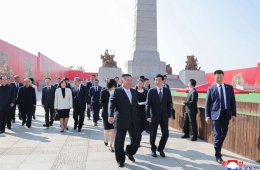
North Korean State Media Remain Silent the Day After Firing Two Missiles
North Korea did not release any information through its state-run media regarding the launch of two short-range ballistic missiles, even the day after the incident.

As of 8 a.m. on September 21, neither the Korean Central News Agency nor the Workers' Party’s official newspaper, Rodong Sinmun, had reported on the missile launches from the previous day. According to the Joint Chiefs of Staff, North Korea launched one short-range ballistic missile from the Wonsan area toward the East Sea at approximately 3 p.m. the previous day, followed by an additional launch at around 5:50 p.m. Each missile flew approximately 450 km and over 600 km, respectively. This marks the 14th ballistic missile launch by North Korea this year, and the first in eight days since September 12. The latest launches also took place ahead of U.S. President Donald Trump’s address at the United Nations General Assembly on September 22 and the U.S.-China summit on September 24.
Recently, North Korea has often refrained from reporting its missile launches or has reported them with a delay. Traditionally, North Korea would disclose the purpose and outcomes of its launches through state media the day after the event. However, the launches conducted on August 6, 12, and 20 went unreported. The training exercise that took place on September 12, which involved drones, strategic cruise missiles, tactical ballistic missiles, and multiple rocket launchers, was only covered by the Korean Central News Agency two days later, and was not published in internal publications such as Rodong Sinmun, which are read by North Korean citizens.
Park Wongon, professor in the Department of North Korean Studies at Ewha Womans University, said, “The recent nuclear-related statements by Kim Yo-jong, Director of the Workers’ Party General Affairs Department, along with the missile launches, point to a sense of urgency in North Korea.” He analyzed, “With President Trump mentioning the possibility of a meeting, North Korea is attempting to showcase the advancement of its nuclear capabilities as much as possible and is trying to negotiate from the position of a nuclear-armed state.” He added that this indicated North Korea’s intention to pursue negotiations on nuclear arms reduction rather than denuclearization.
Regarding the lack of reporting after the launch, Park explained, “The UN General Assembly is not a military event, so North Korea has little justification to announce its missile launches right beforehand.” He added, “North Korea is leaving room for the international community to interpret the meaning of the launch.” He further noted, “The launch itself demonstrates North Korea’s nuclear capabilities clearly, and this could be seen as strategic clarity rather than ambiguity.”
Hot Picks Today
 "Please Pay Me at Least 3 Million Won a Month": More Than Half of Young People Today Prioritize "Working Conditions" Over Company Size
- Selling Like Crazy Every Year... 30-Year-Old Hetbahn Takes on a New Challenge: Tastes Better Than "Mom's Home Cooking" [On-Site Report]
- Sleep Is Koreans' 'No. 1' Health Interest, but the 'Twist' Is They Averaged Less Than 7 Hours a Night This Year
- Ran 18 km With 9-Year-Old Tied to Him at the Waist... "Man Banned From Competing for 3 Years"
- Beachgoer Finds 'Plastic' That Turns Out to Be Perfume Ingredient Worth More Than Twice as Much as Gold
Meanwhile, the 81st United Nations General Assembly High-Level General Debate will commence in New York, United States, on September 22 (local time). Vice Minister of Foreign Affairs, Kim Sun-kyong, is scheduled to represent North Korea and deliver a speech on September 28.
© The Asia Business Daily. All rights reserved. Unauthorized AI training and use prohibited.






![[Market ING] KOSPI Seeks Rebound in Superweek Packed with Corporate Earnings and FOMC](https://cwcontent.asiae.co.kr/asiaresize/307/2026102514484873155_1792907327.jpg)