North Korea Continues Missile Provocations... Successive Launches at Three-Hour Intervals (Comprehensive 2nd Report)
Launched from Wonsan Area... Missiles Traveled 450km and 600km
Marking North Korea's 14th Ballistic Missile Launch This Year
North Korea launched two ballistic missiles in succession, with about a three-hour interval between the launches.

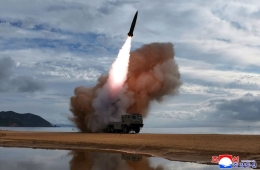
The launch of a North Korean tactical ballistic missile. Photo by Yonhap News Agency
View original imageAccording to the Joint Chiefs of Staff, the military detected the launch of one short-range ballistic missile (SRBM) fired toward the East Sea from the Wonsan area of North Korea at around 3 p.m. on September 20. The detected missile traveled approximately 450 kilometers.
Subsequently, at around 5:50 p.m. on the same day, North Korea launched an additional short-range ballistic missile toward the East Sea from the Wonsan area. This missile traveled more than 600 kilometers.
Both missiles launched in these two instances are believed to be from the Hwasong-11 series, North Korea's representative short-range ballistic missiles. The Hwasong-11 series includes variants such as the Hwasong-11Ga (KN-23), known as the North Korean version of the Iskander, and the Hwasong-11Na (KN-24), commonly called the North Korean version of the ATACMS. The Joint Chiefs stated, "The United States and South Korea are conducting a detailed analysis of the exact specifications," and noted that South Korea, the US, and Japan have been tracking and sharing information on the launches from the outset. They emphasized, "The military is maintaining the capability and posture to overwhelmingly respond to any provocation, closely monitoring North Korea's activities under the robust ROK-US combined defense posture."
This latest launch is interpreted as part of North Korea's effort to modernize its conventional military capabilities under the new five-year defense development plan adopted at the party congress in February. At that time, North Korea announced its intention under the five-year defense development plan to reinforce its ‘tactical missile complex’ aimed at deterring South Korea.
Some analysts suggest that the timing may be intended to reinforce North Korea's message that the construction of its nuclear and overall deterrence capability is non-negotiable ahead of upcoming events such as U.S. President Donald Trump’s speech at the United Nations General Assembly general debate scheduled for September 22 (local time), and the U.S.-China summit on September 24 where the North Korea issue is likely to be discussed.
President Trump last month ordered a reduction in ROK-US joint military drills and publicly indicated his intention to pursue North Korea–U.S. summit talks. A senior U.S. official also stated during a press briefing on September 18 (local time) ahead of the U.S.-China summit that “President Trump is ready to talk with Kim Jong Un, either by phone or in person.”
This marks North Korea's 14th ballistic missile launch of the year and comes eight days since the previous launch. During the last launch on September 12, North Korea fired multiple SRBMs toward the East Sea from the Wonsan area. Two days later, North Korea publicly disclosed via external-facing media that this drill had been a coordinated fire assault training that involved 'mix-and-match' launches of four types: tactical ballistic missiles, attack unmanned aerial vehicles, strategic cruise missiles, and large-caliber thermobaric multiple rocket launchers. Subsequently, from September 16 to 18, North Korean leader Kim Jong Un visited an important munitions factory believed to be producing an upgraded 600mm super-large multiple rocket launcher (five-barrel), a new 240mm multiple rocket launcher, North Korea's version of the Harop drone, as well as new types of drones, where he emphasized the strengthening of artillery power.
Hot Picks Today
 Seoul Tops London and Tokyo for the First Time... Foreign Media: "Seoul Is Becoming the New Paris"
- Just Two Days After Release, iPhone 18 Pro Users Worldwide Report Sudden Reboots and "Panic Full" Issues
- "Same Salary, 3.5-Day Workweek, and Monthly Paid Leave for Women"...Chinese Company’s Bold Experiment
- "Is the YouTuber Telling the Truth?" 300,000 Views in One Day... The Real Story Behind Shin Ramyun's Flavor, According to Nongshim [Tastelovers X-File]
This is also viewed as a reaction to regional military movements led by the U.S. and involving South Korea and Japan. On September 18, Kim Yo Jong, director of the Workers’ Party General Affairs Department, issued a statement condemning multinational maritime exercise ‘Pacific Vanguard’ hosted by the U.S. Navy 7th Fleet, warning that "a response that is proportional or even more offensive" is necessary. She added, "Our resolve to defend our sovereignty will be expressed through even clearer action."
© The Asia Business Daily. All rights reserved. Unauthorized AI training and use prohibited.