"Once Taller Than Korea and China" Quick Meals for Young Japanese in Their 20s and 30s... Average Height Stagnant for Over 30 Years
Men 3 cm and women 5 cm shorter than Koreans and Chinese
Insufficient nutrition and increased proportion of low birth weight infants
While the average height of Koreans and Chinese has been increasing, the average height of Japanese people has stagnated since the 1990s, with contributing factors identified as insufficient energy intake among Japanese and a rise in the number of low birth weight babies.
On September 20, the Nihon Keizai Shimbun (Nikkei) reported on the phenomenon of the average height of Japanese people becoming lower than that of Koreans and Chinese in an article titled, "Why Have Japanese Heights Fallen Behind Korea and China – Factors Beyond Nutrition." Quoting the international research group NCD-RisC, which investigates growth and development across countries, Nikkei pointed out that since the 1990s, average height in Japan has plateaued, leading to the possibility that Japan has been overtaken by China and Korea, and that the gap has widened since.

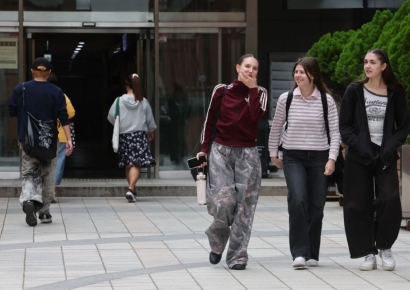
On the 20th, pedestrians carrying umbrellas are crossing the crosswalk in Shibuya, Tokyo, Japan. Photo by AFP Yonhap News
View original imageAccording to estimates published by NCD-RisC in the British medical journal The Lancet in 2020, the average height of 19-year-olds in 2019 was 172.1 cm for Japanese men and 158.5 cm for Japanese women. In comparison, 19-year-old Koreans averaged 175.5 cm for men and 163.2 cm for women, while Chinese averaged 175.7 cm for men and 163.5 cm for women. This means the average height of Korean and Chinese men was about 3 cm taller than Japanese men, while for women, the difference was about 5 cm.
From 1896, over the course of 100 years, the average height for Japanese men increased by approximately 14.6 cm, and for women by about 16 cm; yet, there has been little change since the 1990s. Recent data also shows that the average height of 17-year-old Japanese male students stands at 170.8 cm, which is nearly the same as the historical peak of 170.9 cm.
There was a time in the past when the average height of Japanese people was actually higher than that of Koreans and Chinese. Nikkei highlighted that because Koreans, Japanese, and Chinese are not genetically distant groups, it is difficult to explain the stagnation of height growth in one country over several generations by genetic factors alone. Therefore, the environmental experiences during growth periods are considered important factors.
Nikkei cited insufficient energy intake as the primary reason for the subsequent stagnation in average Japanese height. After World War II, improved nutrition in Japan led to significant increases in average height. However, since the 1990s, per capita energy intake in Japan has either decreased or stagnated, which Nikkei suggests led to the stagnation in height increase. The daily per capita energy intake for Japanese people declined gradually from 1995 to 2023 and then plateaued. The newspaper reported that the energy supply for Koreans and Chinese (reference value for intake including wastage) was 760 to 800 kcal higher than that for Japanese. Additionally, Nikkei pointed out that among young Japanese people in their 20s and 30s, a decrease in vegetable intake and an increase in consumption of convenience foods have led to nutritional imbalances, which also contributed to the stagnation of average height.
Furthermore, there is a marked trend among young Japanese women to excessively restrain body weight and favor a slim body shape. As a result, increased rates of low birth weight babies are being observed due to factors such as slim body types among pregnant women, insufficient nutritional intake during pregnancy, and older maternal age. In Japan, 1 out of every 10 babies born weighs less than 2.5 kg, and the lower weight gain during pregnancy among Japanese women compared to those in neighboring countries has been identified as a possible reason why those babies may grow up to be shorter adults.
Hot Picks Today
 Seoul Tops London and Tokyo for the First Time... Foreign Media: "Seoul Is Becoming the New Paris"
- "Same Salary, 3.5-Day Workweek, and Monthly Paid Leave for Women"...Chinese Company’s Bold Experiment
- "There Are Former Shincheonji Members, but We Have a True Lineage"...Park Jin-young Personally Addresses Allegations
- "Is the YouTuber Telling the Truth?" 300,000 Views in One Day... The Real Story Behind Shin Ramyun's Flavor, According to Nongshim [Tastelovers X-File]
Nikkei added that further research is needed to clarify the specific causal relationship behind the stagnation of average Japanese height.
© The Asia Business Daily. All rights reserved. Unauthorized AI training and use prohibited.