FKI Warns of "Road and Water Supply Issues Ahead of Plant Operations"... Proposes Policy Tasks for Advanced Industries
41 Policy Proposals Submitted to Government and National Assembly
Building Roads and Water Supply Needed for Semiconductor Facilities
Improvements in Pharmaceutical Manufacturing and Quality Assessment
The Federation of Korean Industries (FKI) has submitted recommendations to the government and the National Assembly to strengthen the competitiveness of national high-tech strategic industries—including semiconductors, batteries, displays, biotechnology, and robotics—by expanding infrastructure, providing tax incentives, and improving regulations. The aim is to address obstacles encountered in the field to ensure that corporate investments translate into actual production and tangible outcomes.
On September 21, FKI announced that it had identified 41 policy tasks related to advanced industries and had made recommendations to both the government and lawmakers. By sector, semiconductors accounted for the largest number with 21 tasks, followed by biotechnology with 9, batteries with 4, robotics with 3, and displays with 1. Among these, 20 tasks can be pursued without legal amendment, while 21 require legislative action in the National Assembly.
In the semiconductor sector, the major challenge highlighted was the potential delay in securing basic infrastructure such as roads and water supply ahead of facility operations. For the Yongin Semiconductor Cluster, where the first fab (Y1) aims to commence cleanroom operations in February 2027, FKI proposed an expedited administrative process for the announcement on the expansion of the Wonsam-Mapyung section of Local Road 57.
The recommendations also included calls to shorten the construction period of the wastewater reuse facility needed for the Cheongju semiconductor site. This facility will supply 35,000 tonnes of water per day, with a total project cost of 62.2 billion won, 50% of which is to be publicly funded. FKI pointed out that approximately 42 months elapse from project launch to construction and suggested applying a private investment exception to cut down the period to within 18 months. FKI also recommended clearly stating that wastewater reuse facilities should be eligible for national funding support as specified by the Enforcement Decree of the Special Act on Semiconductors.
Improvement of the electricity sourcing system was also presented as a key task for the semiconductor industry. FKI called for a new certification system to enable companies to stably procure carbon-free electricity and requested that companies be allowed to directly purchase eco-friendly power, such as large-scale hydropower (with an installed capacity exceeding 20MW). FKI also asked that direct transactions of large-scale hydropower electricity be phased in and that related settlement standards be established.

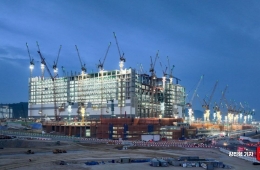
Gyeonggi Yongin Cheoin-gu SK hynix Semiconductor Cluster Phase 1 Fab Construction Site. Photo by Jinhyung Kang
View original imageIn the battery and display sectors, expanding tax incentives to alleviate investment burdens was a key recommendation. To enhance the utility of the investment tax credit, FKI proposed allowing direct refunds and third-party transfers, as well as extending the display industry’s carry-forward deduction period from the current 10 years to 20 years. The organization also requested retroactive application of related measures.
Further, FKI recommended expanding the exemption program for specialized research personnel to help secure research and development (R&D) talent in the battery industry, as well as establishing shared Energy Storage System (ESS) evaluation facilities for joint use by companies.
In the biotechnology sector, FKI called for revising regulations that increase corporate burdens during drug development and production. For example, they suggested loosening Good Manufacturing Practice (GMP) requirements for the initial trial production phase from three production units to one. Additionally, FKI recommended including innovative synthetic drugs and key active pharmaceutical ingredients as national strategic technologies and expanding related tax benefits.
The recommendations also proposed including vaccines and biopharmaceuticals among eligible items for domestic production tax credits and removing the requirement for domestic sales, with the intention of broadening support and encouraging more investment in strengthening domestic production bases.
For robotics, FKI called for greater access to data and computing resources to support the development of humanoids and physical artificial intelligence (AI) technology. The group recommended allowing the use of original video and audio data within safety demonstration zones and expanding access to government computing resources and national physical AI projects to large corporations.
Other suggestions included covering future mobility and air-source heat pumps in tax credit programs and supporting public procurement of home appliances equipped with domestic AI-based models.
FKI stated that the 20 tasks which do not require legal amendment will be prioritized through the revision of regulations, administrative notices, plans, and ordinances, while urging the National Assembly to discuss the 21 legislative measures. Among them, 9 tasks require amendments to the Restriction of Special Taxation Act, and FKI stressed urgent reform of the tax system to support investment and technology development in advanced industries.
Hot Picks Today
 "3821% Returns" "Better Than Stocks": 30s and 40s Flock to the Market, Secondhand Trading Surges
- "I’ll Take This, Please"... Buying the Last Lottery Ticket Brings a Jackpot
- [Exclusive] "Nvidia Researchers to Work in Yangjae"... LG Electronics to Establish 'Joint Robotics Development Base'
- "Often Ate Malatang and Chinese Food..." Shock Over the Reality of Chinese Bamboo Shoots Mass-Produced With Sulfur
- "Surprisingly Real, Perfect Like AI" -- Global Media Praise Korean Fencer's Beauty
Kwon Hyuk-min, FKI’s Head of Growth Strategy, emphasized, "Improving institutional barriers that hinder companies’ investment decisions and activities is crucial for strengthening the competitiveness of national high-tech strategic industries. The government and National Assembly must swiftly improve the most pressing issues experienced in the field so that the business investment environment can continue to be fostered."
© The Asia Business Daily. All rights reserved. Unauthorized AI training and use prohibited.