Over Half of Employees at Workplaces With Fewer Than Five Staff "Unable to Take Paid Leave Even During Major Holidays"
Workplace Gapjil 119 Surveyed 1,000 Employees Nationwide
"Paid Holiday Provisions Under the Labor Standards Act Must Be Expanded"
A recent survey found that more than half of employees working at businesses with fewer than five employees are unable to take paid leave on public holidays or during major holidays.
On September 20, civic group Workplace Gapjil 119 released the results of a survey conducted in cooperation with polling agency Global Research. The poll, carried out from June 1 to June 7, 2026, targeted 1,000 office workers aged 19 and older across the country. According to the findings, 28.8% of respondents said they cannot take paid leave on so-called "red days"—such as major holidays, public holidays, or substitute holidays.

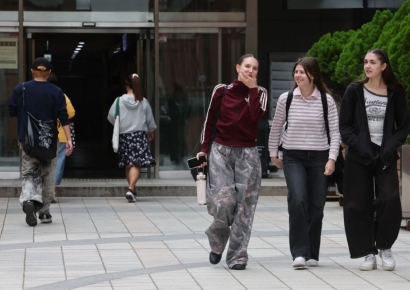
Office workers are commuting on their way to work at the Sejongno Intersection in Jongno-gu, Seoul.
View original imageThe disparity was particularly pronounced depending on the size of the workplace. Among employees at businesses with fewer than five workers, 55.6% stated that they could not take paid leave on red days, exceeding half. In contrast, the same response was given by only 16% of employees at companies with 300 or more workers—about one-third the rate for the smallest workplaces.
Workplace Gapjil 119 attributed the high proportion of employees at businesses with fewer than five staff who are denied paid leave to the fact that the Labor Standards Act’s paid public holiday regulations do not apply to workplaces of that size. Unless a separate contractual clause or company rule designates public holidays as paid leave, employees at businesses with fewer than five employees must work as usual, even on public holidays.
Significant gaps in paid holiday use were also observed depending on factors such as employment status and job type, aside from workplace size. Among non-regular (temporary or contract) employees, 49.8% stated they cannot take paid leave on red days—three times the proportion of regular employees (14.8%). Similarly, among non-office (blue-collar) workers, the figure was 43.8%, again over three times higher than among office workers (13.8%). The disparity was also evident in wage levels: 52.8% of workers earning less than 1.5 million won per month reported being unable to take paid leave, compared to 10.9% of those earning 5 million won or more. In addition, the proportion of respondents saying they could not take paid leave was relatively high among women, workers in their 20s and 50s, ordinary staff, low-wage workers, those with short job tenure, and non-unionized employees.
In a separate survey conducted by Workplace Gapjil 119 between March 23 and April 8 with 500 employees at businesses with fewer than five workers, only 55% answered that they were able to take paid leave on public holidays. Furthermore, 24.4% of these workers reported that, because the provision on paid public holidays from the Labor Standards Act does not apply to them, they have suffered disadvantages.
Hot Picks Today
 Seoul Tops London and Tokyo for the First Time... Foreign Media: "Seoul Is Becoming the New Paris"
Choi Ji-in, an attorney at Workplace Gapjil 119, commented, "The right of workers to rest is a fundamental right, yet current law leads to different guarantees of this right based on workplace size, fostering discrimination. The government must fully expand the application of the Labor Standards Act in order to close legal blind spots and ensure everyone can rest without worry during major holidays."
© The Asia Business Daily. All rights reserved. Unauthorized AI training and use prohibited.