"KOSPI Surpassed 9,000 but Could Drop Below 5,200 Next Year... Expert Explains the Reason"
KOSPI May Drop Below 5,200 in the First Half of Next Year
Concerns Over 10-Year U.S. Treasury Yields and AI Semiconductors
"Reduce Stock Exposure and Increase Cash Holdings"
There is a projection that the KOSPI, which climbed as high as 9,385 intraday this past June, could fall below the 5,200 level in the first half of next year. The analysis points to a rise in U.S. Treasury yields, higher international oil prices, and concerns over the artificial intelligence (AI) semiconductor market as potential burdens on the Korean stock market.
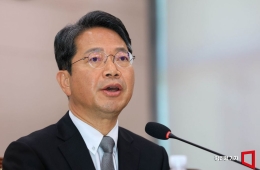
The KBS YouTube channel 'Money Olla' released an interview video with Kim Youngik, adjunct professor at Sogang University Graduate School of Economics, on the 15th.

Kim Youngik, adjunct professor at Sogang University Graduate School of Economics, projected that the KOSPI index could fall below the 5200 level in the first half of next year. Screenshot from KBS YouTube channel ‘Money Olla’
View original imageIn the video, Professor Kim analyzed recent global financial market trends and forecasted the direction of both the KOSPI and the won-dollar exchange rate. He assessed the intraday high of 9,385 reached by the KOSPI this June as the peak of the current upward cycle. He explained that the market has since entered a downward phase, and, considering a typical stock market cycle, this downturn could last for more than a year.
Specifically, Professor Kim noted that there is room for further decline, even after the KOSPI recently dipped as low as the 5,200 range intraday. Citing that the market has not yet reached the bottom of this downturn, he predicted, "It could fall even lower in the first half of next year."
Professor Kim cited the U.S. Treasury yield as one of the main factors. The recent movement of the U.S. 10-year Treasury yield surpassing 5% intraday, he explained, could weigh on risk assets such as stocks. International oil prices exceeding 106 dollars per barrel were also mentioned as a factor increasing uncertainty over inflation and interest rate trajectories. In addition, the so-called "AI semiconductor deceleration theory," the idea that the growth rate of the AI semiconductor industry may slow down, was identified as another risk facing the stock market.

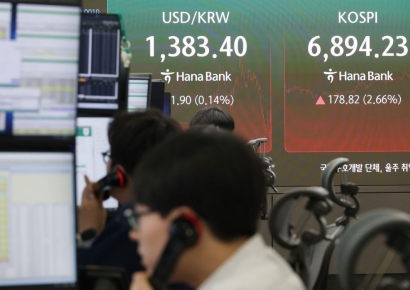
On the 18th, the dealing room electronic board at the main branch of Hana Bank in Jung-gu displayed the won/dollar exchange rate and KOSPI closing price. Photo by Yonhap News Agency
View original imageProfessor Kim also mentioned the possibility that the investment fever surrounding AI could lead to a stock market bubble. Referring to the late 1990s when expectations for technology stocks on the NASDAQ surged and then the market crashed in the 2000s, he suggested that current expectations for AI may be similarly over-reflected in the stock market. He projected that this AI-related bubble could begin to deflate as early as the fourth quarter of this year.
Accordingly, Professor Kim argued that investors should rethink their asset allocation. Based on the flow of leading economic indicators, he stated that now is not the time to increase equity exposure, but rather to reduce it and increase cash-like holdings. "I believe the cyclical component of Statistics Korea’s Composite Leading Indicator peaked in August and has now begun to decline," he explained.
Hot Picks Today
 "KOSPI Surpassed 9,000 but Could Drop Below 5,200 Next Year... Expert Explains the Reason"
- "Will the Semiconductor Industry Be in Trouble?" Stock Prices Have Fallen, but Investments May Increase [Weekend Money]
- "Fighter Jet Lost in Blizzard During Korean War Discovered Off Yangyang After 74 Years"
- In the Same Neighborhood, One Apartment Costs 2 Billion Won, Another 450 Million... What's Happening in Gangnam?
- "Trusting the Elder Who Said 'I Already Paid': 'Fake Guests' Target Wedding Halls for Return Gifts"
On the other hand, Professor Kim presented the possibility of a stronger won in relation to the won-dollar exchange rate. He predicted, "While the exchange rate could rebound in the short term, a medium-term trend toward the 1,200 won range has begun." He cited possible factors such as a decline in the dollar index, China’s potential policy for a stronger yuan, the undervaluation of the yen, the Korea-U.S. real interest rate differential, and Korea’s current account surplus.
© The Asia Business Daily. All rights reserved. Unauthorized AI training and use prohibited.