Lee Focuses on Message: "Housing Prices Will Be Stabilized," "Acknowledges ETF Shortcomings," "Strengthening Social Policy"
Most Time Spent on Real Estate: "We Will Escape the Speculative Republic"
Reaffirming the Will to Mobilize Supply, Regulation, and Taxation Measures
"Permits and Construction Starts Halved Since 2022"... Direct Reference to Oh Sehoon
On September 18, President Lee Jae-myung devoted significant time to directly explaining the direction and rationale of the administration's ongoing economic policies to the public, rather than announcing entirely new economic measures. Regarding the real estate market, he reaffirmed his commitment to stabilizing housing prices, emphasizing plans to expand supply and suppress speculative demand. He also acknowledged shortcomings in the policy design of the single-stock leveraged exchange-traded funds (ETFs) that have been a source of controversy. President Lee hinted that he is considering shifting the policy focus, which has so far centered on economic recovery and growth, partially toward people’s livelihoods and social policy.

President Lee Jae-myung is receiving questions from reporters during a press conference held at the Blue House Reception Hall on the 18th. September 18, 2026. Photo by Yonhap News Agency
View original imageDuring the policy and economic segment of the nationally televised press conference at the Blue House Reception Hall, President Lee identified the concentration of resources in the Seoul metropolitan area as the fundamental driver of rising home prices. He spent the most time on this issue, diagnosing that it is difficult to fundamentally resolve housing price problems unless the current structure—where jobs, education, and infrastructure are concentrated in Seoul, Gyeonggi, and Incheon, attracting both population and housing demand—is addressed.
He also pointed to the long-standing belief in the "invincibility" of the real estate market, as well as past lending and tax policies, as factors driving price increases. In a situation where housing has become a major asset class beyond simply being a place to live, government policies encouraging demand through expanded lending and tax cuts have further exacerbated the concentration of investment in real estate.
While explaining the responsibility for the short-term decline in housing supply, President Lee explicitly mentioned former President Yoon Suk-yeol and Seoul Mayor Oh Se-hoon. He stated, "After the Yoon Suk-yeol administration took office in 2022—the same year Mayor Oh Se-hoon was elected—the number of permits and groundbreakings was halved. Between 2022 and 2025, the numbers have essentially declined by 50 percent, leading to a sharp contraction in supply." President Lee added, "There are various reasons cited, and I even heard some blame the late Mayor Park Won-soon."
Furthermore, President Lee diagnosed that the relaxation of land transaction regulatory requirements in certain areas led to rapid price spikes in those regions, while increased market liquidity further intensified upward pressure. He cited the phenomenon where high-end homes in the Gangnam area lead the market, followed by price increases in other areas, as a key factor worsening the trend toward concentration in select properties, sometimes referred to as "the smart one-house phenomenon."
President Lee stressed, "Breaking out of the era of real estate speculation is this administration’s core task. Others have tried and failed, but I can state firmly that this administration will succeed." He pledged to significantly accelerate land development, permitting, and urban renewal projects such as reconstruction and redevelopment.
The president also emphasized that the government routinely manages housing supply conditions. He explained that the Prime Minister’s office checks supply status daily, and he personally reviews progress on designated regions and projects on a weekly basis. While promising to expand financing in sectors that boost housing supply, he also stated that the administration would continue "targeted policies"—maintaining controls on mortgage lending that stimulates speculative demand.
President Lee’s approach to real estate policy is also noteworthy for its linkage with balanced regional development. He aims to decentralize demand concentrated in the metropolitan area by expediting the relocation of public institutions and central government agencies to non-metropolitan regions such as Sejong. In his opening remarks, he stated, "We will usher in an era where Seoul is the economic capital and Sejong is the administrative capital," pledging prompt execution of policies related to supply, regulation, and taxation.
Regarding the recent housing price trends, President Lee commented that while prices are falling in the Gangnam area and rising in peripheral regions, the gap between regions is narrowing in what he described as "a kind of leveling process." He expects that if the government mobilizes all available policy tools—supply, regulation, and taxation—the real estate market will gradually stabilize.
On the issue of the controversial single-stock leveraged ETFs, President Lee acknowledged deficiencies in policy design. He explained that at the time, he was briefed that tying domestic investor capital to Korea’s market with these products could help local financial markets and stabilize the foreign exchange market, describing the intention as "principally sound."
However, he admitted, "Once the products launched, as the stock market entered a decline, losses for investors were amplified. I believe there was an element of incompleteness in the government’s policy." He further acknowledged that criticism was justified for failing to include investor protections from the outset, which were only implemented later.

President Lee Jae-myung is greeting after concluding a press conference at the Blue House Reception Hall on September 18, 2026. Photo by Yonhap News
View original imageRegarding the appointment of the new policy chief at the Blue House, President Lee stated that the selection will be made in line with an increased focus on social policy. He remarked, "Up to now, we have focused on economic recovery, sustainable growth, and securing growth engines. However, there are views that we should begin to shift policy attention—albeit slightly—toward strengthening social policies, an area many believe to be lacking." This suggests that the delay in appointing a successor to former policy chief Kim Yong-bum is linked to deeper deliberations about future policy direction, rather than merely personnel selection.
On negotiations concerning investments in the United States, President Lee said that the 'national interest' is the ultimate bottom line. Regarding the negotiations, worth 350 billion dollars, he explained that much of the groundwork has been laid, but that "there are details that make agreement difficult, so we are revisiting them." He insisted on maintaining "commercial rationality" in areas such as investment recovery, profit distribution, and the handling of projects incurring losses.
Hot Picks Today
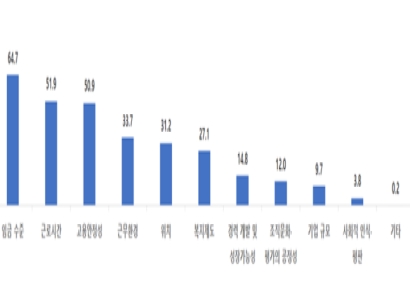 "Please Pay Me at Least 3 Million Won a Month": More Than Half of Young People Today Prioritize "Working Conditions" Over Company Size
- Selling Like Crazy Every Year... 30-Year-Old Hetbahn Takes on a New Challenge: Tastes Better Than "Mom's Home Cooking" [On-Site Report]
- Ran 18 km With 9-Year-Old Tied to Him at the Waist... "Man Banned From Competing for 3 Years"
- "Hey, Lady, Teach Your Kids to Behave!" ... 300,000 Won in Cash and a Bodily Injury Claim Demanded Over Child's Door Ding
- Beachgoer Finds 'Plastic' That Turns Out to Be Perfume Ingredient Worth More Than Twice as Much as Gold
President Lee also applied the same principle to American requests for additional investment from Korean semiconductor companies. He emphasized that additional investment by Samsung Electronics and SK hynix in the U.S. must be weighed against management decisions and domestic industrial strategy, stressing, "We will ensure that the national interest of the Republic of Korea is protected and that a rational outcome is achieved."
© The Asia Business Daily. All rights reserved. Unauthorized AI training and use prohibited.





![[Market ING] KOSPI Seeks Rebound in Superweek Packed with Corporate Earnings and FOMC](https://cwcontent.asiae.co.kr/asiaresize/307/2026102514484873155_1792907327.jpg)