Last-Minute Difficulties in U.S. Investment MOU... President Lee Says "Some Conditions Are Hard to Accept"
"I did not want to make the $350 billion investment... A very difficult and challenging process"
"Commercial reasonableness must be included... The national interest must not be compromised"
Both Korea and the U.S. stress the need for mutual

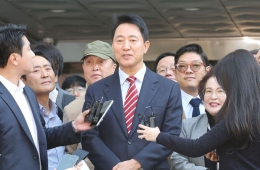
President Lee Jae-myung is answering reporters' questions at a press conference held at the Blue House's Reception Hall on September 18, 2026. Photo by Yonhap News
View original imagePresident Lee Jaemyung revealed that, while substantial agreement has been reached in negotiations for a $350 billion investment in the United States, South Korea is re-negotiating with the United States due to certain conditions that are difficult to accept. He again underscored the importance of "commercial rationality," specifically naming issues such as investment recovery, profit distribution, and loss management as core points of contention.
At a press conference held on the 18th at the Blue House's Yeongbingwan, President Lee described the issue of investing in the United States as "a very complex and difficult task." He noted, "We’re reportedly close to an agreement, but looking at the details, there are some aspects that are not easy to accept. Discussions (with the U.S. side) are still ongoing," he said.
President Lee also explained the process leading up to the decision to invest $350 billion in the United States. He stated, "This is 350 billion dollars of taxpayers’ money—about 500 trillion won; I really didn’t want to proceed," but he added, "After considering tariffs and U.S. relations, and reviewing the agreements of Japan, Taiwan, and Singapore, we too reached a deal. It took a very long time, and although it’s hard to say, the process was extremely difficult and exhausting."
President Lee placed special emphasis on having "commercial rationality" explicitly included in the final agreement during the negotiations. He stated that the U.S. side was initially hesitant to include this term, which led to prolonged deadlock even on the eve of their second Korea-U.S. summit. Ultimately, South Korea's demands were reflected in the agreement.
President Lee explained, "For me, it was non-negotiable that 'commercial rationality' be incorporated into the agreement. The night before the second summit, right up until the next morning, we could not reach a compromise because the U.S. declined to add it." He added, "In the end, we included the phrase 'commercial rationality,' just as South Korea requested. Other countries were not able to get this included."
With the process moving into the stage of selecting actual investment projects, the government and the Blue House are now faced with the challenge of implementing commercial rationality in practice. President Lee said, "Specific investment consultations have started, and new issues have emerged," highlighting concrete questions such as how the investment will be recovered, how profits will be distributed, and how to handle projects that incur losses.

Minister of Trade, Industry and Energy Kim Jungkwan arrived at Newark Airport near New York, USA, on the 10th (local time) and answered reporters' questions. 2026.9.11 Yonhap News Agency
View original imageThe Special Act on Investment in the United States requires a review of the commercial rationality of investment projects. Accordingly, not only the overall $350 billion investment total but also each individual project must be scrutinized for the possibility of investment recovery, profitability, and the structure of profit and loss distribution. President Lee also emphasized, "South Korea's law stipulates that we may only invest in projects with commercial rationality."
Currently, South Korea and the United States are in last-minute negotiations regarding the specific investment conditions, including the first project. In particular, in the nuclear sector, stakes in U.S. nuclear power company Westinghouse (WEC) and the scope of Korean company participation in the construction of new nuclear plants in the U.S. have become central issues. It is reported that South Korea is demanding a certain degree of voting rights and management participation in the process of acquiring a stake in WEC, while also calling for at least two new reactors built in the U.S. to use the Korean-designed APR1400. Meanwhile, the U.S. side is focused on constructing nuclear plants centered on WEC's AP1000, and both sides are fine-tuning the details. The Alaska liquefied natural gas (LNG) project is also being closely scrutinized for its massive investment requirements and the long-term structure of investment recovery, making its ability to meet the test of commercial rationality a key variable.
The timeline for the government announcement of its first project under the U.S. investment program has also been pushed back. The Ministry of Trade, Industry and Energy was originally scheduled to submit a confidential briefing on the first investment project and its specifics to the National Assembly’s Industry, Trade, Resources, SMEs and Startups Committee and the Planning and Finance Committee on the 17th but postponed the meeting due to additional negotiations with the United States. The ministry explained, "We are closely coordinating with the U.S., but identifying common ground is taking time." As the National Assembly briefing was delayed, the signing of the Korea-U.S. memorandum of understanding (MOU) on investment and the first project announcement, both of which were expected around the 18th, have also been pushed back.
President Lee also spoke directly about the burden of negotiations. He said the working-level negotiation team was facing difficulty, and added, "I spend so much time agonizing over this that I can hardly sleep at night." Given the sheer scale of the $350 billion investment and the government's need to consider the risk of losses and requirements for the recovery of funds with each individual project, it is interpreted that he is not rushing to a final agreement.
Hot Picks Today
 "The Transfer Failed, but 'Ding-Dong,' Money Came In"... KRW 32.5 Billion Financial Incident at Toss Bank
- "It's in Season in Autumn, but We May Not Even See It": Plunging Catches Deal a Major Blow
- Female YouTuber Who Disappeared During India Trip Makes Urgent "Proof of Life" Announcement: "I'm Not Being Threatened, Kidnapped or Held Captive"
- HD Hyundai Heavy Industries Labor and Management Reach Second Tentative Agreement; Lump-Sum Payment Increased by 500,000 Won
- Shark 'Bukkangi' Missing... Oil Spill off Busan North Port Raises Concerns
President Lee emphasized, "The national interest is truly crucial," adding, "We must not let ourselves be swayed by spontaneous relationships, pressure, or coercion." He then gave a slight smile, saying, "Not that America is doing so," clarifying his statement.
© The Asia Business Daily. All rights reserved. Unauthorized AI training and use prohibited.