Livelihood Coupons and Extra Budgets Drive Record-High Public Sector Deficit Last Year
Six Consecutive Years of Deficits...
Longest Streak Since the Financial Crisis
Expanded Outlays for Consumption Coupons and Health Insurance
"Semiconductor-Driven Tax Revenue Boost Could Lead to Surplus Next Year"
Last year, South Korea’s public sector—including the government and public corporations—posted a record-high deficit of 83 trillion won. Despite a rise in tax revenues, expanded expenditures for measures such as livelihood recovery coupons and health insurance payments led to the longest streak of deficits since the financial crisis.

According to the “2025 Public Sector Accounts (provisional)” announced by the Bank of Korea on September 18, the public sector balance (total revenue minus total expenditure) recorded a deficit of 83.1 trillion won last year. This marks a significant increase from the previous year’s deficit of 69.1 trillion won and is the largest deficit since statistics began in 2007.
The public sector balance has remained in deficit for six consecutive years since 2020. The previous longest period of continuous deficits was also six years, during the global financial crisis from 2008 to 2013.
Last year, the public sector’s total revenue stood at 1,192.1 trillion won, an increase of 53 trillion won (4.7%) from the previous year’s 1,139.1 trillion won. Specifically, tax revenues—including corporate and income taxes—increased by 45.2 trillion won compared to the previous year, and social insurance contributions such as national pension and health insurance premiums rose by 11.1 trillion won. Sales revenues—encompassing production and import taxes, current taxes, and capital taxes—increased by 1.9 trillion won, but property income receipts fell by 5.4 trillion won. Property income receipts refer to interest or dividend earnings received by the public sector as returns on real or financial assets lent out.
Total public sector expenditures were 1,275.2 trillion won, an increase of 67 trillion won compared to the previous year’s 1,208.1 trillion won. The main contributing factors were growth in final consumption expenditure (21.7 trillion won), increased social benefits (including basic and national pension payouts, 15.2 trillion won), and other current transfers (24.2 trillion won).
Lee Hyun-young, Team Lead of Expenditure National Income Statistics Team 2 at the Bank of Korea, explained, “While the main factor driving deficits in 2023 to 2024 was the drop in corporate tax revenues linked to poor corporate performance, last year’s major cause was the increase in transfers to the private sector (other current transfers).” She added, “With the allocation of two rounds of supplementary budgets for public livelihood stabilization—including 13.5 trillion won in livelihood recovery coupons—transfers to the private sector surged.” She also pointed out that a proactive fiscal execution stance under the new administration, preparations for the Asia-Pacific Economic Cooperation (APEC) summit, and rising health insurance benefit payouts contributed to the increase in government consumption.
By sector, the general government (central and local governments plus social security funds) posted total revenue of 903.2 trillion won last year, up 54.6 trillion won (6.4%) from the previous year, while total spending increased by 57.3 trillion won to 963.3 trillion won over the same period. The general government balance—total revenue minus total expenditure—recorded a deficit of 60.1 trillion won, the largest deficit since records began.
More specifically, the central government saw an increase in overall revenues, mainly due to current tax gains compared to the previous year, but as total spending rose even further, the deficit expanded to 90.1 trillion won. In contrast, local governments’ deficit narrowed to 2 trillion won, as their revenues—buoyed by a significant increase in grants pegged to national tax gains—rose more than expenditures. For the social security funds, total spending on social benefits and other items increased more than revenues, reducing the surplus from 41.8 trillion won to 32 trillion won.
Non-financial public corporations such as Korea Electric Power Corporation and Korea Land and Housing Corporation (LH) recorded a deficit of 22.1 trillion won, up from 16.7 trillion won the previous year. Although sales increased by 1.2 trillion won (0.5%) year-on-year to 231.9 trillion won—driven by higher electricity rates and normalization of treatment at public hospitals—total spending surged by 6.7 trillion won (2.7%) to 254.1 trillion won due to higher investments in public housing construction and expansion of rental housing stock.
Financial public corporations, including Korea Development Bank and Korea Housing Finance Corporation, recorded a deficit of 900 billion won, swinging from a surplus of 5.1 trillion won in 2024. The drop in property income due to falling interest rates reduced total revenues to 66.3 trillion won, which was 3.3 trillion won lower than the previous year. Meanwhile, a sharp increase in current transfer expenditures pushed total spending up by 2.7 trillion won to 67.1 trillion won.
The ratio of public sector balance to nominal GDP was -3.1%. This is higher than the United Kingdom’s -5.7% (among OECD countries with 2025 data released), but lower than Switzerland’s 0.5%.
The ratio of general government balance to nominal GDP stood at -2.2%, which is better than the OECD member average of -4.4%.
Hot Picks Today
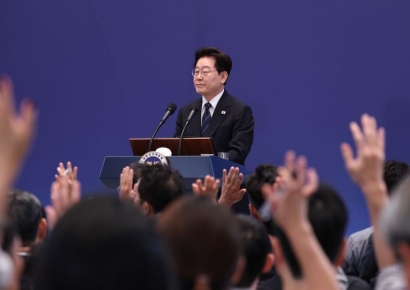 President Lee on Leveraged ETF Criticism: "No One Can Predict Investment Profits"
- When Asked "Should Jeonse Disappear?"... President Lee Says, "I Said It Will Eventually Disappear"
- Personal Information of Students and Parents Leaked in Hacker Breach at Saenggakhan Hwangso Math Academy in Daechi-dong
- "If You Become a Teacher, You Don't Have to Repay Student Loans"... Japan Pulls Out 'Repayment Exemption' After 30 Years
- "Culture Shock After Experiencing Motels": North Korean Defector Women Reveal the Reality of Sexual Culture in the North
Lee further projected, “From this year, thanks to a semiconductor boom, corporate and income tax revenues will increase sharply. As a result, the deficit—especially for the general government—is expected to narrow this year and could return to surplus next year.” She added, “The hike in national pension and health insurance premium rates from this year is also likely to slow the decline in the social security fund’s surplus, contributing further to fiscal improvement.”
© The Asia Business Daily. All rights reserved. Unauthorized AI training and use prohibited.