Koo Yoonchul Leaves After 1 Year and 2 Months: "Regret Not Nurturing a Top Innovative Item... Will Work in the Field in the Private Sector"
One Year and Two Months Reflected Since July 21 Inauguration Last Year
Delivers a Final Farewell Message to Younger Colleagues
"I still vividly remember boarding a plane right after my appointment to fend off the Trump Administration’s tariff bomb. For the South Korean economy to survive, world-leading products and services are indispensable. What I most regret is leaving without having fully nurtured future ultra-innovative economic items amid fierce external headwinds."

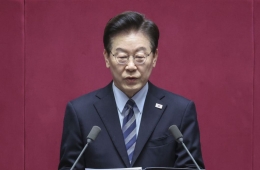
Deputy Prime Minister and Minister of Finance and Economy is giving a lecture with the keywords "AI, Innovation, Field" at the "Last Town Hall Meeting" combined with the farewell ceremony held on the 18th at the Government Complex Sejong in Sejong City. Photo by Yonhap News.
View original imageOn September 18, at the main auditorium of the Government Complex Sejong’s Central Building, Deputy Prime Minister and Minister of Finance and Economy Koo Yoonchul marked the end of his public service career by sharing reflections from his approximately one year and two months in office during his farewell ceremony. Having been nominated on June 30 last year and inaugurated on July 21, Deputy Prime Minister Koo was immediately thrust into the frontline of global trade conflicts upon taking office, including making a quick trip to the United States to surpass the tariff deadline following failed negotiations with U.S. Treasury Secretary Scott Bessent. His early days in office were filled with a relentless schedule.
Looking back, Deputy Prime Minister Koo said, "When I looked at my predecessors, I felt that in the end, there was nothing clearly left behind once their term was over. That’s why this time, I harbored a strong desire to properly foster ultra-innovative economic items that could transform the future of South Korea." He continued, "Had there been no trade disputes with the U.S. or major external conflicts, I would have gone out to the sites once or twice a week to address companies’ difficulties and support research and development (R&D) budgets through systemic improvements. However, since the outbreak of the Middle East war in February, I was unable to visit the field, which I deeply regret."
He also offered candid advice regarding the structural limitations of the Korean economy and its future strategy. Deputy Prime Minister Koo pointed out, "Currently, our society is focused on increasing the number of purported innovative technologies—sometimes twenty or thirty at a time—instead of properly cultivating a single, strong one. Without a genuine world-class item, having more numbers is an overall national loss." He added, "I tried to concentrate on nurturing core growth engines such as power semiconductors, but could not accelerate due to external variables. While macro-management such as controlling inflation, exchange rates, and growth rates is important, over time, that alone cannot be enough. Only by discovering and strongly supporting next-generation products to succeed memory semiconductors in each sector can we resolve economic polarization in Korea and ensure our survival."
Deputy Prime Minister Koo also revealed specific plans for his path after leaving public office. He emphasized, "I now intend to take on roles I couldn’t fulfill while in public service by moving into the private sector. I plan to visit companies and, rather than just spending a day, stay overnight for one or two days to hold intense discussions, contribute ideas, and identify bottlenecks, working together in the field to chart a path toward a world-class economy."
He also frankly shared feelings regarding internal innovation and organizational culture improvements pursued during his tenure. Deputy Prime Minister Koo said, "I boldly eliminated unnecessary miscellaneous work, hoping that employees would be able to complete tasks that once took a full day in just 10 minutes using artificial intelligence (AI), and then spend their time on leisure, recharging, reading, and studying. Although there were complaints early on about having to take AI education when ‘everyone’s already busy enough,’ I remain convinced that only by dramatically improving productivity can individuals grow and expand their capacity."
Speaking on personnel matters, Koo emphasized the importance of paving the way for younger staff members. He stated, "With the current structure making it impossible to increase civil servants’ salaries, personnel management is the most important incentive. Thanks to the exemplary voluntary retirements of 30th class National Administration Examination department heads, a foothold was created for younger employees to advance." He continuously encouraged staff to manage their health and personal growth, advising, "The present moment is the fastest. When you look back a year from now and ask yourself what you have achieved, set goals in areas such as family, health, or writing and find fulfillment in fully accomplishing at least one of them."
At the end of his farewell speech, Deputy Prime Minister Koo asked for unwavering support for his successor. He said, "Take pride in the fact that if the Ministry of Finance collapses, so does the Korean economy. All staff must unite and support the newly appointed candidate, Lee Hyungil. The deputy prime minister’s post is a lonely and weighty one that cannot stand alone without support from the staff." He concluded, "It was truly a joy to work with all of you, and I leave with a happy heart. Let’s meet again in an even better place," thus putting an end to his one year and two months as the nation’s economic leader.
Hot Picks Today
 "Two Spend 500,000 Won in a Flash, Yet Wait Two Hours?" ... 'Dreamland' Shunned by Kids and Foreign Tourists
- The Era of Getting 200 Million Won After 30 Years Is Over... A Japanese Bank's "Perpetual Department Head" Who Just Clocked In Cries Out
- Spain Hit by Its Worst Tragedy... Lee Kangin, Moreno and Real Madrid Join Soccer World in Mourning
- They Said, “Make It Your Home for Life” - Then Suddenly Kicked 200 Passengers Off... What Happened to the Around-the-World Cruise?
- "130 Rice Bowls Sold Out in a Day"... 'Unfiltered Face' Adds 8 Million Won to Night Market Sales: China's Bungeunwoo
Born in Seongju, North Gyeongsang Province, Deputy Prime Minister Koo is a graduate of Yeongsin High School in Daegu and the Department of Economics at Seoul National University. He earned a master’s degree in public policy from the University of Wisconsin in the U.S., and a doctorate in trade and logistics from Chung-Ang University. Entering public service in 1988 through the 32nd National Administration Examination (Finance track), he held a variety of key positions in planning and budgeting, such as Policy Coordination Director at the Ministry of Strategy and Finance, Social Budget Deliberator, Chief Budget Deliberator, and Director of the Budget Office. He served as the Ministry’s 2nd Vice Minister in 2018, Head of the Office for Government Policy Coordination in 2020 (a ministerial-level post), left public office in 2022, and was appointed as Deputy Prime Minister and Minister of Economy and Finance in July 2025. He concluded his over 30-year bureaucratic career as the first Deputy Prime Minister and Minister of Finance and Economy after the government restructuring that created the post.
© The Asia Business Daily. All rights reserved. Unauthorized AI training and use prohibited.