Naver Cloud: "Accelerating Defense AI Through Collaboration... Building a Civil-Military Convergence Ecosystem Is Essential"
"Defense AI Strategy Seminar" Held
Sovereign AI Strategy Unveiled for Defense Transformation (AX)

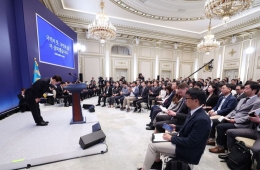
Naver Cloud held the "Defense AI Day" seminar on the 18th at the Shilla Hotel in Seoul, targeting 550 attendees including officials from the Ministry of National Defense, the Joint Chiefs of Staff, and the respective military services. Kim Yuwon, the CEO, delivered the welcoming speech. Photo by Naver Cloud.
View original imageNaver has unveiled its sovereign AI strategy for the transition to defense artificial intelligence (AI) and announced its commitment to accelerating defense AI through public-private cooperation.
On September 18, Naver Cloud held the "Defense AI Strategy Seminar (Defense AI Day)" at the Shilla Hotel in Seoul, with 550 participants including officials from the Ministry of National Defense, the Joint Chiefs of Staff, and each branch of the military. During the event, the company introduced its defense sovereign AI strategy, which is designed to support the military in quickly transitioning civilian technology into defense capabilities while allowing the military to retain direct control over data and models.
Kim Yuwon, CEO of Naver Cloud, stated, "The true adoption of defense AI does not end with technology deployment. It is essential to define the problems the military needs solved, verify these solutions in the field, and then embody them as real capabilities." He added, "The role of companies is not to take center stage, but to provide the fastest and most precise technology support where the military needs it most. Naver Cloud aims to become a key partner, connecting and backing up the abilities of the military, defense companies, startups, and research institutes to resolve actual defense challenges."
Naver Cloud emphasized that it intends to go beyond being a simple AI supplier to become a long-term partner in co-designing and verifying the transformation of defense AI in South Korea. Leveraging its full-stack capabilities spanning AI models, services, and infrastructure, as well as proven security technologies, Naver Cloud aims to take responsibility from infrastructure provision to real-world mission application.
CEO Kim continued, "Naver is not only providing services within Korea, but also aggressively expanding on a global scale. I hope that our AI software technologies can likewise gain momentum in the defense sector and go on to spread worldwide."

Naver Cloud held the "Defense AI Day" seminar on the 18th at the Shilla Hotel in Seoul, targeting 550 attendees including officials from the Ministry of National Defense, the Joint Chiefs of Staff, and various military branches. The photo shows Seonho Kim, former Deputy Minister of National Defense, giving a lecture. Photo by Sojeong Seo.
View original imageSeonho Kim, former Deputy Minister of National Defense, said, "The success or failure of defense transformation depends on how rapidly the military can convert civilian innovation into operational capabilities. It is essential that the private sector leads technological innovation while the military swiftly integrates these solutions into a 'civil-military convergence ecosystem.' Above all, it is vital to organically fuse AI with military operational concepts and weapon systems to achieve actual capability and widespread adoption."
Yoo Kyungbeom, Executive Director and Head of Defense Business at Naver Cloud, proposed that accelerating defense sovereign AI requires an ecosystem that assembles, connects, validates, and evolves civilian technologies. Naver Cloud plans to aggregate specialized expertise in infrastructure, AI models, and applications from each civilian sector, and securely link AI models with military data within a closed network, thereby supporting the military in retaining control over both data and models. The strategy involves gradually demonstrating outcomes first in mission areas where impact is measurable, and then continuously enhancing performance through operation with field deployment engineers (FDEs).

Naver Cloud held the 'Defense AI Strategy Seminar (Defense AI Day)' on the 18th at the Shilla Hotel in Seoul, targeting 550 participants including officials from the Ministry of National Defense, the Joint Chiefs of Staff, and each branch of the military. Provided by Naver Cloud.
View original imageSeong Nakho, Head of Hyperscale AI Technology at Naver Cloud and leader of model development, emphasized the need for a "shared semantic framework" to ensure that autonomous weapon systems can interpret the same situation coherently, even when using different sensors and platforms. As key technologies to achieve this, Seong highlighted spatial intelligence—structuring drone video and sensor information into 3D spaces—and world models, which simulate and predict outcomes based on battlefield variables such as terrain, weather, and radar in virtual environments. The plan is to connect the entire process, from situational awareness to decision-making, action, and learning, so that the military can directly control and implement the intelligence it needs, without dependence on any specific model.
Hot Picks Today
!["Is the YouTuber Telling the Truth?" 300,000 Views in One Day... The Real Story Behind Shin Ramyun's Flavor, According to Nongshim [Tastelovers X-File]](https://cwcontent.asiae.co.kr/asiaresize/93/2025032015504476691_1742453444.jpg) "Is the YouTuber Telling the Truth?" 300,000 Views in One Day... The Real Story Behind Shin Ramyun's Flavor, According to Nongshim [Tastelovers X-File]
"Is the YouTuber Telling the Truth?" 300,000 Views in One Day... The Real Story Behind Shin Ramyun's Flavor, According to Nongshim [Tastelovers X-File]
- "Where Is My Suitcase?" 26 Checked Bags Missing at Incheon Airport in 10 Days... Why?
- Sahmyook University Ranks First in Scholarship Amount per Student in Seoul Area
- "Without Jobs or Money, Lounging in Bed All Day"... Chinese Youths Label Themselves as 'Wall-Hanging'
- With Two Extra Days Added to Chuseok Holiday: "Pack Up, Let's Go Anywhere"... Domestic Travel Demand Surges
A Naver Cloud representative stated, "We are not merely supplying one-off technologies; by utilizing FDEs, we will continuously reflect field requirements in real time and further advance system performance. Based on this approach, we will serve as a core technology partner in helping the military to directly control data and models, enabling the completion of an autonomous and evolving operational capability."
© The Asia Business Daily. All rights reserved. Unauthorized AI training and use prohibited.





!["Rates Are Rising, but Stocks Are Better?"... AI Reshapes Existing Investment Formula [Weekend Money]](https://cwcontent.asiae.co.kr/asiaresize/307/2026091800551633374_1789660516.png)