Kim Yo-jong Criticizes U.S.-Led Multinational Drills: "Offensive Response Beyond Proportionality Needed"
Second Statement Following IAEA’s Denuclearization Demand
"No Change in Course of Strengthening Nuclear Deterrence"
Kim Yo-jong, Director of the General Affairs Department of the Workers' Party of North Korea, has condemned the United States-led multinational joint drill and warned that North Korea "will carry out countermeasures that exceed proportionality in a preemptive manner." This statement, which follows a previous commentary on the International Atomic Energy Agency (IAEA)'s call for denuclearization, reiterated that "there will be no change in the course of strengthening nuclear war deterrence."

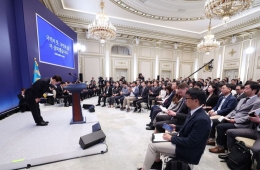
Kim Yo-jong, Director of the General Affairs Department of the Workers' Party of North Korea. Photo by Yonhap News
View original imageAccording to the Korean Central News Agency on September 18, Kim made a statement the previous day criticizing the multinational combined maritime exercise "Pacific Vanguard 2026," held in waters near Guam, describing it as "yet another provocative war game devised by the United States to promote bloc confrontation in the region."
Pacific Vanguard, which began on August 30 in Guam, is a multinational naval exercise led by the U.S. Seventh Fleet and joined by the Republic of Korea Navy, the Royal Australian Navy, and the Japan Maritime Self-Defense Force, among others.
Kim went on to criticize other U.S.-led military exercises in the Asia-Pacific region, such as Cobra Gold, Pitch Black, RIMPAC, and Super Garuda Shield, saying they "pursue impure objectives." In particular, she pointed to the participation of South Korea and Japan, claiming that U.S. military activities "are being strengthened on the basis of a trilateral military cooperation system between the United States, Japan, and South Korea." She added, "The current situation, in which new records of hostility against North Korea are being set, necessitates that we, too, establish new records by responding with actions characterized by proportionality or even greater offensiveness."
Kim further asserted, "There will not be even the slightest change of course on the path to advancing nuclear war deterrent power." She emphasized, "If the Democratic People's Republic of Korea determines that the supreme interests of the nation, military sovereignty, or the region's security environment are gravely infringed by hostile military maneuvers, the DPRK armed forces will invoke the relevant constitutional clauses and mobilize all available means in accordance with constitutional obligations."
Earlier, in her statement on the IAEA, Kim dismissed denuclearization demands, asserting that North Korea's status as a nuclear-armed state is "an irreversible fact both physically and legally." The North Korean Ministry of National Defense also warned on September 17 of the possibility of invoking nuclear weapons policy laws, targeting the U.S.-South Korea Countering Weapons of Mass Destruction Committee (CWMDC).
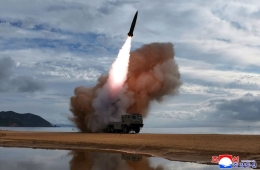
Recent consecutive messages from North Korea are interpreted as indirect responses to U.S. efforts to initiate dialogue with Pyongyang, while simultaneously setting conditions and agenda items for potential future negotiations, thereby pressuring the United States to shift its policy. Moreover, by mentioning "offensive responses that exceed proportionality," North Korea appears to be signaling the possibility of high-intensity military actions, such as missile launches, using future U.S.-ROK-Japan or multinational exercises as justification.
Yang Moo-jin, a distinguished professor at the University of North Korean Studies, commented, "They are directly targeting multinational exercises conducted not only on the Korean Peninsula but also in the waters around the United States, Japan, and Guam." He added, "We can expect test launches of medium- to long-range strategic missiles targeting Guam, overseas U.S. military bases, and even the U.S. mainland." He further analyzed, "Although they did not refer directly to President Trump, by leaving the door open for a summit, they send an indirect message calling for a halt to the joint exercises."
Im Eul-chul, professor at the Institute for Far Eastern Studies at Kyungnam University, noted, "It is unusual to wholly target all multinational exercises in the Asia-Pacific region for criticism," and interpreted this as "an effort to preemptively establish justification for future military responses to U.S. threats, presenting them as proportionate and offensive countermeasures."
Hot Picks Today
 Massive Insider Buying of KRW 1.2 Billion in Treasury Shares With Bonuses... Amorepacific Leaders Back 'KRW 15 Trillion Sales Vision'
- "President's Salary and Home Address Exposed"... Country in Turmoil Over Alleged Leak of 400 Million Personal Records on the Dark Web
- "I Can't Believe There Are Such Kids These Days"... Middle School Students Help Elderly Man Collecting Scrap Paper All the Way to Junk Dealer
- "Contributing 9 Million Won Annually…430,000 Won per Month Steadily from Age 65" …The Power of the “Three-Tier Pension”
- "They Might Start Pitching Tents and Grilling Meat"... The 'Hammock Villain' Appears at Cheonggyecheon
Meanwhile, as with the previous day's statement, this commentary was not reported in domestic media outlets such as the Rodong Sinmun.
© The Asia Business Daily. All rights reserved. Unauthorized AI training and use prohibited.