Can Semiconductor Stocks Weather the High-Interest Rate Wave [Weekend Money]
Big Tech Can’t Give Up on AI Investment Despite High Interest Rates
KB Securities Recommends Samsung Electronics and SK hynix as Top Picks

The U.S. Federal Reserve raised its benchmark interest rate for the first time in three years and two months, heightening concerns about high interest rates in the stock market. For technology sectors sensitive to interest rates, such as semiconductors, the burden of higher rates is even greater. However, some analysts note that robust global demand for artificial intelligence (AI) investments will likely continue to drive profit improvements for memory chip makers such as Samsung Electronics and SK hynix, supporting their stock prices.
On September 19, KB Securities projected that the global semiconductor market will reach 2,000 trillion won this year, doubling from the previous year. The brokerage also forecast that the memory semiconductor market would reach 1,100 trillion won this year, surpassing the non-memory segment for the first time in history.
Historically, the global semiconductor market has consisted of a 70% non-memory to 30% memory structure on average. However, KB Securities analyzes that the rapid surge in memory demand driven by AI adoption is swiftly shifting the market's core focus.
Kim Dongwon, Head of Research Center at KB Securities, explained, “This shift goes beyond a simple business cycle recovery; the evolution of AI computing architecture is moving the value center of the global semiconductor industry from non-memory to memory.”
As of September, KB Securities estimated that U.S. hyperscalers’ AI infrastructure investment for next year would increase by 63% year-over-year to 1,755 trillion won. If the current pace continues, AI infrastructure investment is expected to approach 2,500 trillion won by 2028.
Kim highlighted, “It is important to note that the share of memory is structurally rising in the process of expanding AI infrastructure investments,” and stressed, “This suggests the key to AI performance competition is rapidly shifting from sheer computational power to securing large-capacity, high-bandwidth memory.”
Accordingly, he identified Samsung Electronics and SK hynix as the biggest beneficiaries. Kim pointed out, “From January to September this year, the estimated amount of bonds issued by U.S. hyperscalers for AI infrastructure investment soared eightfold year-over-year to 337 trillion won. The yield on 20-year long-term bonds stands at around 6.0–7.5%.”
However, he added, “It is noteworthy that hyperscalers continue to make AI investments on an unprecedented scale. The expansion is driven by expectations that profit growth from future AI cloud and AI services will allow companies to recover their investment within a few years, even at higher borrowing costs.”
Hot Picks Today
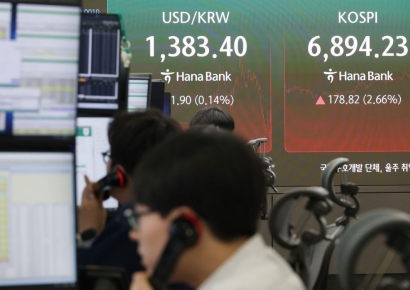 "KOSPI Surpassed 9,000 but Could Drop Below 5,200 Next Year... Expert Explains the Reason"
- "Will the Semiconductor Industry Be in Trouble?" Stock Prices Have Fallen, but Investments May Increase [Weekend Money]
- "Fighter Jet Lost in Blizzard During Korean War Discovered Off Yangyang After 74 Years"
- In the Same Neighborhood, One Apartment Costs 2 Billion Won, Another 450 Million... What's Happening in Gangnam?
- "Trusting the Elder Who Said 'I Already Paid': 'Fake Guests' Target Wedding Halls for Return Gifts"
He further said, “If massive AI infrastructure investments generate such large funding demand that high interest rates are prolonged, paradoxically, these very AI investments—responsible for higher interest rates—could accelerate memory demand and profit growth. In this sense, Samsung Electronics and SK hynix are the top beneficiaries of strong AI demand that outweighs the impact of interest rates.”
© The Asia Business Daily. All rights reserved. Unauthorized AI training and use prohibited.