Korea Takes the First Blow from Fed Hawks... Stock and Bond Markets Show Resilience
KOSPI Holds Firm Despite Fed's Rate Hike
Banks and Insurers Lead Market as Rate Hike Beneficiaries
Short-Term Bonds Rally in the Fixed-Income Market

Despite the U.S. Federal Reserve's unexpected hike in its benchmark interest rate, the Korean stock market is showing resilience, recording solid gains and absorbing the negative news. Analysts note that concerns over rate increases had already been priced into the market over the past few days, and currently, bargain-hunting is flowing into value stocks.
KOSPI Holds Firm Despite Fed's Rate Hike
On September 17, the KOSPI opened at 6,779.02, up 0.91% from the previous trading day, but pared gains to trade at 6,747.75, up 0.44% as of 10:00 a.m. The KOSDAQ started at 820.16, up 0.51%, and was trading slightly lower at 817.89.
Due to the Fed's rate hike, New York’s stock market closed lower overnight. The Dow Jones Industrial Average dropped 1.21% from the previous session, while the S&P 500 Index and the Nasdaq Composite fell 0.45% and 0.01%, respectively. The Federal Reserve, at its Federal Open Market Committee (FOMC) meeting, raised the benchmark interest rate by 0.25 percentage points to a range of 3.75%–4.00%. It marks the Fed's first tightening in three years and two months since July 2023.
The dot plot released after the FOMC suggested the possibility of further rate hikes within the year, putting downward pressure on stock markets. In a press conference, Fed Chair Kevin Warsh emphasized the Fed’s resolve to maintain price stability, stating, “Inflation is too high and has persisted for too long.” The market interpreted these comments as hawkish, signaling a preference for further monetary tightening.
Seoul’s bond market also trended upward, especially for short-term bonds. As of 9:35 a.m., the yield on the 3-year Korean government bond was at 4.07%, up 2 basis points (1bp = 0.01 percentage point) from the previous close. By contrast, the 10-year and 30-year bond yields edged down to 4.53% and 4.68%, respectively.
This is similar to what was observed in the U.S. Treasury market immediately after the FOMC, where "bear flattening" was confirmed — a phenomenon in which short-term yields rise more sharply than long-term yields, narrowing the spread. The U.S. 2-year yield surged to 4.73%. Myoungsil Kim, a researcher at iM Securities, noted: “Much of the additional tightening has already been reflected in market rates, so long-term yields did not spike immediately.”
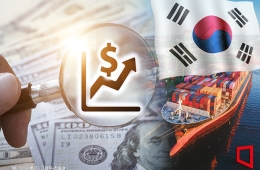
However, the U.S. 10-year Treasury yield remains around 5%, and ongoing factors such as rising international oil prices, continued won depreciation, and the possibility of additional U.S. rate hikes are continuing to press Korean government bond yields upward. Jaekyun Lim, a researcher at KB Securities, commented, “This will exert upward pressure on Korean government bond yields as well,” adding, “with high oil prices persisting, the dollar index is now above 100 due to the Fed’s rate hike. Oil price increases, further tightening by the Fed, and a weaker won all contribute to higher government bond yields.”

On the 17th, when KOSPI started higher, an employee is working at the Hana Bank dealing room in Jung-gu, Seoul. Photo by Yonhap News
View original imageBanks and Insurers Lead Market as Rate Hike Beneficiaries
Despite the drop in the U.S. stock market, the domestic stock market remains robust. Analysts point out that the KOSPI had already dropped by more than 1% this month due to earlier rate hike concerns — absorbing much of the shock in advance. In addition, the pace of U.S. rate hikes is not rapid, and Korean corporates’ earnings cycles, especially in semiconductors, have yet to peak.
According to Kiwoom Securities, following the Fed’s first rate hike after 1994, the average return of the KOSPI was +1.4% after one month, +2.2% after three months, and +3.9% after six months. Jiyoung Han, research analyst at Kiwoom Securities, explained, “Historical data show that during tightening cycles when the economy is growing or corporate profit momentum is solid, earnings increases offset the burden of higher discount rates. This does not mean rate hikes are positive for the stock market overall; rather, it shows market direction depends more on the state of the economy and earnings cycle than on the monetary policy stance itself.”
On this day, stocks categorized as prime beneficiaries of higher rates — such as banks and insurers — are in the spotlight. As of 9:40 a.m., KB Financial Group was trading at 180,500 won, up 2.15% from the prior session. Hana Financial Group (up 2.05%), Shinhan Financial Group (up 1.52%), Woori Financial Group (up 0.55%), Meritz Financial Group (up 4.08%), and Samsung Fire & Marine Insurance (up 2.57%) also saw strong performances. Higher interest rates boost banks’ interest margins and can also raise investment returns on insurers’ assets. However, rising rates tend to suppress IPO and trading activity and are thus unfavorable for securities firms. High rates also hurt biotech and fast-growing venture companies, as it makes funding more expensive and pushes discount rates higher.
At 10:03 a.m., SK hynix was trading at 1,751,000 won, down 0.51% from the previous day, while Samsung Electronics rose 0.10% to 2,540,000 won. Top market-cap stocks including SK Square (up 0.39%), Samsung Electro-Mechanics (down 1.16%), LG Energy Solution (up 0.95%), and Hyundai Motor Company (down 0.55%) showed a mixed trend.
With the likelihood of continued U.S. rate hikes increasing, analysts foresee greater volatility in the Korean stock market ahead. The Micron earnings release at the end of September and Samsung Electronics’ third-quarter earnings announcement in early October are expected to serve as major inflection points for the market.
Hot Picks Today
![[Exclusive] Daiso Draws Shoppers for "3,000-Won Cosmetics"... and Also Boosts Sales at Nearby Olive Young](https://cwcontent.asiae.co.kr/asiaresize/93/2026100608252150863_1791242721.jpg) [Exclusive] Daiso Draws Shoppers for "3,000-Won Cosmetics"... and Also Boosts Sales at Nearby Olive Young
[Exclusive] Daiso Draws Shoppers for "3,000-Won Cosmetics"... and Also Boosts Sales at Nearby Olive Young
- Samsung Electronics Opens Era of KRW 100 Trillion Quarterly Operating Profit... First Ever Among Global Tech Firms (Updated)
- "Wasn't It Supposed to Be Gone? Alarming Surge in Cases Leads US to Declare Disaster Emergency"
- Woman Buys All 196 Apartment Parking Spaces, Installs Locks... Then Faces Lawsuit
- "South Korea's Rep, Born in 1991, Is 35"... 'Married or Divorced? Still OK': Miss Universe Removes Age Limit
Kyoungmin Lee, a research analyst at Daishin Securities, stated, “As we digest a hawkish FOMC, it is important to monitor whether the KOSPI can hold the 6,600 level. However, since the forward price-to-earnings ratio is still below 6 times, valuation normalization remains a consideration, and investors should pay attention to sectors that are oversold or undervalued relative to their earnings, such as IT hardware, semiconductors, retail (distribution), automobiles, secondary batteries, and power equipment.”
© The Asia Business Daily. All rights reserved. Unauthorized AI training and use prohibited.