"Fed Hikes in September and Signals More Raises... Bank of Korea Faces Complicated Rate Calculations"
Fed Hikes Rates for First Time in 3 Years and 2 Months to 3.75-4.00%
Korea-U.S. Rate Gap Widens to 1.00% After Korea’s Preemptive Moves in July and August
Heightened Uncertainty Over Key Variables: High Oil Prices, Intensified Demand-Side Inflat
The U.S. Federal Reserve (Fed) has complicated the Bank of Korea’s interest rate calculations by raising its policy rate for the first time in three years and two months. Previously, the prevailing view in the market was that the Bank of Korea, which implemented back-to-back rate hikes in July and August, would now pause and take time to assess the effects of these increases. However, growing uncertainty over key variables—including persistently high oil prices, the onset of demand-side inflationary pressures, and continued financial imbalances—means that the possibility of additional rate hikes within this year cannot be ruled out.

On September 15-16 (U.S. local time), the Fed raised its policy rate target range by 0.25 percentage points to 3.75-4.00% per annum at its Federal Open Market Committee (FOMC) meeting. This was the first tightening measure in three years and two months, since July 2023. At a press conference, Fed Chair Kevin Walsh stated that recent inflation trends have not improved meaningfully and that current financial conditions are not considered tight. As a result, the interest rate gap between Korea and the United States (based on the upper bound) has widened once again to 1 percentage point.
Market participants assessed the Fed's move as much more hawkish (favoring monetary tightening) than expected, highlighting several factors: the policy statement emphasized a prompt return to inflation targets, economic outlooks and dot plot projections for policy rates were revised upward, and Chair Walsh's comments suggested further rate hikes by noting that "some elements of the accommodative policy stance have been removed." According to the dot plot, 16 out of 18 Fed members support at least one more rate hike before the end of the year. The median U.S. year-end rate was adjusted to 4.1%. On the same day, Kwon Minsoo, Deputy Governor of the Bank of Korea, remarked at a market conditions review meeting that "the Fed’s monetary stance is expected to remain tight going forward."
In Korea, the prevailing outlook is that the Bank of Korea’s Monetary Policy Committee, which preemptively raised rates in July and August, will take a break from further hikes for the time being and monitor the effects. According to the recently released minutes of the August Monetary Policy Committee meeting, four out of five committee members who favored a rate hike and one member, Hwang Keonil, who supported a freeze, expressed concerns that continued rate hikes could worsen hardships for vulnerable groups. As delinquency rates among multiple debtors and other at-risk borrowers surge, further rate hikes could become a financial burden. Bank of Korea Governor Shin Hyun-song has also mentioned that the central bank will observe the impact of the policy rate, which has already reached 3.00%.
The exchange rate acts as a variable in two respects. The possible widening of the interest rate gap between the U.S. and Korea puts pressure on the exchange rate level. However, the fact that the won-dollar rate, which once threatened the 1,600 won mark, has now dropped to the mid-1,300 won range significantly constrains economic growth. Im Jaegyun, a researcher at KB Securities, commented, “Growth in semiconductor prices already peaked in the second quarter, and since the exchange rate started to fall in July, growth in nominal GDP and gross domestic income (GDI) may also slow.” He added, “To meet the market’s elevated growth expectations from strong first- and second-quarter performance, a trickle-down effect from semiconductors is needed, but this has yet to materialize. This lessens the likelihood of another rate increase in October as a result of robust growth.”

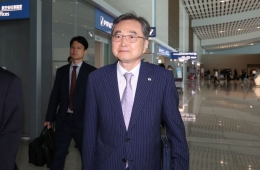
Shin Hyun-song, Governor of the Bank of Korea, is speaking at a press conference after the base rate decision held at the Bank of Korea in Jung-gu, Seoul, on the 27th of last month. Photo by Joint Press Corps
View original imageOn the other hand, several factors continue to support the case for additional rate hikes. Chief among them is concern about inflation. In particular, robust growth driven by the semiconductor boom may generate significant demand-side pressures that could spur further inflation. In the second quarter of this year, the nominal GDP growth rate reached 26.4% year-on-year, the highest in 47 years. On September 10, the Bank of Korea cautioned in its Monetary and Credit Policy Report that “the rapid surge in nominal growth may heighten inflationary pressure from the demand side and exacerbate risks from financial imbalances.”
Hot Picks Today
 "Three Days Off in a Row Is Sweet?" Four-Day Workweek Begins, but Unexpected Burnout Emerges
- Seoul's Jongno 3-ga Named World's Coolest Neighborhood... "Can't Miss Beer with Kimchi and Seafood Pancakes at Street Stalls"
- "Is It Really a Healthy Oil?"... The Surprising Risks of Frying Eggs with Coconut Oil
- "I Thought I Was Middle Class..." Surprised by High Savings and Asset Requirements That Feel Out of Reach
- "97.3% Satisfaction Rate": 600,000 Ride Han River Bus... "Intervals to Be Cut to 15 Minutes, Express Routes Planned"
Other key variables include developments in the Middle East conflict, international oil price trends, concerns over major economies' fiscal soundness, and uncertainties related to the artificial intelligence (AI) industry. In its revised economic outlook in August, the Bank of Korea lowered its projection for international oil prices in the second half of the year from $95 to $84, but as uncertainty in the Middle East has grown, Brent crude has once again exceeded the $100 mark. Researcher Im noted, “Given indications that Iran may seek to pressure President Trump ahead of the U.S. midterm elections, tensions in the Middle East are likely to persist until November, possibly pushing oil prices even higher in the second half of the year.” He added, “If high oil prices persist, the terminal policy rate projected by both the Bank of Korea and the market may need to be revised upward.”
© The Asia Business Daily. All rights reserved. Unauthorized AI training and use prohibited.


![From 17-Year-Old Princess to 54-Year-Old Queen: Why Royal Women Joined the Military [World Photo]](https://cwcontent.asiae.co.kr/asiaresize/307/2026091710422132223_1789609340.png)