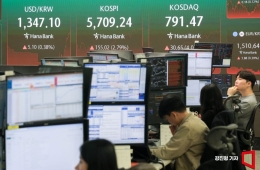
Won-Dollar Exchange Rate Rises 9.2 Won to 1,368.6... Hits 1,370 Range Intraday (Update)
Upward Trend for Five Consecutive Trading Days
Driven by Rising International Oil Prices and U.S. Treasury Yields
Focus on U.S. Benchmark Rate Decision and Remarks by Fed Chair Kevin Warsh
The won-dollar exchange rate has climbed to the upper end of the 1,360 won range for the first time in two weeks. This appears to be due to increased risk-aversion, stemming from the rise in international oil prices, higher U.S. Treasury yields, and the possibility of a benchmark interest rate hike by the U.S. Federal Reserve (Fed).
On September 16, at the Seoul foreign exchange market, the won-dollar exchange rate was recorded at 1,368.6 won as of 3:30 p.m., an increase of 9.2 won compared to the weekly closing price on the previous trading day. The rate surged sharply within the 1,360 won range in the morning, reaching 1,372.9 won at 9:47 a.m., before correcting back down and fluctuating in the mid-to-high 1,360 won range.
This marks the first time in two weeks, since September 2, that the rate has climbed into the 1,370 won range during intraday trading and settled the week in the 1,360 won range. Notably, the rate has been on a continuous upward trend for five consecutive trading days since September 9, when it stood at 1,336.1 won.
Continued instability in the Middle East has kept international oil prices hovering near 100 dollars per barrel. November Brent crude futures rose 2.90% from the previous session to trade at 108.75 dollars per barrel, while October West Texas Intermediate (WTI) crude futures rose 4.38% to 105.83 dollars per barrel.
The yield on 10-year U.S. Treasury bonds also broke through the 'psychological resistance level' of 5% the previous day, reaching 5.045%—the highest since July 2007—and has yet to drop back below 5% as of this day.
Concerns in the market over the Federal Reserve’s almost certain likelihood of raising its benchmark rate are also adding to the pressure. The Fed will hold its Federal Open Market Committee (FOMC) meeting early on September 17 (Korea Standard Time) to decide on the base rate.
Additionally, foreign investors have engaged in net selling worth trillions of won for five consecutive trading days since September 10, which is impacting the exchange rate. On this day, foreign investors recorded net sales of 1.6808 trillion won in the Korea Exchange market.
The U.S. dollar index—which measures the dollar's value against the currencies of six major countries—fell by 0.019 to 99.598.
The won-yen arbitrage exchange rate rose by 4.27 won to 882.37 won per 100 yen. The yen-dollar exchange rate fell by 0.04 yen to 155.07 yen.
Hot Picks Today
 "The Inner Aisles Are Dangerous, I Never Buy These": 3 Foods a Doctor Warns Against
- A 700 Million Won Bonus Was Peanuts... 'This Company' Spent '4 Billion Won per Employee' Amid the AI Boom
- "Only 3-4 Years of Golden Time... China Will Take Over Everything" China’s All-Out Push Into the South Korean Market [China Shock, K-Industry on the Brink | Automobiles] 4
- "I thought I'd regret it if I were the only one who didn't buy one"... FOMO lottery ticket wins A$100 million jackpot
- Kang Minkyung Raved, "Worth the Money," Then It Sold Out in 10 Minutes... Convenience Store Collaborations Pay Off
Mingyeongwon, an economist at Woori Bank, said, "The primary reasons for the rise in the exchange rate are the continued selling of domestic equities by foreign investors and the expansion of dollar purchases by foreign banks. The direction of the won-dollar rate is expected to be determined by the content of the remarks made by Fed Chair Kevin Warsh following the FOMC meeting."

© The Asia Business Daily. All rights reserved. Unauthorized AI training and use prohibited.

!["Please Take Them Off!" They Made It All the Way to the Bed... Then "80% of Fecal Bacteria" Struck [Deep Scroll]](https://cwcontent.asiae.co.kr/asiaresize/307/2026101610053063338_1792112730.png)