[Cultural People] "IP Is a Matter of Choice"... What's Next for KT Studio Genie
Jung Geunwook: "The Broadcast Drama Model Has Collapsed"
Tackling Crisis Head-On with New Business Division for Short-Form and Film
"70% of Revenue to Be Generated Globally Within 3–5 Years"
"The drama business model based on traditional broadcasters has collapsed." This is the diagnosis made by Jung Geunwook, CEO of KT Studio Genie. The primary reason is the collapse of the TV advertising market. Revenue is declining every year, regardless of whether it is terrestrial or cable. Even if a drama achieves high viewership ratings, there is still concern over recovering production costs. Simply following the old methods is no longer sustainable. This sense of crisis propelled CEO Jung to action. This year, he established a New Business Division, consolidating short-form content, channels, digital, web novels, and film business into a single organization.

In an interview with The Asia Business Daily at the International Broadcasting and Video Market (BCWW) held at COEX in Gangnam-gu, Seoul on the 15th, he described this as "an experiment in the style of a startup." He emphasized the need for a culture of implementing ideas on a small scale and quickly iterating them. "From the outside, these may look like existing businesses, but internally, these are entirely new fields," he said, adding, "I believed the decision-making process itself needed to change, moving away from the entrenched formats of traditional dramas."
The expansion into new business areas does not signify a retreat from the drama business. CEO Jung stated, "Since last year, the ENA channel's standing has improved, and the quality of our productions has also increased." As the fundamentals become stronger, opportunities to work with better creators and actors will naturally grow. Based on these capabilities, KT Studio Genie began a non-captive (external sales-focused) strategy this year. They are producing a drama for MBC scheduled to air next year. Together with outstanding creators, they are also pursuing projects that can become OTT (online video service) originals or be released globally.
While the drama business is broadening its horizons, the New Business Division is preparing another bold move—the film business, where CEO Jung previously worked at Showbox and Merry Christmas. The film business is included in the New Business Division due to a longstanding issue with industry customs. He cited the traditional structure where investment companies shoulder all losses as an example, saying, "When the industry was at an early stage, this structure played an important role, but I always questioned whether it should remain unchanged."

This thinking has led to experiments with different profit distribution models—various ratios such as 20% and 80%, or 30% and 70% are being tried. In some cases, production costs are lowered in exchange for higher royalties to creators. The idea is that lowering the break-even point (BEP) increases profitability, allowing for bolder profit-sharing with creators. This shift is also apparent in how production staff are managed. A prime example is the film "New Recruit: The Movie." CEO Jung explained, "Director Min Jinki, along with the cinematography, lighting, and art staff, all moved over from the drama series of the same name," adding, "If there is a clear purpose, we will continue to broaden such efforts."
On the surface, it may appear to be a typical one-source-multi-use (OSMU) strategy, but he clarified that this was not a premeditated result. "It's a term popular in academia, but it's one of the most difficult things in the industry," he dismissed. What CEO Jung emphasized, instead, was the self-sustainability of each individual business. "As a studio, it's natural for us to enhance the value of intellectual property (IP), but if we focus too much on that, each business unit cannot grow robustly," he explained. "Each business unit must be independent and self-sustaining. If we set that up, then our ability to develop and distribute IP will combine naturally to create synergy."
His thoughts on IP ownership are much the same. The structure in which domestic production companies transfer IP to global platforms like Netflix, only to take a low margin, has often been criticized. CEO Jung said, "The idea that you need to own the IP is the obvious answer everyone knows." The problem is that, despite knowing this, it's difficult to put into practice. It is a choice: take the comfortable route in the short term, or, though more challenging, retain IP for the long-term. He elaborated, "I'm sure all production companies knew beforehand that they wouldn't get to keep the IP when signing deals with Netflix, for example—it's just that immediate revenue was necessary for company operations."

KT Studio Genie’s short-form drama 'I Am the Real Third Generation Chaebol!' released through Lil Short in July topped the Korean daily, weekly, monthly, and yearly rankings immediately after its release.
View original imageThe expansion into new business areas has ultimately broadened their options. CEO Jung said, "We are gradually gaining a foothold in the short-form business, and we will release around four films next year," adding, "As the company continues to grow, we will have more capacity to retain and manage our IP."
There was a slightly different calculation regarding the merger with Storywiz in April. CEO Jung, seeing the specialization in short-form planning and development, noted that web novels and short-form content in fact use similar narrative techniques. He also pointed out that Drama Box, a major Chinese short-form platform, started as a web novel company for the same reason. He explained, "Both use devices like cliffhangers and unfold stories in brief segments," adding, "With Storywiz joining us, if we can add the hidden value of web novels, it will help fit the puzzle pieces together."
There is a clear reason for entering the short-form business: the overseas market. CEO Jung said, "After Psy, and with BTS becoming established, the K-pop market expanded by ten or even twenty times." He lamented the fact that film and drama are still largely focused on selling local content. In contrast, short-form content comes with lower barriers to entry. With a short running time of about 1 minute and 30 seconds, and no need for cultural context beyond subtitles or dubbing, such works can more easily reach foreign audiences. Story material and format are more important than intricate narrative pacing. This is why CEO Jung is investing more effort into production methods, business models, and especially global distribution.

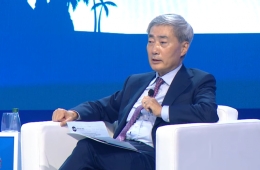
Jung Geunwook, CEO of KT Studio Genie, is speaking at the session titled "Infinite Scalability, Media Paradigm and Business Models Changed by Short-form" during the International Broadcasting and Video Market (BCWW) held on the 15th at COEX in Seoul. / Korea Creative Content Agency.
View original imageThis does not mean distancing from the content itself. CEO Jung’s view is that short-form and long-form businesses influence one another. "While producing short-form content, I experienced firsthand why younger generations keep consuming content with rapid development, little narrative plausibility, or an unfriendly storytelling style," he said. This sensibility is now being reflected in long-form production. "Extending the length or adding complex backstories for the sake of plausibility no longer works," he said. "Even if there are gaps in the narrative, viewers enjoy interpreting and filling them in themselves."
Hot Picks Today
 "I Ate It Often Because It Tasted Good"... This Eating Habit Linked to 40% Higher Odds of Asymptomatic Cerebrovascular Damage
- "Booked a Cheap Flight, Only to Get Blindsided"... Travelers' Complaints "Explode" Over Extra Fees
- "A College Degree Isn't Really Necessary"... Choi Taewon's Advice to Young People
- “Dad Just Gave It to Us as a Gift”... Scratched a Lottery Ticket at a Family Gathering and Hit a 1 Billion Won Jackpot
- "We've gone this far to save on lunch"... Where office workers are flocking instead of restaurants
Short-form content hasn't just honed his storytelling instincts; it has also widened his perspective on the entire company. When asked about the company's future in three to five years, CEO Jung said, "Just like the rapidly growing K-pop companies, I want at least 70% of our increasing revenue to come from the global market." He added, "Including supply to Netflix or Disney+, we can already consider our global revenue ratio to be about 70% to 80%, but even without those, I want to build a structure where at least 50% to 60% comes from our own global sales." The sense of crisis that once made him wary of standing still has now transformed into the confidence to take KT Studio Genie’s business onto the global stage.
© The Asia Business Daily. All rights reserved. Unauthorized AI training and use prohibited.


!["Please Take Them Off!" They Made It All the Way to the Bed... Then "80% of Fecal Bacteria" Struck [Deep Scroll]](https://cwcontent.asiae.co.kr/asiaresize/307/2026101610053063338_1792112730.png)