Crisis Averted for Now, but Only a Temporary Fix... Another Showdown Likely Next Year
Dramatic Agreement Reached Between Seoul City Bus Labor and Management at Dawn on the 16th
Wages to Rise by 3.2%... Ordinary Wage Issue Remains for Next Time
Labor and Management Offer Different Interpretations... Next Year’s “Strike” Could Recur
Oh Sehoon: "A Sustainable Operational Framework Must Be Established"
The labor and management of Seoul city buses have reached an agreement, thereby avoiding a strike. However, they failed to resolve the key issue of ordinary wage standards. With the latest agreement considered only a temporary fix, the conflict between labor and management over ordinary wages could resurface at any time.
The Seoul City Bus Union and the management, represented by the Seoul City Bus Transportation Business Association, reached a final agreement on the wage bargaining mediation proposal centered on a “3.2 percent wage increase,” during the second mediation meeting on the labor dispute held at the Seoul Regional Labor Relations Commission on the 16th. According to the terms, the wage increase will be applied retroactively from February this year to the end of January next year.

After the agreement, Park Jeomgon, head of the Seoul City Bus Union, stated, “Although the union is not completely satisfied, we worked hard to avoid a strike, and the smooth conclusion provides relief for Seoul’s citizens as well.” It is reported that the union gathered internal opinions about the final mediation proposal and obtained majority support.
Although the strike was averted, the ordinary wage issue, which was the most challenging aspect of the negotiations, was not addressed at all. The labor commission, as in January, presented a mediation proposal focused solely on the rate of basic salary increase, which both parties accepted. Management proposed setting the standard calculation time for ordinary wages at 209 hours, but the union maintained a firm stance, stating they would only accept 176 hours as the standard.
The union claims that ordinary wages should be based on 176 hours—calculated by multiplying 22 full workdays per month, as stipulated in the Seoul city bus collective agreement, by eight hours per day. In contrast, management insists that the agreed working hours under the collective agreement are nine hours per day, and when adding the 35 hours of paid weekly holiday, the standard for calculating ordinary wages should be 230 hours.
The Seoul Metropolitan Government estimates that if the union’s proposal of 176 hours is adopted and additional demands for wage and allowance increases are also accepted, approximately 500 billion won in extra funds would be needed annually compared to the current expense. If all of the union’s requests were met, the annual salary for a top-grade driver with 22 years or more of service would reach 85.09 million won. Yeo Jangkwon, director of the Seoul Metropolitan Government Transportation Bureau, said, “A 1 percentage point increase in wages adds about 14 billion won a year,” and, “If all of the union’s demands are accepted, it will result in an additional financial burden, dramatically increasing the deficit in bus subsidies.”
With large differences remaining over the standard calculation hours for ordinary wages, several court rulings on related lawsuits are expected by the end of this year. There are likely to be ongoing disputes, with labor and management offering different interpretations depending on whether 176, 209, or 230 hours are applied, or appealing unfavorable verdicts. Ultimately, this ordinary wage issue could become a main cause of a strike in next year’s wage negotiations.
Separate from the ordinary wage issue, the ongoing excessive wage increase demands each year are also straining the Seoul city budget. The total cost of the city bus quasi-public system rose from 1.3863 trillion won in 2008 to over 2 trillion won this year. During the same period, personnel costs for drivers increased by 87.2 percent, rising from 704.6 billion won to 1.319 trillion won.
The Seoul Metropolitan Government maintains that it is essential to discuss designating city buses as an essential public service, given the recurring anxiety among citizens. Railways, subways, and air transport are already designated as essential public services, requiring a certain level of operation during strikes, but city buses are currently excluded from this requirement.
Soon after the labor-management agreement, Seoul Mayor Oh Sehoon stated, "It is unacceptable to unilaterally set a strike deadline and announce a general strike before sufficient negotiations have even taken place. Labor and management must engage in thorough and intense dialogue and negotiation to reach a compromise, but in the process, citizens’ commutes and livelihoods should never be put at risk." He further emphasized, "While the legitimate rights of workers must be faithfully protected, it is also crucial to establish an operational framework that is sustainable—one that citizens can accept and the city’s finances can withstand."
Hot Picks Today
!["Another Paper Rejection"—How a Female Student from Busan Became the First Korean CEO at a 150-Year-Old Global Company [Power K Woman]](https://cwcontent.asiae.co.kr/asiaresize/93/2026071614060848801_1784178367.jpg) "Another Paper Rejection"—How a Female Student from Busan Became the First Korean CEO at a 150-Year-Old Global Company [Power K Woman]
"Another Paper Rejection"—How a Female Student from Busan Became the First Korean CEO at a 150-Year-Old Global Company [Power K Woman]
- "The Ramen Tasted Best at Jungfrau in Switzerland"... Controversy over Yeosu Officials' Overseas Trip Reports
- "50,000 Won for Used Chapssaltteok Packaging?"... Bizarre Workarounds on Secondhand Platforms
- "Famous Actress on KBS Is Perpetrator's Sister"... KBS Responds to 'Busan Fall Death' Family's Plea
- "Embarrassment Even with International Guests: Series of Crashes by 'K-Drones' Before 1,500 Defense Experts"

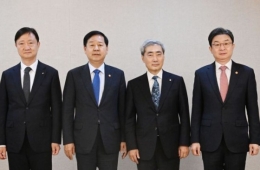
On the 16th, at the Seoul Regional Labor Relations Commission in Yeongdeungpo-gu, Seoul, Kim Jeonghwan, Chairman of the Seoul City Bus Transport Association, and Park Jeomgon, Chairman of the Seoul City Bus Union, shook hands after signing the mediation proposal related to the labor dispute of the bus union. Photo by Yonhap News Agency
View original image© The Asia Business Daily. All rights reserved. Unauthorized AI training and use prohibited.