Hyungil Lee: "Leverage ETF Controversy Has Increased Volatility Contrary to Its Purpose"
"Strategic Sovereign Wealth Fund Will Be Expanded Based on Performance"
Hyungil Lee, nominee for Deputy Prime Minister and Minister of Finance and Economy, stated that he plans to conduct in-depth discussions at the National Assembly regarding the scope of "unavoidable circumstances" that allow non-residency periods to be counted as residency periods. He added that the policy would be applied flexibly when necessary, based on specific cases.

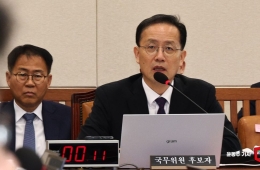
Hyungil Lee, Deputy Prime Minister and Ministerial Nominee for Finance and Economy, is responding to lawmakers' questions at the confirmation hearing held at the National Assembly on the 15th. Photo by Dongju Yoon
View original imageAt the confirmation hearing before the National Assembly's Planning and Finance Committee on the 15th, Lee said, "We will discuss this together with the current tax law at the National Assembly."
The modification of the scope of "unavoidable circumstances" only requires amendments to the enforcement decree, not a full legislative vote. However, it is interpreted as an intention to collect a wide range of views from lawmakers and reflect them in the policy.
Previously, the government announced a tax law revision bill last month, indicating that in cases of non-residency due to unavoidable circumstances, the relevant period would be recognized as a residency period. Examples provided included enrolling in school, changing jobs or work relocations, illness, transferring to another school, living abroad, and caring for parents.
However, some have pointed out that beyond the examples listed, it is necessary to recognize a wider array of exceptional cases.
Explaining the purpose of the current real estate tax reform plan, Lee said, "This was designed with three goals: to establish a residence-centered housing market, to enable fair and equitable taxation, and to create a sustainable tax system."
In response to a question about the projected tax revenue increase resulting from the reform, Lee answered, "As far as I know, the expected amount is around 3.4 trillion won over five years."
When asked about the controversy over single-asset leverage exchange-traded funds (ETFs), Lee commented, "Contrary to the original purpose of introducing these products, their interaction with the semiconductor market has led to an overall increase in volatility," adding, "I sincerely apologize to the public for this."
Regarding Democratic Party lawmaker Kim Taenyon's point that "the scale of the strategic sovereign wealth fund will be at most 1 trillion won, or at most 2 trillion won, which is too small, and it should be increased as part of a future response fund," Lee replied, "While the initial scale may seem small, we intend to expand it as its performance improves."
Hot Picks Today
 "Don't Say 'Americano' Anymore" After the Uproar... Now a Surge in 'Patriotic Spending' Sweeps Canada
- "Weight Dropped Rapidly... Anyone Can Get It Easily": Why a Woman in Her 20s Quit Mountzaro After Losing 6kg in a Month
- "Jay Y. Lee Must Be Pleased"... Jensen Huang Takes Trump's Call on Galaxy Z Fold8
- "That Teacher Is from Harvard"... Surge of Master's and PhD Holders in Chinese Schools as Monthly Pay Tops 1 Million Won
- 'Pronounced Dead,' Now Boiling Again... Chinese Millennials and Gen Z Seek 'Premium Ramen'
When Democratic Party lawmaker Yoon Huduk noted that "the interest income accumulating with financial institutions during an era of rate hikes should be returned to society," Lee responded, "Banks are also an industry and should have a sustainable form," adding, "Even so, it is necessary to expand inclusive finance, supporting the limits and difficulties faced by vulnerable borrowers."
© The Asia Business Daily. All rights reserved. Unauthorized AI training and use prohibited.