Concerns over U.S. Rate Hikes and Rising Oil Prices Weaken Won... Won-Dollar Rate Surpasses 1,360 During Trading
Up 12.1 won from the previous day to 1,359.4 won as of 3:30 p.m.
U.S. 10-year Treasury yield surpasses 5%
International oil prices climb back above $100
Foreign investors log five straight days of net selling in the domestic stock market
The won-dollar exchange rate surpassed 1,360 won during trading hours due to the rise in U.S. Treasury yields and international oil prices. The U.S. 10-year Treasury yield has exceeded 5% amid concerns of inflation resulting from higher oil prices. Additionally, heightened caution over the possibility of another Federal Reserve (Fed) rate hike has driven further strength in the dollar.
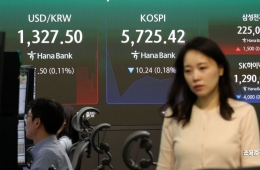
At 3:30 p.m. on September 15, the won-dollar exchange rate in the Seoul foreign exchange market stood at 1,359.4 won, up 12.1 won from the previous session’s weekly closing price. The exchange rate, which traded in the 1,347 won range that morning, expanded its climb into the afternoon and soared to 1,360.3 won at 3:23 p.m.
The main causes of the exchange rate’s rise are soaring oil prices and inflation concerns due to the Middle East war, as well as the resulting increase in U.S. Treasury yields. There was a prior incident in which Saudi Arabia shut down its key East-West oil pipeline following an attack by Yemen’s Houthi rebels. November Brent crude futures rose 1.02% to 105.68 dollars per barrel, while October West Texas Intermediate (WTI) crude futures gained 1.34% to 101.39 dollars. Dubai crude soared 21.3% over the week to 123.66 dollars per barrel.
U.S. Treasury yields also surpassed the 5.0% "psychological resistance level" for the first time since October 2023. Yields for 2-year, 5-year, and 30-year Treasuries have also increased. Accordingly, ahead of the upcoming U.S. Federal Open Market Committee (FOMC) meeting scheduled for September 17 (Korean time), heightened caution over a potential Fed rate hike is seen as another driver of dollar strength.

Ongoing net selling by foreign investors in the domestic stock market has also put pressure on the won-dollar exchange rate. On this day, foreign investors recorded a net selling of 1.5711 trillion won in the KOSPI market, marking five consecutive trading days of net selling. In addition to rising interest rates and inflation fears, sentiment toward technology and semiconductor stocks weakened as leaders of major U.S. artificial intelligence (AI) companies called for slowing the pace of AI technology development.
Minhyeok Lee, an economist at KB Kookmin Bank, said, "In addition to domestic factors such as the suspension of strategic FX hedging by the National Pension Service and a decrease in dollar negotiations, the environment was ripe for a sharp rise in the exchange rate due to rising U.S. Treasury yields and international oil prices surpassing 100 dollars, which caused the value of the won as a risky asset to decline. The increased likelihood of a U.S. rate hike also contributed to this situation."
Hot Picks Today
 "Photos of Kim Jong Un Released by North Korea Are a Deception"... Debate Over Death Rumors Continues
- Despite "Insufficient Balance" Notices, They Board Anyway... Reports of Foreign Fare Evasion Mounting
- "Chinese Tourists Won't Go Anymore"... Arrivals Halved, but Koreans Say "Now's Our Chance" and Open Their Wallets in Japan
- "Even Underwear Has to Be Cut Up with Scissors"... China Hit by Rise of "Trash Hunters" in an "If You're Slow, You're Out" Scramble
- [Exclusive] "We Came for a KRW 140,000 Trip": Following Chinese Tourists in Korea Uncovers a 'Suspicious' Tour
He added, "Once major monetary policy events—such as the FOMC and the Bank of Japan's policy meeting (scheduled for September 17–18)—have concluded, the direction of the exchange rate will be determined again."
© The Asia Business Daily. All rights reserved. Unauthorized AI training and use prohibited.