KOSPI Ends Lower on Foreign and Institutional Selling, Down 0.85%
KOSDAQ Closes Up 0.7%
The domestic stock market closed lower due to simultaneous selling by foreign investors and institutions. Factors such as the shock from the U.S. 10-year Treasury yield and rising oil prices put pressure on the indices.
On September 15, the KOSPI index closed at 6,627.26, down 57.11 points (0.85%) from the previous trading day. Foreign investors and institutions led the decline. Foreign investors recorded a net sell of 1.5711 trillion won, while institutions net sold 904.4 billion won. In contrast, individual investors net bought 832.4 billion won.
By sector, declines outnumbered gains. Transportation equipment and parts fell by 3.35%, followed by insurance (-3.08%), distribution (-2.75%), finance (-2.18%), securities (-2.14%), and telecommunications (-1.48%), which all showed weakness. On the other hand, medical and precision devices rose by 1.23%, with construction (0.84%) and textile and apparel (0.03%) also closing higher.
Most of the top market cap stocks were also on a downward trend. HD Hyundai dropped 8.7%, while HD Korea Shipbuilding & Offshore Engineering (-6.7%), Hanwha Aerospace (-6.5%), Samsung Heavy Industries (-6.3%), HD Hyundai Heavy Industries (-5.3%), HD Hyundai Electric (-5.2%), Samsung Life Insurance (-4.1%), Meritz Financial Group (-4.1%), and Hyosung Heavy Industries (-4%) also declined. Conversely, POSCO Future M gained 5.8%, while LG Energy Solution (3.9%), SK Innovation (3.6%), and Samsung SDI (2.8%) posted increases.

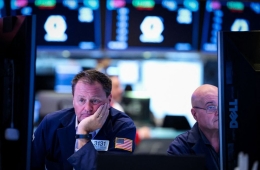
The KOSPI index started the session at 6,659.25, down 25.12 points (0.38%) from the previous trading day, displayed on the electronic board showing the domestic stock market status at the Hana Bank headquarters dealing room in Jung-gu, Seoul on September 15, 2026. Photo by Hyunmin Kim
View original imageThe KOSDAQ index, meanwhile, ended higher. On this day, the KOSDAQ index closed at 812.41, up 5.62 points (0.7%) from the previous trading day. In the KOSDAQ market, foreign investors and institutions recorded net buys of 23.8 billion won and 110.7 billion won, respectively. Individual investors registered a net sell of 139.8 billion won.
KOSDAQ large-cap stocks showed mixed results. Wonik Holdings surged 14.3%, while SPG (13.3%), Peptron (8.4%), OliX (8.1%), PSK Holdings (7.3%), HLB (6.9%), and Mezzion (5.7%) also advanced. On the other hand, ABL Bio fell by 8.6%, with Jusung Engineering (-6.4%), Woori Technology (-4.6%), Voronoi (-2.6%), Silicon Two (-2.6%), and Eugene Technology (-2.5%) also declining.
Kyungmin Lee, a researcher at Daishin Securities, commented, "The direct cause of the market's reversal to a decline in the afternoon was macroeconomic deterioration." He added, "The U.S. 10-year Treasury yield climbed above 5% again to 5.02%, while Brent crude oil rose further to $107.35, prompting the Nasdaq 100 futures to turn negative by 0.22%, and the Nikkei also gave up its earlier gains."
Hot Picks Today
 "I Don't Want Office Romance or Blind Dates"... Why Young Japanese Professionals Are Flocking to 'Imperial Palace Running'
- "Never Mind the Pots and Dishes, Help with the House Payment"...Practical Requests from U.S. Engaged Couples
- "Allegation of Gang Rape by Seven at Campus Fraternity Club: U.S. Prosecutors Reopen Investigation Amid Outcry Over No Criminal Charges"
- Mexican Broadcasters Air Three Documentaries on Korean Culture and AI During President Lee's State Visit
- Noh Hyunjung and Eldest Son of Chung Daeseon Become Largest Shareholders of Hyundai-Affiliated IT Firm HNIX with 39.74% Stake
He continued, "Although no new negative factors emerged, the additional rises in interest rates and oil prices led to perceptions that these factors had already been priced in and contributed to the weakening of bargain-hunting forces."
© The Asia Business Daily. All rights reserved. Unauthorized AI training and use prohibited.

!["Failed Even With Net Assets of 400 Million Won?"... Six Criteria That Define 'The Real Middle Class' [Data Pick]](https://cwcontent.asiae.co.kr/asiaresize/307/2026092809144741876_1790554486.jpg)