Korea Power to Launch Next October: Integrated as a KEPCO Subsidiary, Not as a Public Corporation
[Where Is the Integrated Power Company Heading?]
A Mega Utility Emerges: KRW 67 Trillion in Assets and 53 GW in Capacity
Ownership Structure Unchanged: KEPCO to Keep 100% Stake Even After Merging Five Entities
Over 130 Subsidiaries of

The government will merge the five power generation public corporations into a single entity for the first time in 25 years, but the ownership structure of the power generation industry—centered on Korea Electric Power Corporation (KEPCO)—will remain intact. The new company, “K-Power Corp.,” launching in October next year, will not be an independent public corporation directly owned by the government, but rather a power generation subsidiary wholly owned by KEPCO. While this is a large-scale integration combining about 53GW of generation capacity and assets worth as much as KRW 67 trillion under one roof, it draws a line at overhauling the governance structure of the electricity industry or redefining the relationship between KEPCO and its power generation subsidiaries. Financial strategies to support K-Power Corp.’s expanded role—such as investment in renewables and conversion from coal power—are expected to be addressed through special legislation and throughout the integration process.
53GW Giant Power Generator Emerges... but KEPCO Remains the Owner
According to the Ministry of Climate, Energy and Environment and industry sources on September 16, the integration of the five power generation firms being promoted by the government will be executed as a “horizontal merger,” combining the legal entities and organizations of Korea South-East Power, Korea Midland Power, Korea Western Power, Korea Southern Power, and Korea East-West Power. Just as KEPCO currently owns 100% of the shares in each of the five power generators, KEPCO will continue to own 100% of K-Power Corp. post-merger. Instead of carving out the power generation unit from KEPCO or transforming it into a new public corporation directly owned by the government, the method will be to merge the five existing power generators under KEPCO into a single entity.
This maintains the basic ownership arrangement that has been in place for 25 years since the electric power industry restructuring in 2001. At the time, KEPCO’s power generation division was separated into six companies: Korea Hydro & Nuclear Power and the five power generators (Korea South-East Power, Korea Midland Power, Korea Western Power, Korea Southern Power, and Korea East-West Power). The intention was to introduce competition among power generators and promote gradual restructuring of the power generation sector. While privatization plans for these generators were later shelved, the “KEPCO and six subsidiaries” system persisted for over two decades.
With this integration, the five companies—primarily focused on thermal generation—will be merged into a single company once more. The integrated company’s generation capacity will be about 53GW, making it the 14th largest globally (8th largest excluding China). As of FY2025, the combined assets of the five power generators amount to KRW 66.9989 trillion, liabilities to KRW 37.2416 trillion, and equity to KRW 29.7573 trillion.

However, even with the emergence of a massive power generator with KRW 67 trillion in assets, it will remain within the consolidated boundaries of KEPCO from a financial perspective. The assets, liabilities, and operational results of K-Power Corp. will be reflected in KEPCO’s consolidated financial statements, and KEPCO will retain full control over the power generation business as the sole shareholder.
As the role of K-Power Corp. expands, determining how to secure its financial capacity will become a key issue during integration. The government plans to expand the renewable energy projects currently individually pursued by each of the five power companies at the integrated company level and concentrate “just transition” functions resulting from the phase-out of coal power within K-Power Corp. This situation will inevitably increase the demand for large-scale renewable energy investments and plant conversions.
The government will consider necessary financial support measures as it drafts special legislation in line with the launch of K-Power Corp. However, the integration itself does not immediately translate into direct government funding or additional capital injection from KEPCO. The baseline plan is for the integrated company to inherit the existing assets and liabilities of the five power companies, while determining any needed support methods based on future business plans and financial status.
All 134 Subsidiaries Remain Untouched
The scope of this integration is limited to the five principal power generation companies, not the entire power generation sector. As of the end of June, KEPCO controls a range of companies, including KPS Korea Plant Service & Engineering and KEPCO E&C (which are listed), as well as multiple unlisted companies such as Korea Hydro & Nuclear Power and the five generation companies. The five power generation firms have also established numerous subsidiaries both domestically and abroad during their business expansions.
By company, these subsidiaries number: 18 for Korea South-East Power, 42 for Korea Midland Power, 17 for Korea Western Power, 32 for Korea Southern Power, and 27 for Korea East-West Power, totaling 134. Their forms and functions vary widely, from local corporations set up for overseas and renewable power projects to subsidiaries supporting power plant operations (like security and cleaning).
The government will not merge these subsidiaries in this round of integration. Phase one involves integrating the five parent companies into K-Power Corp., while their subsidiaries will remain as separate legal entities. Given that even just integrating the parent companies requires aligning divergent personnel, financial, accounting, contract structures, and operating systems, the initial focus will be on parent company integration.
The practical implementation of this integration will be challenging. Currently, there are 575 different systems and software products in use by the five companies. Over two decades, each firm has independently developed its personnel, accounting, contracting, and operations systems. These need to be consolidated into one corporate structure, and the management of both domestic and overseas operations must be reorganized accordingly.
Pumped-storage hydropower will remain split between Korea Hydro & Nuclear Power and K-Power Corp. following the integration. Korea Hydro & Nuclear Power currently operates 16 pumped-storage units across seven sites—Cheongpyeong, Samrangjin, Muju, Yangyang, Yecheon, Cheongsong, and Sancheong—with about 4,700MW in capacity. New plants with a combined capacity of 3,700MW are under construction at Yeongdong, Hongcheon, Pocheon, Hapcheon, and Yeongyang. Among the five power companies, Korea Midland Power has secured new pumped-storage projects in Gurye and Bonghwa, Korea South-East Power in Geumsan, and Korea East-West Power in Gokseong—4 sites totaling 2GW.
Pumped-storage hydropower’s role is increasing alongside the expansion of renewables; it serves as a large-scale energy storage system by pumping water to higher elevations using surplus power generated during peak solar and wind production and then generating electricity when demand is high. President Lee Jaemyung highlighted the need to expand pumped-storage hydro in his briefing to the Ministry of Climate in December last year. How roles are divided between Korea Hydro & Nuclear Power and K-Power Corp. during further expansion of pumped-storage hydro is likely to become a follow-up issue in the next wave of electricity sector restructuring.

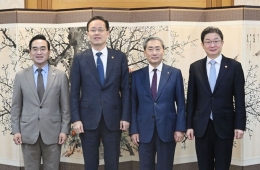
Kim Sung-hwan, Minister of Climate, Energy and Environment, is entering the integrated plan meeting for power generation public enterprises held on September 4 at the Korea Electric Power Corporation Namseoul Headquarters in Yeongdeungpo-gu, Seoul, receiving a warm welcome from members of five power generation public enterprises: Korea South-East Power, Korea South Power, Korea East-West Power, Korea Western Power, and Korea Midland Power. 2026.9.4 Photo by Kim Hyun-min
View original imageFrom Five CEOs to One... Headquarters Structure Also Consolidated
The most immediate changes from the integration of the five power generators will be seen among the executives and in the headquarters structure. Each of the five currently has a CEO, an auditor, and two standing executive directors. Following the launch of K-Power Corp., the management structure will be streamlined to one CEO, one auditor, and four standing executive directors.
Central functions such as planning, finance, and HR, which were previously duplicated across companies, will also be consolidated. The new headquarters will likely be structured around four main divisions: renewable energy, just transition, safety & technology, and planning & administration. This structure enables unified management of renewable energy businesses and responses to coal phase-out, which had been handled separately by each company.
About 2,400 people are currently employed at the five companies’ headquarters. The government plans to relocate approximately 1,800 of them to the integrated headquarters and regional bases, with about 600 assigned to three or four regional renewable energy headquarters. These regional bases will be responsible for renewable energy projects and the coal transition in their respective areas.
By contrast, current field operations of existing thermal power plants will maintain their operating systems for the time being. The rationale is that rapidly reorganizing field-level operations immediately after legal integration could adversely affect both safety and the stable supply of electricity.
The government is pursuing a plan to establish a separate building for the integrated headquarters. Currently, Korea South-East Power is headquartered in Jinju, Gyeongnam; Korea Midland Power in Boryeong, Chungnam; Korea Western Power in Taean, Chungnam; Korea Southern Power in Busan; and Korea East-West Power in Ulsan. Most of these buildings accommodate around 500 people, so consolidating headquarters in any one of them does not seem feasible to the government.
For decision-making streamlining and improving interdepartmental collaboration, the plan is to consolidate core headquarters functions in a single location. The specific location will be determined in conjunction with the second phase of the public institution regional relocation policy, considering the current regional distribution of power sector public corporations, the local economic impact of coal phase-out, and the living and work conditions for employees.

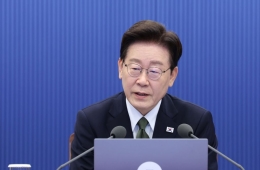
Kim Sung-hwan, Minister of Climate, Energy and Environment, is speaking at a meeting on the Integrated Plan for Power Generation Public Enterprises held on the 4th at the Korea Electric Power Corporation Namseoul Headquarters in Yeongdeungpo-gu, Seoul. 2026.9.4 Photo by Kim Hyun-min
View original imageReintegration After 26 Years... “Building a Single Company” Over the Next Year
There will be about one year of practical integration efforts before the official launch of K-Power Corp. This month, the government will establish an Integration Preparatory Committee for Power Generation Public Corporations, chaired by the Second Vice Minister of Climate, Energy and Environment. KEPCO, the five power generators, and subject-matter experts will participate to detail organizational and personnel arrangements, operating systems, overseas business plans, and other points necessary for the merger.
A separate legal basis will also be created. The government aims to pass special legislation during the current National Assembly session to support the merger of the five power generation companies. This bill will specify the basis for the integrated company's establishment, succession of assets, rights and obligations, succession of employment contracts, simplification of merger procedures, and relief for any tax burdens arising during the integration.
Hot Picks Today
 "Only 3 Passengers on a 180-Seat Flight"... The Shocking State of the 'Honeymoon Hotspot'
- "Work That Took a Month Now Done in Just 8 Hours"…Samsung and LG Turn to AI to Counter China's Pursuit
- "Returning Excess Fees Collected Under Previous Administration"...$680 Per Person Refund for 950,000 Americans
- "Such chaos for the first time in 140 years"... Even illnesses surge, Tokyo stunned by 'unbelievable' event
- "Nothing Left to Buy, Feeling Indifferent"... 'Rich Daughter' Vibe in Department Stores with 'Hyunbaek Core'
After passage of the special bill, an Integration Promotion Committee will spearhead the actual merger process. This step-by-step process will include harmonizing organizational and position structures, HR and compensation systems, finance, accounting, contracting, and IT networks—the systems that each company has operated independently for over 20 years. The government plans to complete formal registration and executive appointments by September next year and to officially launch K-Power Corp. on October 1, 2027.
© The Asia Business Daily. All rights reserved. Unauthorized AI training and use prohibited.