[Bio Story] ① Park Youngmin: "There Are Limits to Competing on Pipeline Numbers... We Must Foster New Drugs That Will Go All the Way"
Interview with Park Youngmin, Head of the National New Drug Development Project Group
Phase 2 of the National New Drug Development Project: "Selection and Focus"
Emphasizing Differentiation over Competing on Scale with China
"Having a large pipeline itself should not be regarded as an achievement. What matters is how many candidates can actually reach global clinical trials and approval."
Park Youngmin, Head of the National New Drug Development Project Group (KDDF, hereafter referred to as "the Project Group"), stressed this point during an interview with The Asia Business Daily on September 17, 2026, at the National New Drug Development Project Group in Mapo-gu, Seoul, regarding the direction of Korean policies supporting new drug development. He emphasized that it is now time to focus less on "how many candidates are discovered" and more on "how to see projects through to the end." While the past five years have focused on providing a foundation for diverse drug candidates to take on new challenges, he argued that going forward, it is necessary to select and foster pipelines that can compete in the global market.
Park also observed that, as China rapidly expands its influence in the global new drug development market through massive capital investment and an extensive pipeline, there are limits for Korea to engage in similar "scale competition." He stated, "We are ultimately shifting our focus from 'discovering many candidates' to 'nurturing those that can actually go all the way.'"

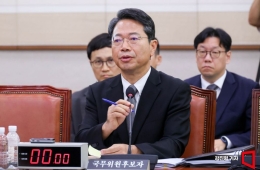
Park Youngmin, Head of the National New Drug Development Project Group, is giving an interview to The Asia Business Daily at the National New Drug Development Foundation in Mapo-gu, Seoul, on the 4th. Photo by Jin-Hyung Kang
View original imageFrom Broadening the Base to 'New Drugs That Can Reach the End'
The National New Drug Development Project is a pan-ministerial research and development (R&D) initiative launched in 2021 and running until 2030, aimed at strengthening the global competitiveness of Korea’s pharmaceutical and biotech industries and fostering an ecosystem for new drug development. The entire program is divided into two phases of five years each, with the second phase running from this year until 2030. The project supports the entire new drug development cycle, from the discovery of effective and lead compounds, to candidate material verification, nonclinical studies, and phase 1 and 2 clinical trials. While the first phase focused on securing a variety of pipelines and broadening the foundation for new drug development, the second phase is centered on identifying among the accumulated pipelines those with high global competitiveness and a strong likelihood of development success, and then channeling resources into follow-up development and commercialization.
![[Bio Story] ① Park Youngmin: "There Are Limits to Competing on Pipeline Numbers... We Must Foster New Drugs That Will Go All the Way"](http://www.asiae.co.kr/news/img_view.htm?img=2026091615463531057_1789541195.png)
Through phase one, the Project Group supported a total of 553 projects, resulting in 72 Investigational New Drug (IND) approvals and 2 product approvals. However, Park cautioned against assessing the project’s achievements solely by such numbers, because there is often a considerable time gap between the execution of a task in new drug development and when actual clinical or approval outcomes are realized. He commented, "We place greater importance not on the sheer number of projects, but on milestones achieved, entry into the IND process, and actual verifiable outcomes in the global market such as technology transfers and partnerships."
The core of the second phase is "selection and focus." However, this does not mean raising the bar for early-stage research. Evaluation criteria do not stop at whether a technology is novel; they also assess whether there is sufficient evidence and target validation in disease biology, whether the candidate has clinically meaningful differentiation compared to competitors, and whether a development strategy is in place to carry the project through to global clinical trials and regulatory approval. Even after project selection, competitiveness is continuously evaluated through phase-by-phase milestones. Park said, "In the early stages, we’ll keep the door open for new ideas, but as candidates move through development, the selection process will become much more rigorous."
Another key challenge for the second phase is securing funding for late-stage clinical trials. The Project Group’s direct support currently extends primarily up to phase 2 trials. Given that phase 3 global clinical trials require funding on the scale of tens or even hundreds of billions of won, it is unrealistic to rely solely on government R&D budgets to cover all costs.
Park said, "What we consider even more important than direct project support is building a system where promising pipelines, having reached phase 2 with our support, do not stall for lack of funds but can progress to phase 3 and approval through private investment and policy financing." He added, "The goal of phase two is not for the Project Group to cover all the costs of phase 3, but to create a bridge so that good pipelines we support do not break off at phase 2, but can move to the next stage of capital."
Limits of a Volume-Driven Contest with China... Finding Differentiated Areas
This strategy is also in line with the rapidly changing global new drug development environment. In particular, China has dramatically ramped up the scale and speed of new drug development based on vast pipelines, capital, and clinical infrastructure. In some oncology sectors, such as antibody-drug conjugates (ADCs) and bispecific antibodies, China is even seen as having achieved significant qualitative competitiveness.
Park pointed to the scale and speed of drug development as the areas where the gap between Korea and China has widened the most. He said, "Korea faces limits when trying to compete with China in terms of pipeline numbers or by following the same crowded targets and modalities."

Park Youngmin, head of the National New Drug Development Project Group, is giving an interview to The Asia Business Daily at the National New Drug Development Foundation in Mapo-gu, Seoul, on the 4th. Photo by Kang Jinhyung
View original imageThat being said, he believes that the foundation for early-stage research should not be narrowed. While maintaining a base where a variety of ideas can emerge, he argued that resources should be focused on areas where global competitiveness can be secured. In particular, he cautioned against jumping into ADCs, targeted protein degradation (TPD), or cell and gene therapy simply because a certain technology appears promising. He stated, "The starting point should not be 'Which technology is promising?' but 'Which patient needs remain unmet?' Defining unresolved problems and identifying the underlying biological mechanisms—as well as the modality that can target them most effectively—should be the focus."
Korea's already-established strengths in biopharmaceutical development and manufacturing are considered an advantage. Park, however, suggested that this should not stop at contract manufacturing but should extend to the development of innovative new drugs discovered domestically and their commercialization in global markets. He emphasized that achieving the next level of growth—beyond technology-out licensing—will require both capital and development capabilities.
Hot Picks Today
 "Three Days Off in a Row Is Sweet?" Four-Day Workweek Begins, but Unexpected Burnout Emerges
- "Can't I Even Have Cheonggukjang at Home?" "You Wouldn't Understand Until It Happens to You"... Apartment Plea Sparks Heated Online Debate
- "Is It Really a Healthy Oil?"... The Surprising Risks of Frying Eggs with Coconut Oil
- 1990s Daughters Aging Faster Than 1965 Mothers... The Mystery Behind Surging Young-Onset Cancers
- "97.3% Satisfaction Rate": 600,000 Ride Han River Bus... "Intervals to Be Cut to 15 Minutes, Express Routes Planned"
Park concluded, "The bottleneck in Korea’s new drug development is not easily attributed to just one factor such as funding, clinical capability, or global networks; rather, it is a matter of integrated 'strategy' bringing these elements together." He added, "Ultimately, the key is not simply 'how long can we retain our technology,' but building up the capital and development capabilities so that domestic companies can choose between technology transfer, joint development, and direct development as needed."
![[Bio Story] ① Park Youngmin: "There Are Limits to Competing on Pipeline Numbers... We Must Foster New Drugs That Will Go All the Way"](http://www.asiae.co.kr/news/img_view.htm?img=2026043016304247755_1777534241.jpg)
© The Asia Business Daily. All rights reserved. Unauthorized AI training and use prohibited.



![From 17-Year-Old Princess to 54-Year-Old Queen: Why Royal Women Joined the Military [World Photo]](https://cwcontent.asiae.co.kr/asiaresize/307/2026091710422132223_1789609340.png)