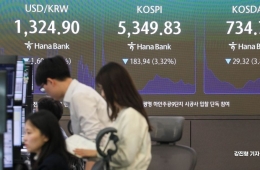
Money Supply in July Increases by 12.7 Trillion Won... Inflow of Corporate Funds Driven by Semiconductors
July Broad Money Supply (M2) Average Balance Reaches 4,225.6 Trillion Won
Up 0.3% from Previous Month, Driven by Growth in Time Deposits and Installment Savings
In July, the amount of money in circulation increased by more than 12 trillion won, marking the eighth consecutive month of M2 growth. This trend is attributed to an inflow of surplus corporate funds, driven by the semiconductor industry's strong performance, which led to a rise in time deposits and installment savings accounts.

An employee is holding a 50,000 won bill at the Hana Bank Counterfeit Response Center in Jung-gu, Seoul. Photo by Yonhap News
View original imageAccording to the Bank of Korea on September 15, the seasonally adjusted average balance of broad money supply (M2) for July 2026 was 4,225.6 trillion won, an increase of 12.7 trillion won (0.3%) from the previous month. M2 has risen for nine consecutive months since November 2025.
M2 is a broad measure of money supply that includes currency in circulation, demand deposits, and transferable savings deposits (narrow money, or M1), as well as money market funds (MMF), time deposits and installment savings accounts with maturities less than two years, negotiable certificates of deposit (CDs), and repurchase agreements (RPs).
By financial product, time deposits and installment savings with maturities less than two years posted an increase of 27.3 trillion won, while money trusts with less than two years to maturity rose by 11.4 trillion won, leading the overall growth. A Bank of Korea official explained, "Time deposits and installment savings accounts increased due to the inflow of surplus corporate funds and funds related to derivatives, and money trusts also expanded as deposits from semiconductor companies grew."
By economic entity, non-financial corporations increased their balances by 20.6 trillion won, and the others category (including social security institutions and local governments) rose by 6.3 trillion won. In contrast, households and nonprofit organizations saw a decrease of 11.6 trillion won.
The average old M2 balance, which includes beneficiary certificates, fell by 0.8% compared to the previous month, but increased by 10.3% from a year earlier. This is attributed to the 48.9% year-on-year increase in beneficiary certificates, which alone boosted the old M2 balance by 5 percentage points.
The seasonally adjusted average balance of M1 was 1,372.5 trillion won, a decrease of 2.2% from the previous month.
Financial institution liquidity (Lf, average balance) came to 6,343.9 trillion won, down 0.4% compared to the previous month, while broad liquidity (L, end-of-month balance) stood at 8,078.4 trillion won, a decline of 0.5% on a month-over-month basis.
Hot Picks Today
 He Left It in the Car and Forgot... "I Nearly Collapsed with Joy": Man Wins $1.48 Million Lottery
- Goldman Sachs Cuts KOSPI Target by 25%... "Excessive Pessimism, Still Attractive"
- "'Nodding Off' on the Subway? Here's Why Koreans Are Getting Even Less Sleep"
- "Please Pay Me at Least 3 Million Won a Month": More Than Half of Young People Today Prioritize "Working Conditions" Over Company Size
- Beachgoer Finds 'Plastic' That Turns Out to Be Perfume Ingredient Worth More Than Twice as Much as Gold
The Lf measure encompasses M2 as well as long-term financial products with maturities of two years or longer and financial products issued by non-depository institutions. The L measure includes Lf, along with other financial institution products, government bonds, local government bonds, corporate bonds, and commercial paper.
© The Asia Business Daily. All rights reserved. Unauthorized AI training and use prohibited.