Government Proposes Social Dialogue on Mega-Special Zone Act Labor Exemptions, Including Loosening 52-Hour Workweek Limit
Minister Kim Young-hoon Holds Press Conference on the 15th
"An Uncharted Path... Stakeholders Must Take Part in Dialogue"
The government is launching a tripartite social dialogue between labor, management, and the government to discuss labor exemptions to be included in the 'Mega-Special Zone Special Act,' which aims to foster advanced industries such as semiconductors and artificial intelligence (AI). As labor groups have strongly protested provisions allowing greater flexibility in labor regulations—such as loosening the 52-hour workweek for highly paid research and development (R&D) personnel—the government has decided to convene a forum that includes both Korean confederations of trade unions, as well as representatives from management circles, to seek a compromise.

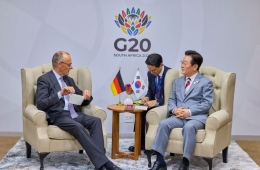
Kim Younghoon, Minister of Employment and Labor (left), and Kim Rakjung, Secretary for National Agenda at the Blue House, are attending and conversing at the Cabinet meeting held on September 15, 2026, at the Government Seoul Office in Jongno-gu, Seoul. Photo by Jo Yongjun
View original imageOn September 15, Kim Young-hoon, Minister of Employment and Labor, held a press conference at the Government Seoul Office, proposing a 'one-point social dialogue' specifically on the labor exemptions in the Mega-Special Zone Act.
Minister Kim stated, "As global competition intensifies in advanced industries, it is urgent to establish special economic zones to address regional disparities and create jobs for young people." He added, "However, because the proposed labor exemptions represent uncharted territory for our society, it is essential that both labor and management, as key stakeholders, participate directly in these discussions to bridge their differences and engage in thorough dialogue." He also emphasized, "In this era of great transformation, we must seek solutions for growth in partnership with labor, moving beyond the frameworks of the past and adopting a new perspective. I urge all parties to join in this dialogue for the sake of jobs for the next generation and the future of our society."
Hot Picks Today
![[On the Scene] "Even Limited-Edition One Piece Cards... Something to Catch Your Eye on Every Floor" - What's Behind the 300-Person Opening-Day Rush in Central Cheongnyangni?](https://cwcontent.asiae.co.kr/asiaresize/93/2026102312311072072_1792726270.jpg) [On the Scene] "Even Limited-Edition One Piece Cards... Something to Catch Your Eye on Every Floor" - What's Behind the 300-Person Opening-Day Rush in Central Cheongnyangni?
[On the Scene] "Even Limited-Edition One Piece Cards... Something to Catch Your Eye on Every Floor" - What's Behind the 300-Person Opening-Day Rush in Central Cheongnyangni?
- "How Much Can You Buy with 20,000 Won?"... Unexpected Shopping Hotspot Drawing China's Millennials & Gen Z [China.zip]
- Shark 'Bukkangi' Missing... Oil Spill off Busan North Port Raises Concerns
- "Can't Fit Him in an Ambulance"... Special Vehicle Rushed in for 300-kg Patient
- "Was He Looking Because She Was Prettier Than Me?"... Tracking Her Boyfriend's Gaze Reveals a Twist [Experiment Notes]
This proposal is a follow-up to President Lee Jaemyung's meeting with the leaders of the two major labor federations on September 3, during which he requested that key labor issues—including those related to the mega-special zones—be addressed through social dialogue. The Mega-Special Zone Act is designed to accelerate economic growth and nurture strategic industries in the five major regions and three special areas by designating key growth hubs and granting broad regulatory exemptions covering finance, fiscal investment, and infrastructure. During the legislative process, labor groups have protested the proposed provisions for greater labor flexibility within the zones, arguing that they constitute a rollback of labor rights. The main labor exemption proposals currently under discussion include: exemption from the 52-hour workweek limit; payment of overtime, night, and holiday wages as regular allowances instead; expansion of the flexible work hour system; extension of the maximum period for temporary employment; and broadening the scope for dispatch labor. The government, both major labor federations—including the Korean Confederation of Trade Unions and the Federation of Korean Trade Unions—and major employers’ associations such as the Korea Employers Federation, are all expected to participate in the one-point social dialogue. Minister Kim noted, "These talks will be an opportunity for dialogue and compromise aimed at strengthening industrial competitiveness and creating quality jobs. In addition to labor exemptions, we will also discuss proposals from both labor and management regarding the protection of workers’ health and the improvement of corporate productivity."
© The Asia Business Daily. All rights reserved. Unauthorized AI training and use prohibited.