[Good Morning Stock Market] U.S. Narrows Losses at Close... Korean Market Expected to Recover Previous Day's Drop
Impact of Semiconductor Stock Plunge
Korean Market Expected to Recover Previous Losses
on Premature Pricing-in and Narrowing Intraday Declines in the U.S. Market
The U.S. stock market weakened due to a surge in 10-year Treasury yields and concerns over a possible slowdown in artificial intelligence (AI) momentum. However, there is an outlook that the Korean stock market will start to recover some of its previous sharp losses, supported by the narrowing declines seen in the U.S. market during intraday trading.
On September 14 (local time), at the New York Stock Exchange, the Dow Jones Industrial Average closed at 52,421.2, down 0.29% from the previous session. The S&P 500 closed down 0.48% at 7,619.98, and the Nasdaq finished down 0.56% at 26,186.41.
The main reason for this is understood to be the strengthening expectations for a rate hike by the U.S. Federal Open Market Committee (FOMC) in September, which sent 10-year Treasury yields above 5% during the session. In addition, the plunge in semiconductor stocks such as Micron (-5.2%) and Nvidia (-3.4%), triggered by worries about an AI slowdown, had a considerable impact.

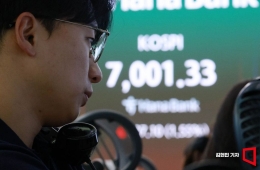
As tensions in the Middle East escalate and international oil prices surpass $100 again, affecting the domestic stock market, employees are monitoring the stock market, exchange rates, and oil prices at the dealing room of Hana Bank's headquarters in Jung-gu, Seoul on the 11th. On this day, the KOSPI opened at 6,802.50, down 231.42 points (3.29%) from the previous session, and the KOSDAQ started at 816.91, down 20.01 points (2.39%), gradually reducing the decline. September 11, 2026, Photo by Cho Yongjun
View original imageHowever, the U.S. stock market managed to recover a significant portion of its early losses by the close. Regarding this, Ji Young Han, a researcher at Kiwoom Securities, noted, "The possibility of a move above 5% had already been considered, and market bets that the Federal Reserve would not continue with successive rate hikes appear to have supported the market’s lower bounds." He added that instead of interpreting the 10-year yield reaching 5% as a signal of a downtrend for equities, it would be more appropriate to wait and assess whether market interest rates stabilize after the upcoming September FOMC later this week before adjusting positions.
The Korean stock market is also likely to recover some of its losses from the previous session, helped by the narrowing declines in the U.S. market during intraday trading. In the case of semiconductor stocks, a growing wave of selling has appeared due to concerns over an AI slowdown. Han explained, "The rapid pace of AI technological advancement is spurring the selling trend. While the market is not fundamentally doubting AI industry growth, in a situation where there is noise in the prevailing narrative, the additional uncertainty ahead of the September FOMC has heightened sensitivity to negative news."
Hot Picks Today
 "I Went for the Cheap Coffee, but Now I Feel Uneasy"... Major Coffee Franchises Cited for Violations One After Another
- “No Room Available Despite Advance Reservation”… Lodging Industry’s 'Contract Breaches by Businesses' Surpass Last Year’s Annual Total in Just 8 Months
- In Korea, Studying Medicine Is in High Demand, but in China, It's Shunned: "Why Become a Doctor When You Can’t Make Money?"
- "50 Million Won for Weekly Encounters"... Man in His 60s Sentenced for Deceiving Woman in Her 20s with Forged 1.4 Billion Won Account
- "After Spending 170,000 Won on Hanwoo, This Is What I Got": Why Webtoon Artist Kim Gyusam Decided to Give Cash Instead
With news regarding AI regulation and safety emerging, there is a possibility that short-term volatility in semiconductor stock prices may increase, necessitating caution for investors. However, as there have not yet been signs of reduced AI investment or weakening memory demand, the practical benefit of responding with aggressive selling amid higher volatility is expected to be limited. Han suggested that at this point, it would be reasonable to either maintain existing positions or diversify some holdings into shareholder-friendly sectors such as banking, insurance, and holding companies, which have relatively lower betas compared to the KOSPI and semiconductor stocks and have provided stronger downside protection.
© The Asia Business Daily. All rights reserved. Unauthorized AI training and use prohibited.