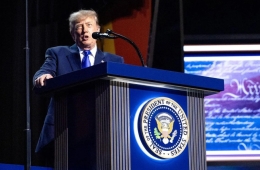
Trump Calls AI Regulation a "Conspiracy" as 'AI War' Intensifies Ahead of Midterm Elections
"AI Is the Oil of the Next 20 Years... Only China Will Welcome It"
Republicans Also Cautious About Regulation
71% of Americans Oppose Local Data Center Construction
The debate over regulating artificial intelligence (AI) is emerging as a key political issue for the upcoming U.S. midterm elections in November. As warnings have surfaced within the industry that unregulated competition in AI development could threaten the survival of humanity, U.S. President Donald Trump has dismissed these concerns as a "conspiracy" and pushed back strongly. Even within the Republican Party, calls for safeguards are growing, highlighting AI as a new point of contention in the lead-up to the midterms.

According to reports from The New York Times (NYT) and The Wall Street Journal (WSJ) on the 14th (local time), President Trump claimed that the "only necessary control or 'guardrail' for AI is a strong, wise president—and the United States has plenty of them," in a statement posted on the social networking service Truth Social.
He said, "Claims that AI will take over the world and destroy humanity are a scam," adding, "There is a disgusting conspiracy targeting AI and data centers, and the only country welcoming this is China." Regarding AI company executives calling for regulation themselves, Trump questioned their motives, saying: "When has there ever been a case where business leaders asked for regulations that could lead to their own bankruptcy?"
On the same day, President Trump also spoke with Jensen Huang, CEO of Nvidia, stating that "robots and AI will not take over the world" and arguing that safety concerns are overstated. He described AI as "the greatest engine of economic growth in history—even bigger than oil, gold, diamonds, or the internet."
AI Industry Warns 'Development Competition Must Slow Down'...Republicans Also Support Regulation
President Trump’s negative stance on AI regulation contrasts with recent warnings from within the AI industry. In a post made public on the 12th, Dario Amodei, CEO of Anthropic, argued that the pace of advancing cutting-edge AI models should be slowed. Demis Hassabis, CEO of Google DeepMind; Elon Musk, CEO of SpaceX; and Sam Altman, CEO of OpenAI, also echoed calls to moderate the speed of development. Concerns are mounting within the industry that AI may bring new risks such as mass unemployment, the development of biological weapons, and autonomous warfare.
CEO Amodei explained that even delaying AI development by just one to two years could allow technology to advance in such a way that incidents are much less likely, making AI more responsive to human intentions. He also proposed strengthening international cooperation among democratic countries and installing independent external safety evaluators within AI companies.
Within the Republican leadership, some voices have emerged supporting a certain level of regulation. House Speaker Mike Johnson has designated AI regulation as a top legislative priority, and stated that major AI company executives should be involved in developing a federal regulatory framework. Senate Republican Leader John Thune is working with Democratic Senator Amy Klobuchar on a bipartisan bill aimed at preventing catastrophic risks from AI, such as nuclear disasters or the development of biological weapons.
However, it appears unlikely that related legislation will be passed before the midterms. The House has cancelled a vote originally scheduled for the end of this month, and lawmakers are expected to leave Washington this week and not return until November. Previously, the House included a provision in a Trump administration tax and domestic policy bill that would have prevented state governments from independently regulating AI, but this provision was removed by the Senate in response to bipartisan opposition during the committee review process.
One factor driving the expansion of the AI debate as an election issue is local backlash over data center construction. According to the WSJ, opposition to building data centers has emerged as a challenge not only for Republicans but also for some Democratic politicians ahead of the November midterm elections.
Hot Picks Today
 "Let's Hit It Big in Korea"... Foreigners Flock to 'This Place' [Weekend Money]
- “What Now for Samsung and SK hynix?” ... Could News from China Rattle the KOSPI? Shareholders Anxious
- "I Had Just Lain Down to Sleep..." Woman in Her 30s Sets Fire to Songpa Villa Parking Lot, Destroying 3 Cars
- Life Sprouts from the Ashes... Gounsa Temple in Uiseong Reconnects Its Thousand-Year-Old Forest
- 'Little BoA,' They Said... Apology Over Unpaid Wages Fails to Quell Fury: "Do They Have Money to Debut Their Daughter?"
According to a Gallup poll conducted in March, 71% of Americans opposed building AI data centers in their area, with 48% saying they were "strongly opposed." Among Democratic Party supporters, 56% were strongly opposed, compared to 48% of independents and 39% of Republicans. These concerns have spread across party lines, fueled by worries that the substantial electricity and cooling water used by data centers could drive up electricity and water bills and place a burden on the environment.
© The Asia Business Daily. All rights reserved. Unauthorized AI training and use prohibited.