President Lee: "Uzbekistan Is the Core Partner in Central Asia"... Launch of "Korea Desk" (Comprehensive)
Summit Talks with the Uzbek President
"Expanding Trade and Investment for Shared Prosperity"
Broader Cooperation in Critical Minerals, AI, and Defense
Launch of the Korea-Uzbekistan Business Council
Collaboration in High-Speed Rail and
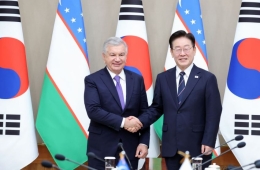
On September 14, President Lee Jae-myung held a summit with President Shavkat Mirziyoyev of Uzbekistan and agreed to broaden the axis of bilateral cooperation from the existing focus on transportation and infrastructure to cover strategic industries such as key minerals, artificial intelligence (AI), defense, and bio sectors. The two countries will institutionalize support for Korean companies' entry into Uzbekistan by officially launching the 'Korea Desk,' a dedicated body for Korean businesses within the Uzbek government, and by inaugurating a bilateral Business Council including entrepreneurs from both nations.

President Lee Jae-myung and President Shavkat Mirziyoyev of Uzbekistan are holding an expanded summit at the Blue House on the 14th. September 14, 2026. Photo by Yonhap News
View original imageIn the expanded summit held at the Blue House that afternoon, President Lee described Uzbekistan as “a core partner in Central Asia,” expressing his intention that the two countries should further expand trade and investment, forging a long-term, prosperous relationship together.
President Mirziyoyev also assessed Korea as “a special country” for Uzbekistan, stressing the significance of how bilateral relations have evolved from a strategic partnership into the only “special strategic partnership” among Central Asian nations. The intent is to leverage the trust accumulated between the two countries to further strengthen cooperation, particularly in economic and industrial fields.
During the talks, the two leaders discussed concrete cooperation measures to guide the “special strategic partnership” in a future-oriented direction. President Mirziyoyev noted that ties between Korea and Uzbekistan have developed into the closest and most exemplary partnership in Central Asia, and reaffirmed unwavering support for the Korean government’s policy on the Korean Peninsula.
On the economic front, the emphasis was on improving the business environment for Korean companies operating in Uzbekistan. The summit paved the way for the official opening of the 'Korea Desk' within the Uzbek government, dedicated to supporting Korean businesses. It also marked the launch of the first bilateral private-sector economic platform, the ‘Korea-Uzbekistan Business Council.’
The two presidents expressed expectations that the Korea Desk and the Business Council will provide institutional support for stable investment and local entry by Korean firms, and serve as channels for both governments and businesses to jointly explore new ventures.

President Lee Jae-myung and Uzbek President Shavkat Mirziyoyev greet a children’s welcoming group at the official welcoming ceremony held at the Blue House on September 14, 2026. Photo by Yonhap News Agency
View original imageThe scope of cooperation will also be widened to cover advanced and strategic industries. In the key minerals sector, the two sides agreed to strengthen collaboration across the entire supply chain continuum—from exploration and development to processing—centered around the ‘Korea-Uzbekistan Rare Metals Center.’ The plan is to combine Uzbekistan’s rich mineral resources with Korea’s processing and manufacturing prowess to enhance supply chain stability.
In the AI sector, the two countries will pursue joint transformation of the manufacturing field to an AI-driven paradigm, based on the ‘Manufacturing AI Transformation (AX) Cooperation MOU’ they signed. By collaborating on technology, talent, and infrastructure, the aim is to upgrade existing digital manufacturing partnerships into AI-based manufacturing innovation.
Bilateral cooperation in transportation and logistics infrastructure, an area of mutual strength, will also continue. The two leaders reviewed achievements such as high-speed rail projects and agreed to support Korean companies’ active participation in new Uzbek infrastructure projects, building on successful bids including the Tashkent New International Airport and Urgench Airport development and operation projects.
In particular, the introduction of eight high-speed train sets in Uzbekistan and the establishment of a national genomics and biobank center, the ‘Biome Center,’ will undergo feasibility studies through the Economic Development Cooperation Fund (EDCF). Based on study results, the scope of these projects will be specified and linked to Korean companies’ entry into the local transportation and healthcare infrastructure markets.
Defense has newly emerged as a major pillar of bilateral cooperation. The two presidents agreed to build on the high level of mutual trust to generate new achievements in the defense industry and to continuously broaden the sphere of cooperation. In conjunction with the summit, Korea Aerospace Industries (KAI) and UzTechTrade signed a defense cooperation contract.
In healthcare and bio, the plan is to strengthen the foundation for entering the pharmaceutical and medical device markets by establishing a medical health cluster and fostering regulatory cooperation in medical products. The goal is both to support the advancement of Uzbekistan’s health system through regulatory cooperation, and to improve conditions for Korean pharmaceutical and bio companies' local entry.
Both sides also agreed to strengthen joint responses to environmental challenges in Central Asia, such as the desertification of the Aral Sea and water scarcity. In addition to ongoing cooperation in forestry and environmental initiatives, the two countries will seek out new projects in renewable energy, energy efficiency, and landfill gas power generation to address climate change, as well as make progress on international greenhouse gas reduction projects.
They also pledged to expand people-to-people exchanges. In 2025, the number of reciprocal visitors between the two nations reached a record high of 150,000. The two governments will increase cooperation in tourism and education to further facilitate mutual visits. Korean language education will also be reinforced, with Uzbekistan adopting Korean as an official subject at its government-organized Olympiad, among other initiatives.
Given that Uzbekistan is home to the largest Koryoin (ethnic Koreans from the former Soviet Union) community in Central Asia, joint Koryoin-related endeavors will continue. Marking the 90th anniversary in 2027 of the Koryoin settlement in Central Asia, the two countries have agreed to conclude the jointly promoted ‘Koryoin History Museum Project’ and to ensure that the historical legacy of Koryoin society is passed down to future generations.

President Lee Jae-myung and First Lady Kim Hye-kyung are heading to the dinner hall with Uzbek President Shavkat Mirziyoyev and First Lady Ziroat Mirziyoyeva at the Blue House on September 14, 2026. Photo by Yonhap News
View original imageImmediately following the summit, the two leaders attended a signing and exchange ceremony for a total of 13 agreements, MOUs, and contracts. The sectors included high-speed rail, bio projects, manufacturing AX, medical products, finance, defense, education, tourism, agriculture, intellectual property, and forestry. The Export-Import Bank of Korea and the Uzbek side also agreed to cooperate on joint project development and financial support for strategic sectors such as key minerals, AI and data centers, smart cities, and dedicated industrial complexes for Korean companies.
Hot Picks Today
 You Can Receive Monthly Payments Like a Pension Without Selling Your Home... The Local Mutual Growth Housing Pension That Provides 1.69 Million Won Each Month
- "Unimaginable in Korea"...Koreans Surprised by Secondhand Smoke in Japan and China Restaurants
- Iran Expands Hormuz Strait Sanctions to 77 Vessels, Including Korean Shipping Company Ships
- "Canceled After Five Days and Lost 770,000 Won"... Hit by Steep Fees After Pressing the Cancel Button
- "I Thought She Was an Ordinary SKT Employee... The Unexpected Identity of Nongshim's Third-Generation Bride"
In a written briefing, Kang Yujeong, Chief Presidential Spokesperson, explained, "The documents exchanged this time expand bilateral cooperation from a previously transportation- and infrastructure-centered focus to advanced industries and sectors felt directly by citizens, and encapsulate the concrete projects and institutional foundations supporting agreements reached between the two presidents. As a result, the relationship between our two countries has been provided a path for practical and forward-looking development, with past transport and infrastructure-centered cooperation now expanding into advanced industries and high-impact sectors, anchored by concrete projects and systems stemming from the summit accords."
© The Asia Business Daily. All rights reserved. Unauthorized AI training and use prohibited.

![How Did Tacos Come to Have Two Shells [Delicious Stories]](https://cwcontent.asiae.co.kr/asiaresize/307/2026091410392626963_1789349966.jpg)