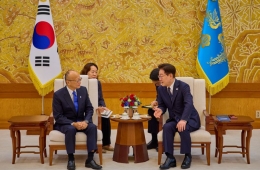
Yongcheol Choi, National Fire Agency Chief: "Organizational Culture Reform Plan to Be Announced on the 21st... Strict Action Against Misconduct"
First Press Conference Held in Sejong After Inauguration on the 14th
Blocking Tolerance of Misconduct... Establishing a Fair Personnel Evaluation System
Refining Field Response Systems... Strengthening Commander Training
Yongcheol Choi, Administrator of the National Fire Agency (pictured), announced that on September 21, he will officially release and begin implementing the "Comprehensive Plan for Reforming the Organizational Culture of the National Fire Agency." He expressed his determination to strictly address negative practices within the organization, including misconduct, abuse of authority, and unfair instructions.

On September 14, Administrator Choi held his first press conference with reporters in Sejong City following his inauguration and stated, "Regardless of position or rank, any wrongdoing will be corrected." He identified the establishment of a fair and healthy organizational culture that employees can truly experience as his top priority.
The National Fire Agency is currently finalizing the reform plan by collecting feedback from staff surveys, anonymous tips, and on-the-ground opinions. This plan aims for continuous and structural improvement, rather than being a one-time campaign.
The core measures include strengthening central inspection functions, establishing protection systems for anonymous reporting, and eliminating the tacit acceptance of misconduct due to nepotism or favoritism. The personnel evaluation system will also be revised to focus on competency, performance, character, and leadership, with the goal of building an organization where quietly diligent staff receive proper recognition.
Alongside the organizational culture reform plans, Administrator Choi outlined the main direction of fire service policy as “Staying true to the basics, strong on the ground, and trusted by the public as 119.” He emphasized, "The starting point for firefighting is the field," and that the ultimate goal of all policies is to protect people's lives at the scene of disasters.
He also stressed, "As important as saving the public is ensuring that first responders deployed to the scene return safely after their missions." He announced plans to further refine the on-site response system, covering everything from checking risk information to entry and withdrawal procedures.
To this end, the National Fire Agency will establish the core field response process — “Command Declaration-Situation Assessment-Strategy and Tactics-Decision to Deploy” — under the slogan “Ground Combat.” This ground combat slogan will be incorporated into standard operating procedures (SOP) as well as education and training, with the aim of fostering a workplace culture where the fundamentals are applied automatically even in crisis situations.

In order to enhance disaster response capabilities, the National Fire Agency will also significantly strengthen training and competency verification systems for commanders. The policy management course for those promoted to Senior Fire Superintendent will be extended from four to 24 weeks, and will be fully implemented starting January 2027. Additionally, command competency training will be provided for each rank, including Fire Commissioner, Senior Fire Superintendent, Fire Superintendent, and Fire Captain. Next year, command competency enhancement centers will be expanded, starting in Daegu and then in Jeonnam, Chungbuk, and Northern Gyeonggi Province.
Beginning in March next year, a new senior executive competency evaluation system will be introduced for candidates for Senior Fire Superintendent, assessing organizational management, strategic planning, communication, and collaboration skills. The personnel system will shift away from a focus on career length or years of service to one that evaluates real command and organizational management abilities.
In the first half of next year, stress prevention and trauma management education will be newly added to the basic training course for new firefighters. This is intended to enhance the psychological resilience and on-site adaptation of new recruits through progressive exposure to disaster scenes, understanding of stress responses, and learning from real-life coping cases.
Hot Picks Today
 "You Can't Settle for Less Just Because You're Eating Alone" Dining Alone for 100,000 Won a Meal... Solo Buffet Reservations Soar by 216%
- "Each 10-Won Drop in Exchange Rate Boosts Profit by 2.5 Billion Won"...Stocks Benefiting from the Strong Won at 1,340 Won Level
- "Unimaginable in Korea"...Koreans Surprised by Secondhand Smoke in Japan and China Restaurants
- "What Did They Put on the Porsche?"...The Story of a 27-Year-Old Chinese Owner Who Covered Their Car with Photos of 90 Missing Children
- "Canceled After Five Days and Lost 770,000 Won"... Hit by Steep Fees After Pressing the Cancel Button
Administrator Choi said, “What the public expects from firefighters is for 119 to be the first to arrive in a crisis and someone they can trust and rely on. We will strengthen response systems and commander training to ensure that fundamentals and principles function properly in the field, and promptly correct any bad practices so that both the public and our members can have confidence in the fire service organization.”
© The Asia Business Daily. All rights reserved. Unauthorized AI training and use prohibited.

![How Did Tacos Come to Have Two Shells [Delicious Stories]](https://cwcontent.asiae.co.kr/asiaresize/307/2026091410392626963_1789349966.jpg)