President Lee Meets ADB Chief: "Expanding Cooperation on Critical Minerals and Energy in Central Asia"
President Lee Meets ADB President Kanda Ahead of Korea-Central Asia Summit
Discussions on Cooperation in AI, Nuclear Power, and Energy Infrastructure
On September 14, President Lee Jae-myung met with Masato Kanda, President of the Asian Development Bank (ADB), and agreed to expand cooperation in areas such as core mineral supply chains with Central Asia, artificial intelligence (AI), and energy infrastructure including nuclear power. With the first Korea-Central Asia summit scheduled for September 16, President Lee aims to link Central Asia summit diplomacy with the ADB’s financial and development capabilities to broaden the global reach of Korean companies.

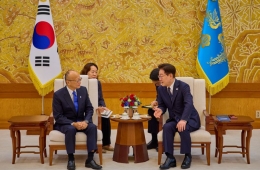
President Lee Jae-myung met with Masato Kanda, President of the Asian Development Bank (ADB), at Cheong Wa Dae on the 14th to discuss issues related to Korea-Central Asia cooperation. (Source: President Lee Jae-myung's X)
View original imageAccording to a written briefing by Kang Yoo-jung, Chief Spokesperson for Cheong Wa Dae, President Lee held the meeting at 11 a.m. in his office, receiving President Kanda of the ADB, who visited Korea to attend the Korea-Uzbekistan Summit and the Korea-Central Asia Summit.
President Lee emphasized, "Central Asia is a region with significant growth potential due to its abundant resources and geographic advantages," and proposed expanding collaboration between Korea and the ADB. President Kanda, praising Korea’s remarkable achievements amid an uncertain global economy, expressed admiration for President Lee’s leadership in AI and the digital sector.
Both sides identified core mineral supply chains as a top priority for cooperation. President Lee underscored the need for enhanced collaboration between Korea—which possesses strong technological and industrial capabilities—and the ADB, which has extensive business experience and financial tools throughout Asia, particularly to stabilize the supply chain of critical minerals in Central Asia, including Uzbekistan. President Kanda stated that core mineral supply chains are a key focus area for the ADB, expressing hope for stronger cooperation with Korea, given its industrial strengths.
Central Asia boasts abundant reserves of major mineral resources, including uranium, copper, and rare earth elements, making it of growing strategic importance to Korea as it seeks to diversify its supply chains. The government plans to use this round of Korea-Central Asia summit diplomacy as an opportunity not only for resource development but also to expand supply chain collaboration into areas such as refining, processing, and industrial partnerships.
In the field of AI, Korea will combine its technological capabilities with the ADB’s development experience. President Lee outlined the government's "AI for All" vision and Korea's global AI cooperation initiatives, stressing that "a combination of Korea's AI strengths and the ADB's development expertise can produce meaningful outcomes."
In the energy sector, they discussed ways to integrate Korean business technologies and experience into ADB-led projects to expand energy infrastructure in the Asia-Pacific region, such as the ASEAN (Association of Southeast Asian Nations) power grid and financial support for nuclear power. Both sides agreed to actively cooperate to ensure that Korea’s expertise plays a key role in future related projects.
Hot Picks Today
 "You Can't Settle for Less Just Because You're Eating Alone" Dining Alone for 100,000 Won a Meal... Solo Buffet Reservations Soar by 216%
- "Each 10-Won Drop in Exchange Rate Boosts Profit by 2.5 Billion Won"...Stocks Benefiting from the Strong Won at 1,340 Won Level
- "Unimaginable in Korea"...Koreans Surprised by Secondhand Smoke in Japan and China Restaurants
- From 1.75 Million to 140 Million Won a Month... Former National Team Player Earns '80 Times More' After Putting Down the Racket
- "Canceled After Five Days and Lost 770,000 Won"... Hit by Steep Fees After Pressing the Cancel Button
This meeting took place ahead of the inaugural Korea-Central Asia Summit, which will be held in Seoul on September 16. The government plans to elevate the Korea-Central Asia Cooperation Forum, established in 2007, to a summit-level platform and broaden the scope of collaboration to include core minerals, energy infrastructure, and AI.
© The Asia Business Daily. All rights reserved. Unauthorized AI training and use prohibited.


![How Did Tacos Come to Have Two Shells [Delicious Stories]](https://cwcontent.asiae.co.kr/asiaresize/307/2026091410392626963_1789349966.jpg)