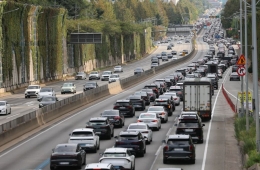
"This Chuseok Feels Too Short, Let's Take Monday Off Too"... Anticipation Grows for Surprise Designation of September 28 as a Temporary Public Holiday
No Official Review or Designation by Government Yet
Mixed Opinions on Boosting Domestic Demand Versus Increased Burden on Businesses
With about ten days remaining until the Chuseok holiday, there is growing demand to designate Monday, September 28—the day after the holiday—as a temporary public holiday, granting people an extra day off. This year’s Chuseok holiday, including the weekend, lasts only four days, which feels relatively short compared to last year when, by taking a single annual leave day, people could rest for up to ten days.

However, under current regulations, September 28 is not automatically recognized as a substitute holiday. Designating it as a temporary public holiday would require a separate government decision. As of now, the government has not issued any official stance or announcement regarding the designation of September 28 as a public holiday.
This Year’s Chuseok Holiday Lasts Four Days… 28th Not Eligible as a Holiday
This year’s Chuseok holiday runs for three days from Thursday, September 24 to Saturday, September 26. With Sunday, September 27 immediately following, employees on a five-day workweek will actually have a four-day break. Last year, overlapping holidays such as National Foundation Day, Hangeul Day, weekends, and substitute holidays meant that by using just one day of annual leave, it was possible for some to enjoy up to ten days off, making this year feel notably shorter by comparison.
Some have expressed hope that since the last day of the Chuseok holiday, September 26, coincides with a Saturday, Monday the 28th should automatically be treated as a substitute holiday.
However, under the current “Regulations on Holidays of Government Offices,” substitute holidays are only applied when the Chuseok holiday overlaps with a Sunday or another public holiday. This year’s Chuseok holiday period (September 24–26) does not overlap with a Sunday, and thus is excluded from the list of automatic substitute holidays by law. Ultimately, the only way the 28th can be designated as a holiday is through a Cabinet meeting resolution, whereby the government officially declares it a temporary public holiday.
There Is Precedent for Last-Minute Designation… But Possibility Remains Uncertain
There remains a possibility, however slim, that September 28 could still be made a temporary public holiday. Over the past 11 years, the government has designated a total of seven temporary public holidays to ensure people’s rest and to stimulate domestic demand. There have even been cases where such designations were made less than two weeks before the holiday itself. For example, the temporary holiday on August 14, 2015 was announced only 10 days beforehand, while the May 6, 2016 temporary holiday was announced just eight days in advance.

However, these past cases do not guarantee a designation this year. So far, the government has not officially indicated that it is even considering making September 28 a temporary public holiday.
Stimulating Domestic Consumption vs. Outflow Overseas… Economic Calculations Also a Factor
Concerns Over Disruptions in Industry and Gaps in Childcare
The main reason the government remains cautious about designating a temporary public holiday is the mixed views on its potential economic impact. While the policy has been aimed at boosting private consumption and revitalizing the domestic economy, critics have pointed out that longer holidays tend to prompt more people to travel overseas rather than spend domestically, aggravating the outflow of consumers.
In fact, during last year’s extended Lunar New Year holiday—made possible by the designation of a temporary public holiday—2,972,916 people traveled abroad within just one month, marking the highest departure volume on record. This has led to criticism that longer breaks do not necessarily translate into expanded domestic consumption.

View of Incheon International Airport Terminal 1 on January 24, last year, ahead of the Lunar New Year holiday.
View original imageThere are also concerns about the burdens such a decision imposes on businesses and the private sector. If Monday the 28th were to suddenly become a public holiday, manufacturing firms in particular would inevitably face lost productivity due to interruptions in operations, along with higher costs in the form of legally mandated holiday pay. Additionally, unplanned closures of schools and daycare centers would pose significant challenges for working parents of young children due to gaps in childcare.
Debate Intensifies Online; Government Remains Cautious with No Official Review
Opinions are similarly divided online regarding the idea of a temporary public holiday. In communities for office workers, many welcome the proposal, noting that travel time alone often consumes most of the holiday, and that being able to travel long distances without taking additional annual leave would be a relief. On the other hand, some argue that simply adding holidays in difficult economic times is pointless, and point out that other public holidays such as the National Foundation Day and Hangeul Day are already scheduled for early October, making normal work necessary.
Among small business owner communities—particularly those focused on local commercial districts—there are strong concerns that longer holidays will drive urban populations out of the city, resulting in direct harm to business operations, prompting widespread caution against prematurely designating additional holidays.
Hot Picks Today
 "Auntie, When Will Dried Shredded Squid Return as a Side Dish?"...Once Vanished from Restaurants, Now Making a Comeback
- Monthly Salary Soars 3.7 Times from 8.25 Million Won to 30.59 Million Won... 86 Fair Trade Commission Retirees Join Law Firms Over 10 Years
- "You've Earned Your Wealth—Now It's Time to Use It Well"...Seniors Turning to Financial Centers Before Illness Hits [Finance Embracing Seniors] ①
- Stain Found on Asian Games Gold Medal, Replaced Same Day; Japan Praises Its Own Response
- "V and Go Yoonjung Wear Them Too"... The Transformation of the ‘Grandma Ring’ Captivates Foreigners [K-Holic]
If the government makes no statement regarding a temporary public holiday, Monday, September 28 will remain a regular weekday with standard work and school schedules. As additional public holidays are already scheduled in early October, all eyes remain on whether the government will make any last-minute decision that could change the status quo.
© The Asia Business Daily. All rights reserved. Unauthorized AI training and use prohibited.