Trump Insists "U.S. Rates Must Be Lowest in the World"... Repeats Pressure Ahead of FOMC (Comprehensive)
Blaming Zelensky for Soaring Diesel Prices
"Attacks on Russian Refineries Must Stop"
"Not Worried About Xi Cancelling U.S. Visit"
U.S. President Donald Trump once again pressured the Federal Reserve (Fed) ahead of the Federal Open Market Committee (FOMC) regular meeting, insisting that the U.S. base interest rate should be the lowest in the world. He placed the blame for the recent surge in U.S. diesel prices on Ukraine’s attacks on Russian refineries, and stated he was not concerned about the possibility of Chinese President Xi Jinping canceling his planned visit for the U.S.-China summit scheduled for the 24th.

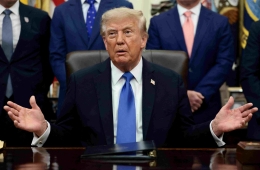
While visiting Ireland, President Trump met with journalists at his own Doonbeg Golf Club on the 13th (local time), declaring, "America should have the lowest interest rate in the world," and added, "It doesn’t matter what the economic indicators say."
As the FOMC is set to convene on the 15th and 16th, he made a public demand for the Fed to lower interest rates. The current U.S. base interest rate is 3.50 to 3.75 percent per year.
When asked about his predictions for the FOMC outcome, President Trump replied, "I don’t know," but again argued that it is unfair for the U.S. to shoulder higher interest rates than other countries. He also raised the possibility of halting trade with nations with which the U.S. runs a trade deficit, underlining the necessity for rate cuts.
However, recent inflation data suggests the Fed would have a difficult time deciding to cut rates. In August, the U.S. Producer Price Index (PPI) rose 0.4 percent from the previous month and 5.4 percent from a year earlier. As inflationary pressure mounts again due to rising energy prices, some in the market even speculate that the Fed could further raise rates.
Kevin Hassett, White House National Economic Council(NEC) Director, stated that while President Trump wants lower rates, he continues to support Fed Chair Kevin Warsh’s independence. Nevertheless, with President Trump mentioning the rate level just before the FOMC, the debate about political pressure on the central bank looks set to continue.
"Stop Attacks on Russian Refineries"... Surge in Prices Blamed on Zelensky

The background behind President Trump’s intensifying calls for rate cuts appears to be the political pressure ahead of the midterm elections. With U.S. diesel prices exceeding $6 per gallon for the first time ever, cost-of-living concerns have emerged as a key issue ahead of the November midterms. President Trump identified Ukraine’s attacks on Russian refineries, rather than the war in Iran, as the main cause of the spike in diesel prices.
He said, "We spoke with Ukrainian President Volodymyr Zelensky about the issue," adding, "There are plenty of other targets to strike, so I told him not to hit diesel fuel facilities."
He further emphasized that Ukraine’s attacks have triggered a global diesel shortage, reiterating, "There must be a halt to acts of destroying Russia’s diesel-related infrastructure."
Ukraine has carried out focused attacks on Russian refineries, deploying drones and other means in an effort to undermine Russia’s war finances and fuel supply network. In response, Russia has imposed restrictions on diesel exports. As one of the world’s major diesel exporters, reduced Russian production and exports have contributed to the rise in global prices.
According to the American Automobile Association (AAA), the average U.S. diesel price has soared past $6.20 per gallon, reaching a record high. The causes include not only supply concerns stemming from the Iran war and attacks on Gulf energy facilities, but also Russia’s refinery disruptions.
However, President Trump’s decision to highlight Ukraine’s actions, rather than a more complex mix of factors such as Middle East tensions or the limited ability of American refiners to boost output, is interpreted as a political move to place responsibility for rising fuel prices on President Zelensky.
"Not Worried About Xi Cancelling U.S. Visit... Excellent Relations with China"

U.S. President Donald Trump and Chinese President Xi Jinping are leaving the venue after concluding the U.S.-China summit at Naraemaru within the 5th Air Mobility Wing of Busan Air Force Base in 2025. Photo by Yonhap News Agency
View original imagePresident Trump also expressed confidence that President Xi’s visit to the U.S. and the U.S.-China summit, scheduled for the 24th, would proceed as planned. When asked whether he was concerned that President Xi might cancel his visit to the U.S. due to the Iran war, he replied, "No."
President Trump said, "We have maintained an excellent relationship," and added, "He wants the best for himself, and so do we." He continued, "I believe that during my years in office, China treated us very fairly." He criticized previous administrations, claiming, "China made enormous gains during the Biden and Obama administrations."
If President Xi’s visit goes ahead, it will mark his first trip to Washington since 2015. Although President Trump visited China in May and held a summit with President Xi, the two countries were unable to make meaningful progress on major issues such as extending the trade truce.
Accordingly, this summit is expected to focus on key agendas including tariffs and trade friction, export controls on advanced semiconductors, the Taiwan issue, and the passage issue in the Strait of Hormuz.
Hot Picks Today
 "Each 10-Won Drop in Exchange Rate Boosts Profit by 2.5 Billion Won"...Stocks Benefiting from the Strong Won at 1,340 Won Level
- "Foreign Investors Buy In, While Executives Sell: 'K-Beauty Stock' Soars 87% in Two Months"
- "Dividend Payouts of 40 Million Won Before Their First Birthday"...'Baby Shareholders' Put Ordinary Workers at a Disadvantage
- "Don't Use Chinese-Made Products": One U.S. Warning Triggers a 5 Trillion Won Jackpot for Korean Batteries [Weekend Money]
- '12 Billion Bottles of Surplus' – Enough for the World to Drink for 3 Years... Wasn't MZ Just Trending Recently?
The United States hopes that Saudi Arabia, which maintains close ties with Iran, will leverage its influence to help resolve the crisis. However, it remains uncertain whether China will directly pressure Iran, its strategic ally.
© The Asia Business Daily. All rights reserved. Unauthorized AI training and use prohibited.