Lee Cautions Against Reform "Purity" and "Reaction"... Dilemma as Moderate and Traditional Supporters Drift Away
Lee Jae-myung’s Reform: Aiming for Broad Consensus, Distancing from Radical Demands
Real Estate and Prosecutorial Reform Spark Disputes over Pace and Methods
Constitutional Amendment and Special Prosecutor Fuel Controversy Over Personal Interest
The 1789 French Revolution toppled the monarchy, but it did not end in a simple victory for the revolutionary forces. As the revolution grew more radical, the Jacobin "Reign of Terror" ensued, and after Robespierre's fall in 1794, the Thermidorian Reaction began. The subsequent government, the Directory, also failed to resolve the economic crisis and political turmoil, eventually leading to Napoleon's coup and consolidation of power in 1799. After Napoleon's downfall, the monarchy was even restored. While factors such as war and economic difficulties played a role, the narrowing of the revolution's support base and the growth of backlash due to its increasing radicalization is an enduring lesson from the history of the French Revolution.

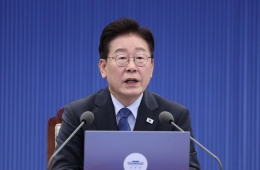
President Lee Jae-myung is seated after the national anthem during the Senior Secretary Meeting held at the Blue House on September 11, 2026. Photo by Yonhap News
View original imageThis is why President Lee Jae-myung has recently been repeatedly invoking the term "reaction." At a meeting with expatriates in Paris, France, on September 9 (local time), President Lee referred to the French Revolution, stating, "By pushing the situation too far, they eventually faced what is known as a reaction." He added, "Through counter rallying and the departure of moderates, the revolution faced a dark period of counterrevolution," emphasizing that "when there is an abundance of energy, there is a need for restraint."
He continued to deliver the same message after returning to Korea. On September 12, through X (formerly Twitter), President Lee wrote, "Reform is more difficult than revolution," and stressed, "We must be vigilant against radical agitation meant to showcase one's ideological purity, as this leads to resistance, counter rallying, ultimately impedes reform, and causes a reaction." He also stated, "Holding authority must come with corresponding unlimited responsibility."
Notably, his remarks that "elections and wars are different" and "all public officials should be servants for all" were interpreted as messages aimed internally at his own political camp. President Lee's line of thinking appears to be that, even after a presidential election victory, it is not possible to achieve stable reform by having the winning side monopolize all state authority or by directly incorporating the demands of its support base into government policy. Ultimately, the approach Lee seems to advocate is to "maintain the goals of reform but find the greatest common denominator in its pace and methods that moderates can also agree to."
However, recent public opinion trends diverge from President Lee's hopes, showing simultaneous declines in support among moderates and progressives. In a Korea Gallup poll conducted on July 17, President Lee's positive job performance rating stood at 52%. At that time, 84% of progressives and 55% of moderates gave a positive assessment. In a subsequent survey conducted less than two months later, on September 11, the overall positive rating dropped to 38%. Among progressives, the figure fell to 63%, and among moderates, it was only 37%. While the overall approval rating declined by 14 percentage points, support among progressives dropped by 21 percentage points and among moderates by 18 percentage points.
The same trend is evident in other surveys. According to NBS, President Lee's approval rating was 55% on July 16, with progressives at 85% and moderates at 57%. In the survey conducted on September 10, the overall approval dropped to 43%, with progressives at 70% and moderates at 41%. For the first time, the negative rating of 48% surpassed the positive rating. Both polling agencies indicated a concurrent decline in support among moderates and progressives, rather than consolidation among progressives as moderates depart.
This trend appears in individual policy areas as well. Housing policy faces criticism for excessive taxes and regulations, while others argue that the reversion to pre-existing comprehensive real estate holding tax rules for single non-resident homeowners marks a policy "retreat." In the latest NBS survey, only 24% positively evaluated the government's real estate policy, while 65% were negative. In Korea Gallup surveys, real estate has recently topped the list of reasons for negative presidential evaluations.
Public opinion on prosecution reform shows a similar pattern. While the abolition of the prosecution's direct and supplementary investigative powers and the establishment of public prosecution and major crimes investigation agencies have been discussed, moderates have voiced concern over potential negative side effects. Some in the ruling camp and segments of the progressive camp also criticize follow-up institutional reforms, arguing that these do not sufficiently dismantle the existing prosecution authority and labeling this as "reform retreat." Recently, there have even been disagreements over the Blue House's nomination of Kim Ji-hong, who had opposed reducing the prosecution's investigative powers, as the first head of the Major Crimes Investigation Agency.
The same is true for evaluations of the second-term cabinet appointments. When controversy surrounding Yong Hye-in, the Minister of Gender Equality and Family nominee, expanded, party leadership, including Kim Min-seok, representative of the Democratic Party, effectively urged her to resign, citing "public sentiment." Yong ultimately resigned voluntarily on September 13, just 14 days after her nomination. Given that the Blue House had maintained its position that her nomination should be judged in a parliamentary hearing, it is clear that deteriorating public opinion swayed even personnel decisions. Consequently, the Blue House has lost even the symbolic significance of appointing "2030, women, and progressives."
The push for constitutional reform was originally intended to promote the decentralization of power and a restructuring of the political system, but as the issue of introducing a four-year consecutive presidential term and whether it would apply to the current president came into focus, the debate has shifted to whether this is simply a "Lee Jae-myung consecutive term constitutional amendment." Although President Lee reiterated at the Paris meeting that "my term is clearly limited under the Constitution," there are persistent calls from all political camps for him to more explicitly rule out any intention to seek reelection. A similar situation surrounds the special investigation into alleged fabricated indictments, originally intended to shed light on illegal or unjust prosecutorial investigations. Separate from its original intent, the debate around the special investigation has grown into suspicions that it aims to cancel the prosecution of President Lee, thus increasing political pressure.

President Lee Jae-myung is delivering an encouragement speech at a luncheon meeting with overseas Koreans held at a hotel in Paris, France on the 9th (local time). 2026.9.9 Yonhap News Agency
View original imageAccordingly, there is a growing call for more transparent and clarified stances—in housing policy, prosecution reform, and appointments, to restore trust in policy judgment and decision-making, and in constitutional reform and the special investigation into fabricated indictments, which have become entangled with the president's personal interests. There are concerns that if President Lee's style of reform is seen as a retreat or merely an adjustment of pace for political advantage, it will not be easy to regain support from either moderates or progressives.
Attention now turns to the upcoming press conference, where President Lee is expected to clarify his positions on these issues. Whether his repeated warnings about "reaction" signal changes in the direction, pace, or methods of governance and reform, and how far he will draw the line regarding a "consecutive term constitutional amendment" or the possibility of "dropping the charges" in his own case, are key points to watch. As both moderates and progressives waver, the need for President Lee to directly explain the concrete meaning of his "restrained reform" as well as the future direction of his administration is only increasing.
(※ Please refer to the website of the National Election Survey Deliberation Commission for detailed results of the Korea Gallup and NBS opinion polls.)
Hot Picks Today
 "Foreign Investors Buy In, While Executives Sell: 'K-Beauty Stock' Soars 87% in Two Months"
- "Don't Use Chinese-Made Products": One U.S. Warning Triggers a 5 Trillion Won Jackpot for Korean Batteries [Weekend Money]
- 1,000 Names Fill the Paper, But Only 3 Stand on the Podium: The Dilemma of the Nobel Prize at 125 Years [125 Years of the Nobel Prize]①
- "Dividend Payouts of 40 Million Won Before Their First Birthday"...'Baby Shareholders' Put Ordinary Workers at a Disadvantage
- '12 Billion Bottles of Surplus' – Enough for the World to Drink for 3 Years... Wasn't MZ Just Trending Recently?
© The Asia Business Daily. All rights reserved. Unauthorized AI training and use prohibited.