Hyundai Research Institute Raises This Year’s Growth Forecast from 2.7% to 3.5%... Next Year to 2.4%
Expanded AI Investment and Robust Semiconductor Exports
Recovery in Facility Investment and Increase in Fiscal Spending

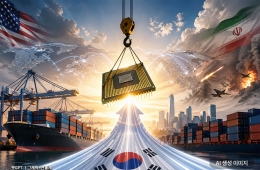
The Hyundai Research Institute has significantly raised its forecast for South Korea's economic growth rate this year from the previous 2.7% to 3.5%. The institute attributes this upward revision to robust semiconductor exports stemming from increased global investment in artificial intelligence (AI), a recovery in facility investment, and expanded government fiscal spending, all of which have contributed to South Korea's entry into an economic expansion phase. However, for next year, the institute projects that export growth will slow considerably, causing the growth rate to drop to 2.4%.
In its report released on the 13th, titled "Tasks Left by Growth in the 3% Range: The Need for Qualitative Growth through Structural Improvement," the Hyundai Research Institute forecasted this year’s economic growth rate at 3.5%. This is 0.8 percentage points higher than the previous projection of 2.7%.
The main factor behind this upward revision in the growth forecast is exports. Benefiting from expanded global investment in AI, robust semiconductor exports continue, and the recovery in facility investment as well as the increase in government fiscal spending are contributing to the ongoing economic expansion.
The institute also anticipates that the expansionary trend will continue next year. While strong semiconductor exports are expected to persist, government spending will increase to 820.9 trillion won, supporting economic growth. Nevertheless, the growth rate is projected to fall by 1.1 percentage points, from 3.5% this year to 2.4% next year.
The pace of domestic demand recovery is also expected to slow. The private consumption growth rate is forecast to decrease from 2.4% this year to 2.0% next year. The institute explains that the base effect from this year’s increase in consumption, household debt burdens, and rising interest rates may constrain the recovery in consumption.
Facility investment growth is also expected to slow, from 5.3% this year to 3.7% next year. Although investment, especially in semiconductors and information technology (IT), is expected to continue, the institute pointed out that worsening corporate financing conditions due to rising interest rates could restrict further expansion of investment.
The area expected to see the most significant change is exports. The institute projects export growth will plunge from 50.8% this year to 2.9% next year. While strong performance is expected to continue, particularly in semiconductors and other IT products through the first half of next year, the base effect from this year's sharp increase will reduce the growth rate, and there is also a possibility that exports may decline in the second half.
The institute assessed that after achieving growth in the 3% range this year, structural improvements aimed at boosting the quality of growth, rather than the growth rate itself, will become more important. It recommended that efforts to revitalize domestic demand and enhance growth potential be carried out simultaneously, while expanding investment in AI and advanced industries, and diversifying export markets and product portfolios to reduce dependence on specific countries and industries.
Hot Picks Today
!["Don't Use Chinese-Made Products": One U.S. Warning Triggers a 5 Trillion Won Jackpot for Korean Batteries [Weekend Money]](https://cwcontent.asiae.co.kr/asiaresize/93/2025121709393659037_1765931975.jpg) "Don't Use Chinese-Made Products": One U.S. Warning Triggers a 5 Trillion Won Jackpot for Korean Batteries [Weekend Money]
"Don't Use Chinese-Made Products": One U.S. Warning Triggers a 5 Trillion Won Jackpot for Korean Batteries [Weekend Money]
- "Receiving 39 Million Won in Dividends Before Their First Birthday"... 'Baby Shareholders' Impacting Ordinary Workers
- Order Volume Surges by 9,000%...How Generation Z in China Finds Fulfillment With Just 20,000 KRW [China.zip]
- 24K Gold-Plated Details Set Record: World's Only Cadillac Sold for $1.8 Million, Becoming the Most Expensive in Brand's History
- Foreign Tourists Leave in Tears Praising Seoul: "Wi-Fi So Fast, My Fingers Can't Keep Up" [K-holic]
Regarding monetary policy, the institute advised that it should continue to be managed flexibly, with price stability and financial stability as fundamental principles, while comprehensively considering growth trends and domestic and international economic conditions.
© The Asia Business Daily. All rights reserved. Unauthorized AI training and use prohibited.