Yongin Mayor Lee Sang-il: "Samsung and SK Expected to Invest 1,600 Trillion Won in Yongin Semiconductor Complexes"
Mayor Lee Outlines Semiconductor Industry Development Policies on Legal Broadcasting
"Investment on the Scale of Two Years’ National Budget... Yongin Will Be Transformed"
Urges Government for Swift Solutions on Power and Water Supply, and Resolution of Transmission Line Disputes
Lee Sang-il, Mayor of Yongin Special City in Gyeonggi Province, appeared on the program “The Birth of Wealth with Kim Jinhee” on Legal Broadcasting on the night of the 12th. He stated, “It is estimated that Samsung Electronics and SK hynix will invest around 1,600 trillion won in the Yongin semiconductor industrial complexes—an amount equivalent to two years’ worth of Korea’s national budget. Yongin will undergo a complete transformation through these massive investments by anchor companies that are leading the global semiconductor market.”

Lee Sang-il, Mayor of Yongin Special City, appeared on Legal Broadcasting on the night of the 12th to introduce the city's semiconductor industry promotion policy. Photo by Legal Broadcasting
View original imageMayor Lee introduced the current status of the semiconductor industrial complexes being established by Samsung Electronics and SK hynix in Yongin, the results of attracting domestic and international materials, components, and equipment companies, and policies for fostering semiconductor talent. He also stressed that in order for the industrial complexes to succeed, the government must actively address the provision of electricity and water as well as resolve regional conflicts.
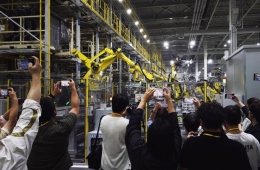
He explained, “Yongin is where Korea’s semiconductor industry first began in 1983. Specifically, in Nongseo-dong of Giheung-gu, which is home to the Samsung Electronics Giheung Campus. Samsung Electronics plans to invest 3.7 trillion won in this area of 370,000 pyeong to build a future research complex that will include semiconductor R&D and production facilities.”
In addition, SK hynix is investing 600 trillion won to build four semiconductor fabrication facilities on a 1.26 million-pyeong site in Wonsam-myeon, Cheoin-gu—forming the Yongin Semiconductor Cluster General Industrial Complex. Mayor Lee continued, “By February next year, half of the first fab will be completed, and a cleanroom on its first floor will begin operation. When the complex is finished in 2033, around 40,000 people are expected to work there.”
Samsung Electronics is also constructing a national advanced system semiconductor industrial complex on a 2.35 million-pyeong site in Idong and Namsa-eup, Cheoin-gu. With an investment of 360 trillion won by 2040, the company will build six production facilities, and once completed, the site is expected to operate with more than 105,000 residents.
Mayor Lee predicted that Samsung Electronics’ investment in the national industrial complex could increase significantly beyond the initially announced 360 trillion won.
He explained, “Considering Samsung has announced a 400 trillion won investment to build two fabs in Honam of a similar scale to Yongin, the investment to construct six fabs in Yongin could reach up to 1,000 trillion won. Combining this with SK hynix’s 600 trillion won, the total investment is projected to be about 1,600 trillion won.”
The three Yongin semiconductor industrial complexes were designated as national advanced strategic industry specialized complexes in July 2023. This designation raised the floor area ratio from 350% to 490%, allowing production facilities to be built with triple-stacked floors. SK hynix also expanded its initial investment plan from 122 trillion won to 600 trillion won.
Mayor Lee also outlined Yongin’s success in attracting all of the world’s top four semiconductor equipment manufacturers. The world’s top photolithography company, ASML from the Netherlands, has established a field service office in Wonsam-myeon, while Applied Materials Korea from the United States plans to set up a large field office in a nearby collaboration complex.
Meanwhile, Lam Research, the world’s third-largest semiconductor equipment manufacturer, has built R&D facilities in the Jigok Industrial Complex in Giheung-gu, and Tokyo Electron, the world’s fourth-largest, is also pushing to construct a research center in Wonsam-myeon. Domestic semiconductor firms such as SEMES, Jusung Engineering, Wonik IPS, and Soulbrain, all partners of Samsung Electronics, have also decided to invest in Yongin.
Mayor Lee emphasized that strengthening the competitiveness of domestic companies is as important as attracting global materials, components, and equipment firms. He added, “Not only local governments but also systemized policies at the central government level are needed to ensure that our companies can demonstrate their capabilities in the global market.”
He also highlighted the importance of the Yongin national industrial complex by mentioning the difference in market share between Taiwan’s TSMC and Samsung Electronics in the field of system semiconductors.

Lee Sang-il, mayor of Yongin Special City, appeared on the Legal Broadcasting Channel on the night of the 12th to introduce the city’s semiconductor industry promotion policy. Provided by Yongin City
View original imageMayor Lee noted, “While TSMC accounts for about 70% of the non-memory market, Samsung Electronics holds only around 7%. The advanced system semiconductor national industrial complex in Yongin is intended to serve as the advance base for narrowing the gap with TSMC in the non-memory sector, and the success of this industrial complex is the key to boosting Korea’s future competitiveness.”
He also called for measures to secure two core elements for the semiconductor industry: power and water supply.
Mayor Lee explained, “Electricity and water pipelines for the operation of the first and second fabs of SK hynix have already been secured, but the government must quickly establish solutions for the third and fourth fabs. For Samsung Electronics, the plan is to provide 3 GW of power to the first and second fabs by building six LNG power plants on the complex site, but a specific plan for the third through sixth fabs has not yet been developed.”
He further stated, “To operate both Yongin semiconductor complexes, 16 GW of electricity and about 1.1 million tons of water per day will be required. The government must quickly draw up and implement a supply plan in consultation with Korea Electric Power Corporation and Korea Water Resources Corporation, among others.”
He continued, "For the water pipeline to supply the first and second Samsung Electronics fabs, it is necessary to connect approximately 46 kilometers from Paldang Dam, and the integrated pipeline to supply Samsung’s third through sixth fabs and SK hynix’s third and fourth fabs should also connect from Paldang Dam and Hwacheon Dam. The government must take proactive measures at the national industrial policy level to resolve regional conflicts surrounding the construction of transmission lines.”
Hot Picks Today
!["Long Lines in Korea, But Did You Know This Story?... The Pride of Mexican Soul Food [Delicious Stories]"](https://cwcontent.asiae.co.kr/asiaresize/93/2026091113030025126_1789099380.jpg) "Long Lines in Korea, But Did You Know This Story?... The Pride of Mexican Soul Food [Delicious Stories]"
"Long Lines in Korea, But Did You Know This Story?... The Pride of Mexican Soul Food [Delicious Stories]"
- Cracks in Samsung and SK hynix’s Duopoly?... Micron’s Bet with the ‘100,000 HBM Wafers’ Bomb [ChipTalk]
- "This Is the Must-Visit Spot for Foreigners in Korea—Not Olive Young or Daiso... How Foreign Tourists Are Changing the Profit Formula [Weekend Money]"
- "Can't You Pay a Bit More?"... Survey Shows Men and Women Differ on Fair Way to Split Dating Expenses
- "The Effects of 'Perfect Beauties' on Mental Health: Just How Harmful Are Unrealistic Standards? [Experiment Note]"
© The Asia Business Daily. All rights reserved. Unauthorized AI training and use prohibited.