[Energy Odyssey]②After 46 Years, Korea’s Oil Stockpiling Paradigm Shifts...From “Static Stockpiling” to “Dynamic Stockpiling”
Ⅰ. Korea Caught in an Energy Bottleneck
Beyond Emergency Releases: Linking with Private Procurement Networks via Government Oil Swap Program
Expanding International Joint Stockpiling and Trading
Maximizing the Economic Use of Reserves and Storage Facilities
Nationwide Network of 9 Reserve Bases with Capacity of 146 Million Barrels: Foundation for Crisis Response
#Huge oil storage tanks and underground caverns dug deep beneath the ground. Across the country, Korea National Oil Corporation’s oil stockpiling bases store oil and petroleum products such as crude, gasoline, and diesel, secured over decades. Usually, these stockpiles remain quietly out of sight—but when war breaks out or oil-producing countries cut off supply, these facilities become the nation’s “final warehouse,” the backbone of Korean industry and transportation. However, the role of this final warehouse is evolving. The paradigm of national oil stockpiling is shifting from passively storing reserves until a crisis hits, to actively utilizing both stored oil and storage facilities.
As of 2024, Korea is the world’s fourth-largest net oil importer and the eighth-largest oil consumer. The country relies heavily on the Middle East and has a low rate of developing oil resources independently, making it highly vulnerable to oil supply shocks caused by international geopolitical changes. It was in this context that the government, having experienced two oil shocks in the 1970s, established Korea National Oil Corporation in 1979 and began the national oil stockpile program the following year.
Forty-six years later, the paradigm of oil stockpiling is shifting from “how much can be accumulated” to “how can the secured stockpile assets be used.” The focus is moving away from “static stockpiling”—simply storing reserves until a crisis—to “dynamic stockpiling,” where government reserves are linked with private sector procurement networks, oil-producing countries’ crude is housed at domestic bases, and profits from managing these assets are channeled back into further stockpiling.

A view of the Korea National Oil Corporation's Seosan Oil Storage Base located in Seosan, Chungnam. The Seosan base has a total storage capacity of 14.6 million barrels, including 11 million barrels of crude oil and 3.6 million barrels of petroleum products. Photo by Korea National Oil Corporation
View original imageIf Middle Eastern Oil Is Delayed, Government Reserves Come First...Direct Connection to Private Sector Supply Network
According to Korea National Oil Corporation on September 12, government oil reserves have consistently served as a safety net, released into the market whenever the international oil market is destabilized. For example, 4.94 million barrels were released during the Gulf War in 1991; 2.916 million barrels during Hurricane Katrina in 2005; and 3.465 million barrels during the Libyan crisis in 2011. In 2022, Korea released 3.17 million barrels as part of internationally coordinated efforts to respond to high oil prices, and twice more released 4.42 million barrels and 7.23 million barrels, respectively, in response to the Russia-Ukraine war. In March of this year, the government decided to release a record 22.46 million barrels under a joint action by the International Energy Agency (IEA) amid the Middle East crisis.
The approach to utilizing strategic stockpiles is also becoming more flexible. Rather than simply releasing government reserves after supply disruptions occur, the government now directly connects its own crude oil with the procurement networks of private refiners. The most notable example is the introduction of the government oil reserve swap program (SWAP) this year.
The basic principle is to exchange the “arrival times” of crude held by the government with oil refiners’ crude secured from overseas. If a refiner has acquired alternative crude from outside the Middle East, but transportation to Korea will take time, it can first receive oil from the government stockpile. Once the refiner’s oil arrives in Korea, it is returned to the reserve base. This way, the government does not permanently deplete its reserves, yet can fill temporary supply gaps for the private sector.
This swap program resulted in an immediate drawdown of the reserves. When the program launched on March 31, all four domestic refiners (SK Innovation, S-Oil, HD Hyundai Oilbank, and GS Caltex) expressed their intention to participate. Over 20 million barrels in total were eligible for application in April and May alone, and on the program’s first day, one refiner pursued a swap contract for 2 million barrels. With war in the Middle East increasing uncertainty in crude imports, refiners sought to use government reserves to tide over the gap until substitute oil could arrive in Korea.
The first delivery occurred about three weeks later at the Geoje stockpiling base in South Gyeongsang Province. On April 21, stockpiled crude was loaded onto a tanker for shipment to a domestic refiner under the swap agreement. Korea National Oil Corporation conducted inspections of key facilities—including loading and offloading equipment, underground caverns, and above-ground tanks—and verified that reserves could be released quickly in case of emergency. This was a tangible example of how government reserves, normally inactive, were mobilized to bridge a supply gap for the private sector.
The swap program specifically targets the “time gap” caused by the distance between supply sources and Korea. According to the government, after signing import contracts, Australian crude takes about 14 days to reach Korea, Middle Eastern crude 20 days, and American crude about 50 days. Even if a refiner secures U.S. crude as a replacement for Middle Eastern supply, it may have to wait up to 50 days for delivery. During this period, government reserves can be used to prevent interruptions at refineries, and the replacement oil is returned to the reserve base upon arrival. Thus, government reserves are becoming not just a static stockpile, but an asset that buys valuable time until the private sector’s global supply lines are reconnected.
This approach is distinct from previous practice, where government and private sector reserves and procurement operated in separate silos. Now, by linking government-held strategic reserves with the global procurement networks of private refiners, the nation’s entire oil assets are managed more flexibly.

A ship is docked at Korea Energy Terminal (KET) located in Ulsan Nam-gu, Ulsan North Port. KET is the country's first oil and LNG combined energy terminal with participation from the Korea National Oil Corporation. Photo by Korea National Oil Corporation
View original imageImporting, Buying, and Selling Oil from Producer Countries...Expanding the Scope of “Dynamic Stockpiling”
The swap program is one component of the changing paradigm of oil stockpiling. The broader trend is Korea National Oil Corporation’s push to shift from “static” to “dynamic” stockpiling.
In the past, the concept was simple: the government purchased crude with public funds, stored it for the long term, then released it in a national emergency. The focus was on accumulating and preserving as much stock as possible, with minimal withdrawals.
Dynamic stockpiling takes a different view. Maintaining the core goal of national energy security, the government regards not only reserves but also storage facilities as assets to be actively managed. The goal is to safeguard energy security while generating profits—profits and additional access to crude are funneled back to further strengthen stockpiling capacity.
One particularly notable approach is international joint stockpiling, in which oil-producing countries’ state oil companies or global oil traders store their crude in Korea’s reserve bases. Korea can better utilize excess storage capacity, while overseas companies gain the advantage of storing oil close to the Northeast Asian market.
For Korea, it also means that crude oil the country did not pay for directly is physically present on the peninsula. In a supply crisis, there is a critical difference between waiting for tankers to leave foreign ports and having oil already stored in domestic bases, ready for use.
Korea National Oil Corporation has been engaged in international joint stockpiling and stockpile trading since 1999. It currently operates these businesses via strategic partnerships with state oil companies from producer countries and international oil traders.
Oil trading involves utilizing strategic reserves by leveraging price fluctuations in international crude, petroleum products, and LPG markets, provided it does not undermine the core objective of maintaining national reserves. Profits from this trading are redirected to further bolster the national reserves.
These efforts have produced significant results. According to Korea National Oil Corporation, by the end of 2025, the government’s stockpile will have increased by 9.385 million barrels through the active management of these assets—representing more than 9% of the total government reserves. The structure has shifted from solely relying on government budget for crude purchases to a model in which asset management itself generates new capital for additional reserves.
The role of storage facilities themselves is also evolving beyond that of a simple warehouse. Korea National Oil Corporation operates large commercial tank terminals in Yeosu and Ulsan. Oilhub Korea Yeosu (OKYC) has a capacity of 8.2 million barrels, while Korea Energy Terminal (KET) at Ulsan North Port has 5.75 million barrels. Unlike conventional strategic storage, these facilities offer services such as blending, heating, aggregation, and division as well as storage of crude and petroleum products. A new business is also being planned for Ulsan South Port.
The core goal of dynamic stockpiling is to ensure that stockpiled oil and facilities are never left idle. The resources managed as part of national energy security now include not just government-held reserves, but also private procurement networks, crude oil from oil-producing countries stored domestically, and available space in reserve facilities, all grouped as protective assets.

The Nationwide Oil Safety Net...About 200 Million Barrels Held Nationally by Government and Private Sector Combined
The value of “dynamic stockpiling” ultimately depends on the physical reserves and storage capacity maintained on-site.
As of the end of February this year, the government held around 100 million barrels of oil (excluding the amount for joint stockpiling) at nine national stockpiling bases. The total storage capacity at these nine sites is 146 million barrels, with four crude bases, four petroleum product bases, and one LPG base distributed nationwide.
Including reserves held by refiners and other private sector players, Korea’s combined oil stockpile stands at about 200 million barrels. By the IEA’s net import standard, this is enough for over 200 days of coverage—a figure well above the IEA minimum requirement of 90 days for member countries.
The nine national bases each play different roles based on location and the type of oil stored. The largest is in Yeosu, South Jeolla Province, which can hold up to 52.2 million barrels of crude. Next is Geoje in South Gyeongsang with 47.4 million barrels, and Ulsan with a capacity for 16.8 million barrels. The Seosan base in Chungnam holds 11 million barrels of crude oil and 3.6 million barrels of petroleum products for a total capacity of 14.6 million barrels. These four together account for 127.4 million barrels of storage capacity.
Petroleum product storage bases are also located in the metropolitan area and inland. Guri, Gyeonggi Province, accommodates 3 million barrels; Yongin, 2.5 million barrels; Gokseong, South Jeolla, 2.1 million barrels; and Donghae, Gangwon Province, 1.1 million barrels. Pyeongtaek has facilities for LPG and other materials with a 6.2 million barrel capacity.
The nine bases run by Korea National Oil Corporation are distributed along Korea’s east, west, and south coasts, as well as metropolitan and inland areas, so that even if one region faces trouble, the national reserve network isn’t impacted all at once.
The other key pillar of Korea’s oil stockpiling system is the private sector. Refiners and importers are required by law to maintain a certain level of reserves. Refiners must maintain inventories covering 40 days’ worth of consumption. The structure is designed so the government can secure a final safety net for the nation, while private companies maintain a minimum inventory—providing a dual layer of protection against shocks.
However, it is not entirely accurate to simply consider the government’s 100 million barrels and the private sector’s approximately 100 million barrels as a single “200 million-barrel national warehouse.” Government reserves are strategically acquired for emergencies, whereas private sector stocks include inventory maintained for regular operations and sales.
The “200 days” cited is based on the IEA’s net import standard, and does not mean Korea could maintain current consumption levels for exactly 200 days without any problems if foreign supply were to stop completely.
More Important Than 200 Million Barrels: “Time”—How Rapidly You Can Respond in Crisis Matters Most
The reason for the changing paradigm of reserves is this: in a real supply crisis, the actual amount in barrels is not the sole deciding factor. The kinds of oil held, the locations of storage, and how quickly stockpiles can be sent to refiners all affect what can really be used. It also matters whether government reserves can bridge the gap before substitute oil from overseas arrives.
Korea is a global leader as both oil importer and consumer, but depends heavily on the Middle East and has a low self-development rate. For this reason, Korea National Oil Corporation assesses that Korea’s ability to respond to oil crises is relatively low compared to other major importing countries.
In other words, the standard for national energy security has become too complex to be explained merely as “how much you have stockpiled.” The key now is whether the right type of oil is stored in the right locations, government reserves can be released quickly to the private sector in emergencies, and refiners can secure replacement crude from around the world during that window. Getting oil from producer countries stored in domestic facilities during normal times is part of this approach.
Korea’s government reserve system, begun in 1980, has now built up to a 100 million-barrel level after 46 years. Including private inventories, the nationwide oil safety net stands at about 200 million barrels. Now, efficiently managing and mobilizing these assets is as critical as simply accumulating more volume.
Hot Picks Today
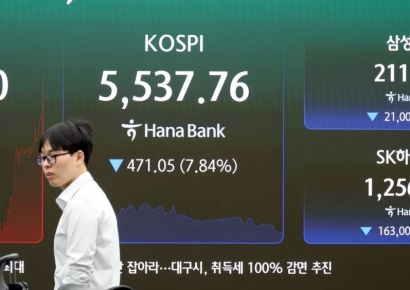 "What on Earth Is Happening to the Stock Market?" ... KOSPI and KOSDAQ Plunge 8%, Trading Halted (Comprehensive)
- "They Promised Free Stock Lessons, Then Asked for KRW 3 Million?" ... Suspicious Invitations Spreading on SNS
- "I Was Just Going Barefoot at Home"... "Absolutely Not": Why Doctors Warn Against It
- "I Was Proud He Finished His Homework Quickly"... Dad Shocked After Checking Son's YouTube History
- "No Need to Hire a Model"... The 25-Year-Old Woman Who Entered Social Media with a Face That Cost Just 1,500 Won [AI Content: The Bright and Dark Sides] 1
An official from Korea National Oil Corporation commented, “We are moving away from the static stockpiling focused solely on oil security, toward a dynamic stockpiling concept that manages stockpile assets within the framework of national security while also considering economic efficiency,” adding, “Through continued international joint stockpiling, oil trading and other efficient management of reserve assets, we will work to achieve government reserve targets in a timely and more effective manner.”
© The Asia Business Daily. All rights reserved. Unauthorized AI training and use prohibited.