President Lee to Host First Korea–Central Asia Summit on 16th... Expanding Critical Mineral Supply Chains
Leaders of Five Central Asian Nations Gather in Seoul
Upgrading Ministerial-Level Cooperation to Summit Level
Adopting the "Seoul Declaration" for a Mid- to Long-Term Vision
Relay of Bilateral Summits with Five Countries Starting on the 14t
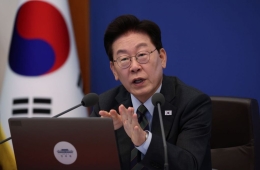
On September 16, President Lee Jaemyung will host the first ever Korea-Central Asia multilateral summit with the leaders of the five Central Asian countries in Seoul. The summit will elevate the “Korea-Central Asia Cooperation Forum”—established at the ministerial level in 2007—to a leaders-level partnership, with a focus on diversifying supply chains centered on key minerals and energy. The government plans to adopt the “Seoul Declaration,” broadening the scope of cooperation, which previously concentrated on resources and infrastructure, toward future industries including artificial intelligence (AI), digital technology, and science and technology.

At the offline event "Silk Road, Meeting" commemorating the 1st Korea-Central Asia Summit 2026 held at Cheonggye Plaza in Seoul on the 26th, visitors are writing supportive messages. 2026.8.26 Yonhap News Agency
View original imageKang Yoojeong, Chief Presidential Spokesperson, announced in a written briefing on the 11th that, “The first Korea-Central Asia Summit will be held in Seoul on the afternoon of the 16th.” President Lee will chair the meeting under the theme of “Directions for Korea-Central Asia Cooperation and Partnership for Enhancing Innovation, Prosperity, and Connectivity.”
This is the first multilateral summit between the Korean government and the Central Asian countries. With global uncertainties rising and global competition over resources and supply chains intensifying, the presidential office expects that this will serve as a strategic turning point in Korea’s relationships with Central Asian countries such as Kazakhstan and Uzbekistan.
First, the government will upgrade the cooperation framework, which since the inception of the Korea-Central Asia Cooperation Forum in 2007 has remained at the ministerial level, to a leaders-level body. During the summit, the “Seoul Declaration,” outlining a mid- to long-term vision for cooperation, will be adopted to establish the institutional foundation for multilateral cooperation.
At the center of economic cooperation are key mineral and energy supply chains. The government’s plan is to combine Central Asia’s abundant mineral and energy resources with Korea’s exploration and processing technologies to diversify global supply chains. The government will also strengthen cooperation in customs, regulations, and intellectual property rights, and, in the infrastructure and plant sectors, will identify country-specific projects to expand the opportunities for Korean companies to enter local markets and secure contracts.
The areas of cooperation will also be expanded beyond the existing focus on resources and infrastructure to include cutting-edge and eco-friendly industries such as AI and digital technology, science and technology, the response to climate change, water resources management, and disaster response. The presidential office stated, "This will lay the foundation for new growth that looks ahead to the next 30 years."
Immediately following the summit, President Lee and the leaders of the five Central Asian countries will attend the “Korea-Central Asia Business Summit.” Around 500 government and business representatives from Korea and Central Asia are expected to participate, building networks and discussing practical cooperation in each field. An official state dinner with the leaders and dignitaries from all countries will also be held that evening.
Before the summit, from September 14, President Lee will hold a series of bilateral talks with the leaders of the five Central Asian countries. The meetings will begin with Uzbekistan on the afternoon of the 14th, continue with Turkmenistan in the morning and Kazakhstan in the afternoon of the 15th, and conclude with Tajikistan and Kyrgyzstan in the morning of the 16th. The leaders of Uzbekistan, Turkmenistan, and Kazakhstan will make state visits to Korea, while the leaders of Tajikistan and Kyrgyzstan will be on official visits.
Cooperation in security and public safety will also be on the agenda. The government aims to secure support from Central Asian countries on the Korean Peninsula issue, while also strengthening joint responses against transnational crimes such as terrorism, drug trafficking, and cybercrime. As a model, the government cited a recent case where, through cooperation with Kazakhstan, 19 members of a voice phishing scam organization worth about 5.8 billion won were apprehended—demonstrating the aim to link diplomatic achievements to public safety.
On the occasion of the 90th anniversary of Koryoin (ethnic Koreans in Central Asia) settlement in Central Asia next year, the government will also expand human and cultural exchanges. Plans include increasing support for Korean language and cultural education locally, expanding youth and talent exchange programs, and strengthening cooperation to enable Koryoin to play a greater role as a human asset linking the two regions.
Hot Picks Today
![[Exclusive] "My paycheck fell short, and I couldn't get a card loan either" More people in their 40s and 50s turn to 'cash advances'; "debt-investing woes" put long-term delinquency among those in their 20s and 30s on red alert](https://cwcontent.asiae.co.kr/asiaresize/93/2026102011173167293_1792462652.jpg) [Exclusive] "My paycheck fell short, and I couldn't get a card loan either" More people in their 40s and 50s turn to 'cash advances'; "debt-investing woes" put long-term delinquency among those in their 20s and 30s on red alert
[Exclusive] "My paycheck fell short, and I couldn't get a card loan either" More people in their 40s and 50s turn to 'cash advances'; "debt-investing woes" put long-term delinquency among those in their 20s and 30s on red alert
- "Seoul Has Never Seen This Before"... Monthly Rent Hits 1.66 Million Won as 51% Share Signals a 'Seismic Shift'
- “I Thought It Was Just Inflammation”: 70 Men Have Died of Breast Cancer in This Country in 5 Years
- "Korean Beef for Dinner Tonight" - Drawn in by Half-Price Deals, but... "What Else Is There to Buy?" at 'Empty' Homeplus
Chief Spokesperson Kang declared, “We will elevate cooperation with Central Asia to a new level across all sectors, including supply chains, future industries, and human exchanges,” adding, “This will lead to tangible results in implementing the New Northern Policy and diversifying Korea's diplomacy.”
© The Asia Business Daily. All rights reserved. Unauthorized AI training and use prohibited.